


Breaking the Curse: A Victory for the Ages
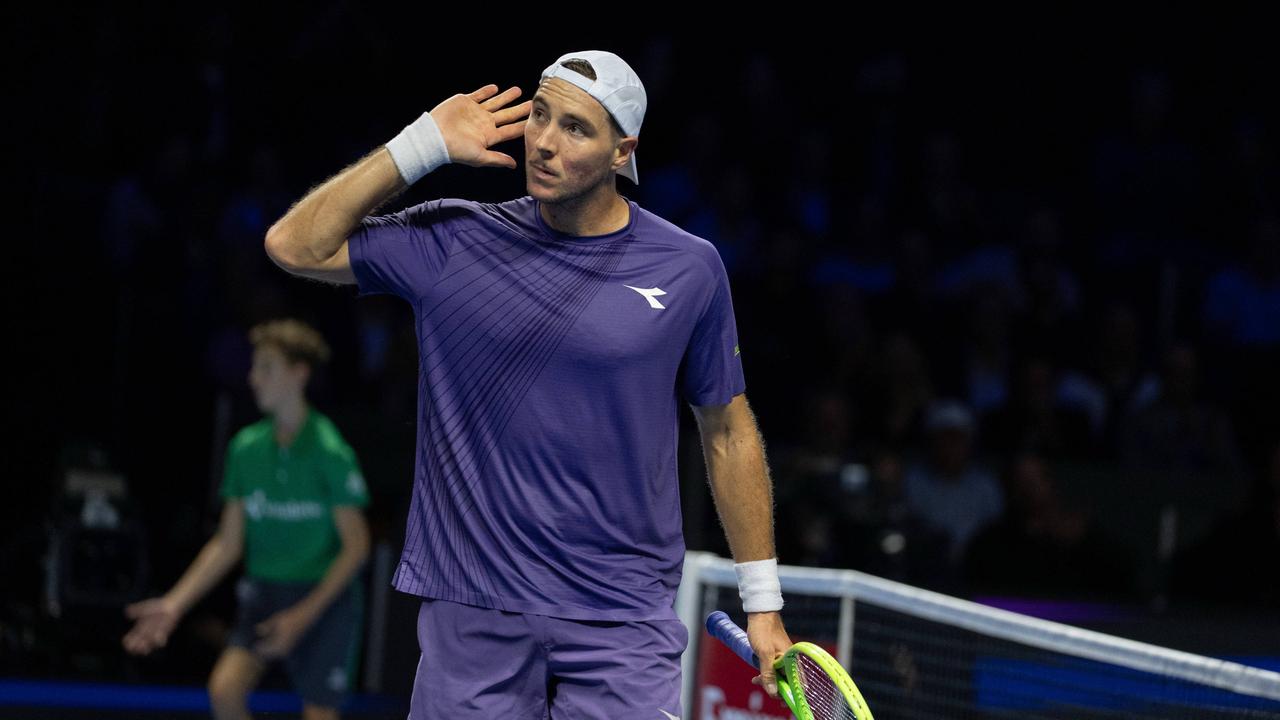
In a result that has sent shockwaves through the tennis world, Germany’s Jan-Lennard Struff has finally breached the wall that has stood against him for nearly a decade. In a dramatic, high-octane encounter at the Swiss Indoors in Basel, the 36-year-old veteran overcame tennis legend Novak Djokovic, triumphing 6:7 (4:7), 7:5, 7:6 (7:5) in a match that lasted two hours and 35 minutes.
The victory marks a significant turning point in the career of the Warstein native. Before this evening, Struff had faced the Serbian icon eight times, and eight times he had walked off the court in defeat. To break such a streak against one of the greatest players in the history of the sport—and to do so in such a pressure-cooker environment—is not merely a win; it is a testament to the endurance and tactical evolution of a player who refuses to be defined by his age.
The Chronology of the Battle
The match began with the intensity expected of a clash between two seasoned professionals. From the opening serve, it was evident that Struff had brought a clear game plan: dictate play with his massive serve and shorten points before they could devolve into the long-range rallies that Djokovic historically dominates.
The First Set: A Narrow Miss
The opening set was a masterclass in serving efficiency. Both players held serve with relative ease, with Struff’s aggressive net approaches keeping the Serbian off balance. However, Djokovic’s ability to find "extra gears" in tie-breaks proved decisive once again. Despite a valiant effort, Struff conceded the opening set 6:7 (4:7), leaving spectators wondering if the familiar narrative of his previous eight losses against the former world number one was set to repeat.
The Turnaround: Resilience in the Second
If the first set was a display of skill, the second was a display of sheer mental fortitude. Trailing in the set, Struff refused to allow his level to drop. As the games progressed, he began to find his rhythm on the return, putting pressure on the Djokovic serve that hadn’t been there in the first frame. With the score locked at 6:5, Struff broke the Djokovic serve in a crucial moment, snatching the set 7:5 and forcing a decider.
The Decider: The 27th Ace
The third set became an endurance test. By this point, both players were operating at the limit of their physical capacity. The crowd in Basel was treated to a showcase of high-stakes tennis, with both players exchanging service holds. As the tie-break approached, the tension in the stadium was palpable.
Struff, displaying a level of poise that has come to define his late-career resurgence, maintained his composure. The match reached its climax on the back of his primary weapon: his serve. Delivering his 27th ace of the night at a critical juncture, Struff sealed the final set tie-break 7:5, securing a victory that will undoubtedly go down as the highlight of his 2026 season.
Supporting Data: By the Numbers
The statistics from the match highlight the sheer dominance of Struff’s service game. 27 aces is a staggering number in a best-of-three set match, indicating that the German was not just hitting the ball hard, but hitting his spots with surgical precision.
- Match Duration: 2 hours and 35 minutes.
- Total Aces (Struff): 27.
- Head-to-Head Record (Prior): 8–0 in favor of Djokovic.
- Current Tournament Context: Quarter-final qualification.
- Struff’s Recent Form: Coming off a runner-up finish in Brussels, where he narrowly lost to Tallon Griekspoor.
These figures illustrate a player who is currently in peak physical condition, despite the grueling nature of the professional tour at age 36.
The Context: A Season of Near-Misses
It is impossible to analyze this victory without looking at the context of Struff’s recent weeks. Just days ago, the German was embroiled in a heartbreaking defeat at the Brussels Open, where he fought his way to the final only to fall to Dutchman Tallon Griekspoor in three sets (6:4, 3:6, 4:6).
Many commentators feared that the emotional toll of that loss would linger, potentially leading to a lackluster performance in Basel. Instead, Struff utilized the momentum of his successful week in Belgium to fuel his performance against Djokovic. His sole ATP title remains the 2024 Munich trophy, but with his form trending upward, the tennis community is beginning to wonder if a second title is on the horizon.
Official Responses and Post-Match Sentiment
Following the conclusion of the match, the tennis world reacted with widespread admiration for the German’s performance. While the official ATP post-match press conference focused on technical aspects, the prevailing sentiment was one of genuine surprise and respect.
"I had to stay aggressive," Struff noted in his post-match comments. "Against someone like Novak, if you sit back and wait, you are already beaten. I knew that my serve had to be on point today, and thankfully, it was there when I needed it most."
Analysts have been quick to point out that while Djokovic has struggled with consistency in the latter stages of his career, he remains the gold standard for tactical tennis. For Struff to beat him, he didn’t just have to serve well; he had to play a flawless tactical game.
Implications for the Future
What does this mean for the remainder of the tournament and the broader landscape of the ATP tour?
The Path Forward in Basel
Struff now advances to the quarter-finals, where he is set to face the Portuguese talent Nuno Borges. While the emotional high of beating a legend like Djokovic can sometimes lead to a "letdown" performance in the following round, Struff’s maturity suggests he will be prepared for the challenge. Borges is a formidable opponent, but the confidence gained from tonight’s victory is an intangible asset that cannot be overstated.
The "Late Bloomer" Narrative
Struff’s career serves as a powerful case study for the "late bloomer" phenomenon in professional tennis. In an era where players are often expected to peak in their mid-20s, the 36-year-old German is proving that with proper physical management, a high-octane serve, and a professional mindset, it is possible to compete—and win—at the highest level well into the later years of one’s career.
The Djokovic Factor
For Novak Djokovic, the loss is a reminder that the field has caught up. The "Big Three" era, which dominated tennis for two decades, is slowly giving way to a more egalitarian tour where any player in the Top 50, on their day, can challenge the legends. Djokovic remains a formidable force, but his aura of invincibility is undeniably fading.
Conclusion: A Night to Remember
The victory in Basel is more than just a notch on a belt; it is a career-defining moment for Jan-Lennard Struff. By overcoming his toughest adversary, he has signaled to the rest of the tour that he is not merely participating—he is competing for titles.
As he prepares for the quarter-final against Nuno Borges, the tennis world will be watching closely. Whether he goes on to win the title in Switzerland or not, he has already achieved something that will remain etched in his professional biography for years to come: the night he finally solved the puzzle of Novak Djokovic.
The sport continues to evolve, and with results like these, it is clear that the veteran guard is still very much capable of dictating the narrative. For Struff, the focus now turns to recovery and preparation, but he can rest easy knowing that he has conquered a mountain that stood in his path for the better part of a decade.


