

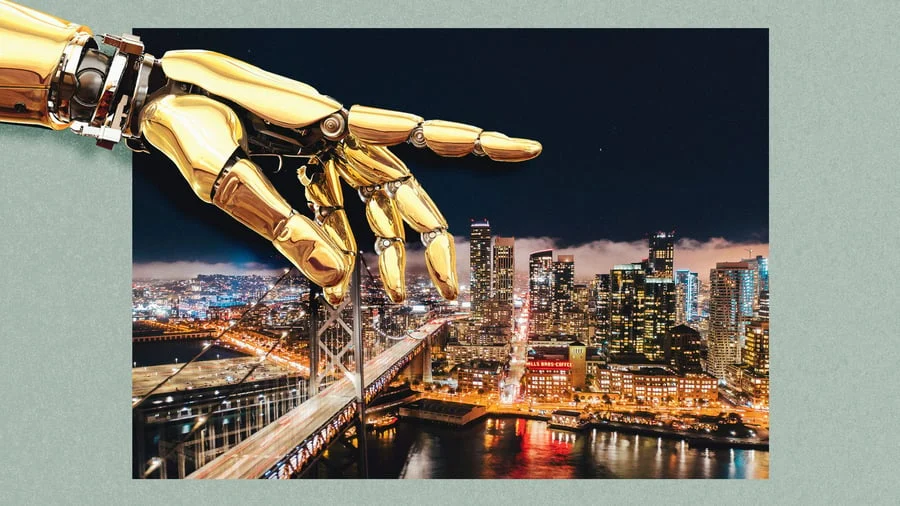
By [Your Name/Journalistic Desk]
In the heart of San Francisco’s Mission District, the "Standard Deviant" brewery serves as an unlikely epicenter for a seismic shift in the German labor market. Amidst a rotating tap list of Dunkelbiers, IPAs, and the occasional seasonal Oktoberfest brew, the atmosphere during a late-September "German Founder Mixer" is thick with the scent of hops and the restless energy of ambition. For many of the young men and women gathered here, this isn’t just a networking event—it is a base camp for an exodus.
Marvin Gabler, a 30-year-old entrepreneur with the crisp, pragmatic look of a Silicon Valley veteran, sits on a wooden bench, nursing a drink and laying out a stark economic reality. "If you are 25 years old and can walk away with $400,000 in cash and millions more in equity, why on earth would you start a career at a company like Bosch?" he asks. For Gabler, the German industrial giant represents a path that is increasingly losing its luster for the nation’s most talented generation. It is a symbol of a corporate hierarchy that, in his view, is fundamentally misaligned with the speed of the modern AI revolution.
The Anatomy of the Migration: From Munich to Mission
The departure of young, high-skilled German talent to the United States is not an entirely new phenomenon, but the current wave is distinct in its velocity and its focus. While previous generations of German expats often headed to the U.S. for prestige or specific academic roles, the current influx is driven by the unprecedented acceleration of Artificial Intelligence.
Gabler, who founded his first startup, Jua, in 2022, represents the new vanguard. After analyzing the European landscape, he concluded that the continent lacked the ecosystem—and the sheer capital density—required for his next venture. He has been in San Francisco for just over two months, working in near-secrecy on a project that aims to simulate the physical world using AI. His goal? To create "machines that invent machines," potentially revolutionizing the development of advanced materials.
"It’s not just about the money," Gabler explains. "It’s about the proximity to the fire." In San Francisco, he finds a concentration of compute power, venture capital, and fellow "hungry" talent that, in his estimation, simply does not exist in Europe—despite the continent’s world-class universities and strong technical education.
Chronology of the Shift: A Decade of Divergence
To understand the current "Gold Rush," one must look at the evolution of the tech ecosystem over the last decade.
- 2014–2018: The Berlin Bloom: During this period, Berlin established itself as the startup capital of Europe. Companies like Delivery Hero and SoundCloud proved that European ventures could scale.
- 2019–2021: The Pandemic Pivot: Remote work changed the dynamic. Many developers began working for U.S. firms from their apartments in Germany. This served as a "soft launch" for many, as they became accustomed to American salaries and working cultures.
- 2022–Present: The AI Explosion: With the rise of Large Language Models (LLMs) and generative AI, the focus shifted from simple software applications to foundational AI infrastructure. This requires massive capital and a high-risk tolerance—the hallmarks of the Silicon Valley model.
The current trend is defined by a younger demographic than ever before. Many of these individuals are bypassing the traditional corporate training ground entirely, choosing instead to dive into the California startup scene or high-paying AI labs as soon as they complete their degrees, or sometimes even before.
Supporting Data: The Talent Drain
While official statistics are currently lagging behind the anecdotal reality, the consensus among venture capitalists is clear: the brain drain is accelerating. Industry insiders suggest that the number of German-founded startups in the Bay Area has grown significantly since 2022.
The incentives are staggering. American AI labs are reportedly offering compensation packages that reach seven figures for PhD-holding researchers in their mid-twenties. Compared to the salary structures of German engineering firms, the gap is not merely a difference in cost of living; it is a structural difference in the valuation of human capital.
"The best minds are going," says one venture capital partner who requested anonymity. "They aren’t just leaving for a job; they are leaving because the AI cycle is fundamentally different from anything we have seen before. It is not an incremental change; it is a rewriting of the rules of production."
German VCs, acknowledging the shift, have begun to adapt. Firms like Pointnine and 468 Capital have ramped up their travel schedules, with partners now frequently flying from Berlin, Munich, and Stuttgart to the West Coast to scout talent. Their objective is to capture the "German-founded" teams before they are fully assimilated into the American venture ecosystem.
Official Responses and the Corporate Struggle
The traditional German industrial sector, known as the Mittelstand and the "DAX" giants, is currently in a state of quiet alarm. Executives at major firms recognize that their "Employer Value Proposition" is under threat.
In private forums, leaders of German automotive and manufacturing firms have discussed the need for "Silicon Valley-style" innovation hubs. However, critics argue these are often "innovation theater"—corporate labs that lack the decision-making autonomy and the equity-based incentive structures that make startups in San Francisco so potent.
"The problem is cultural," says a policy analyst based in Berlin. "Germany is excellent at refining existing processes—’Ordnung’ and precision. But AI development requires a ‘break things’ mentality that is inherently uncomfortable for the German corporate structure."
Government initiatives, such as the Exist startup grant or various AI research funding programs, have attempted to stem the tide. Yet, founders like Gabler argue that funding is only one piece of the puzzle. The lack of a secondary market for shares, the regulatory hurdles for experimental tech, and the social stigma attached to business failure remain significant barriers in Germany that the U.S. does not face.
The Implications: A Hollowed-Out Future?
The implications of this migration are profound for the European economy. If the next generation of AI-native companies is born and matured in California, the intellectual property, the tax revenue, and the future job creation will remain firmly in the hands of the United States.
- The Loss of Innovation Capital: If the smartest minds leave, the "ecosystem" at home stagnates. This leads to a vicious cycle where remaining startups struggle to find top-tier engineering talent, leading them to leave as well.
- Corporate Stagnation: The German industrial sector risks becoming a "user" of AI rather than a "creator" of AI, forced to buy the technology they should have been developing themselves.
- The Geopolitical Balance: AI is increasingly seen as a national security asset. A dependency on U.S. tech firms for the core infrastructure of the future German economy presents a long-term strategic risk.
Conclusion: A New Gold Rush
As the night at the Standard Deviant winds down, the conversations continue. The optimism is infectious, but there is a tinge of melancholy for those who wish their home country could provide the same fertile soil for their dreams.
For Marvin Gabler and his peers, the decision to leave was not made lightly, but it was made with the cold precision of a software engineer. When asked if he would ever return, he pauses. "I love Germany," he says, adjusting his glasses. "But you don’t go to the desert to look for water. You go to where the gold is. Right now, that’s here."
The "German Founder Mixer" is more than a gathering of expatriates; it is a mirror held up to the European economy. The message is clear: the AI Gold Rush is not waiting for old-world institutions to adapt. It is moving, it is fast, and it is happening on the other side of the Atlantic. The question for Germany is no longer how to stop the migration, but whether it can build an environment that makes the next generation want to stay. Until then, the exodus will continue, one flight from Frankfurt to SFO at a time.
























