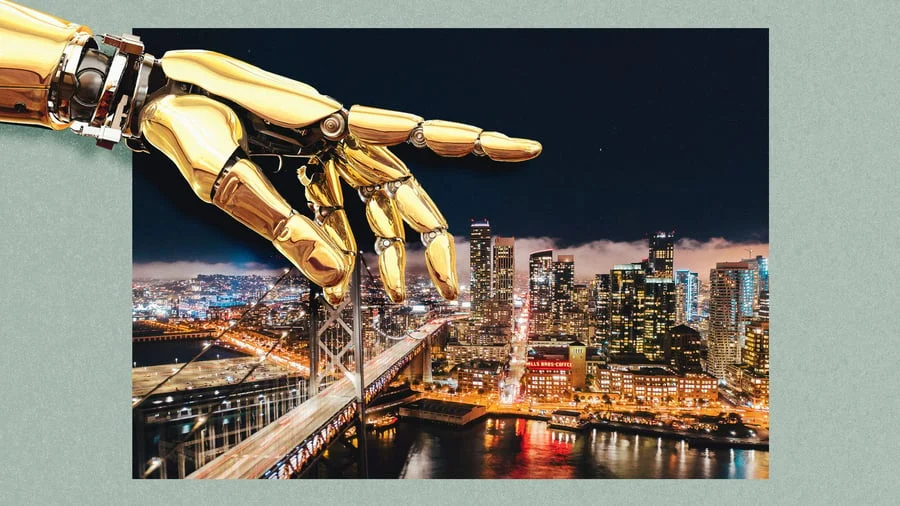
The Golden Gate Beckons: A New Generation of German Innovators
In the heart of San Francisco’s Mission District, the Standard Deviant Brewing Company offers a curated selection of traditional lagers and crisp Pilsners. However, on a crisp evening in late September, the establishment played host to a different kind of gathering: the "German Founder Mixer." Amidst the clinking of glasses and the hum of conversation, a distinct trend emerged—the rapid migration of Europe’s elite technical talent toward the epicenter of the global Artificial Intelligence (AI) revolution.
Marvin Gabler, a 30-year-old entrepreneur with a sharp, analytical gaze, sits on a wooden bench, drink in hand. He represents a new archetype of the German professional: the cross-Atlantic founder. When asked why a talented, highly educated 25-year-old would choose to bypass the stability of a storied German industrial giant like Bosch in favor of the volatility of a Silicon Valley startup, Gabler provides a blunt, pragmatic answer.
"If you are 25 and have the opportunity to take home $400,000 in cash, plus millions in equity, why would you start your career at a traditional conglomerate?" he asks. For Gabler, the math is simple, and the implications for the German economy are profound. Having founded his first startup, Jua, in 2022, he has already concluded that the environment for high-stakes, rapid-scale AI development is currently non-existent in Europe.
The Chronology of an Exodus: From Academic Excellence to Global Competition
The migration of German talent is not a new phenomenon, but its velocity and focus have shifted dramatically with the emergence of generative AI.
- The Early 2010s: German talent primarily migrated for internships or specific engineering roles in established tech hubs. The "brain drain" was characterized by a search for experience rather than a fundamental shift in entrepreneurial base.
- 2020–2022: The COVID-19 pandemic and the subsequent rise of remote work masked some of the physical relocation. However, the foundational work for many current startups was being laid during this period.
- Late 2022–2023: The launch of ChatGPT and the subsequent "AI Gold Rush" acted as a catalyst. European developers and researchers realized that the infrastructure, capital, and peer density required to build at the bleeding edge of AI were almost exclusively located in the San Francisco Bay Area.
- Mid-2024 to Present: We are currently witnessing a structural shift. It is no longer just about individual jobs; it is about entire founding teams relocating to California before they even register their companies.
Gabler’s own journey reflects this timeline. After testing the waters in Europe, he spent the last two and a half months in San Francisco. He is currently working on a project that aims to simulate the physical world using AI—a field he describes as "machines inventing machines." His mission is to use AI to revolutionize materials science, a sector where traditional German industries like manufacturing and chemistry have historically held an edge, but are now struggling to keep pace with the iterative speed of American startups.
Supporting Data: The Magnitude of the Shift
While comprehensive, government-backed longitudinal studies on this specific wave of emigration are still in their infancy, the anecdotal and industry evidence is overwhelming. German venture capital (VC) firms, including notable players such as Pointnine and 468 Capital, have begun to alter their investment strategies.
Increasingly, these firms are sending partners on regular circuits between Berlin, Munich, Stuttgart, and San Francisco. They are no longer just looking for startups in Germany; they are flying to the West Coast to chase the German founders who have already relocated.
The Financial Incentives
The economic disparity is staggering. According to industry insiders, PhD-level AI researchers in their mid-twenties are being offered compensation packages—consisting of base salary, sign-on bonuses, and massive equity grants—that exceed the lifetime earning potential of many middle-management roles in the German "Mittelstand."
- Silicon Valley: Total compensation packages for elite AI talent often range from $500,000 to over $1 million annually.
- Europe: While salaries are competitive by local standards, the equity upside is significantly capped by different regulatory frameworks, smaller venture capital rounds, and a more cautious risk-appetite.
Official Responses and Institutional Perspectives
The German government has historically taken pride in its world-class university system, which produces a steady stream of highly skilled engineers, mathematicians, and computer scientists. However, the consensus among these graduates is that academic excellence is no longer enough to retain them.
The Institutional Dilemma
German academic institutions and industrial leaders have begun to voice concerns. At various tech summits, representatives from the German industrial sector have acknowledged the "exodus," citing the need for "digital sovereignty" and a "European AI ecosystem." However, these pleas often clash with the reality of the market.
"We are educating the world’s best AI experts, but we are effectively subsidizing the American tech sector," one university dean recently remarked on the condition of anonymity.
The sentiment is clear: Germany provides the raw intellectual material, but the United States provides the foundry. Until the European ecosystem can offer a comparable density of capital, high-risk tolerance, and a regulatory environment that favors rapid deployment over bureaucratic compliance, the drain is unlikely to stop.
Implications: The Long-Term Cost for European Industry
The departure of these founders is not merely a loss of headcount; it is a loss of the next generation of industrial leadership.
1. The Erosion of Industrial Hegemony
If "machines that invent machines" are being built in California, the companies that rely on traditional materials science—the backbone of German exports—will find themselves using foreign technology to sustain their competitive advantage. This shifts the value capture from the manufacturer to the software architect.
2. The Cultural Shift
For decades, the "German Dream" was a stable career at a company like Bosch, Siemens, or BMW. That cultural narrative is fracturing. The current generation of tech-literate youth views the "classic corporate career" with skepticism, or even disdain. When the benchmark for success is a multi-million dollar exit by age 30, a corporate promotion track feels stagnant.
3. The "AI Cycle" Paradox
As Gabler notes, "AI is different from any cycle we’ve seen before." Unlike the dot-com bubble or the initial mobile app gold rush, AI has the potential to fundamentally restructure the physical world. If Europe sits on the sidelines while this restructuring happens, the economic gap between the two continents may widen to a point where it is no longer bridgeable.
Conclusion: The Gold Rush Continues
As the sun sets over the Mission District, the "German Founder Mixer" at Standard Deviant serves as a microcosm of a larger, more permanent shift. These young entrepreneurs are not leaving because they dislike their home country; they are leaving because the physics of the current tech market dictates that the highest probability of success lies across the Atlantic.
For the European Union, the challenge is clear. It is not enough to promote innovation through grants and committees. It requires a radical reimagining of how capital flows, how risk is rewarded, and how the next generation of founders perceives their own potential. Until then, the exodus will continue, and the brightest minds of the next generation will keep finding their fortune in the gold-dusted hills of California.