The literary world has turned its gaze toward a singular, restless intellect. Anne Carson, the 76-year-old Canadian poet, classicist, and essayist, has been awarded the Nobel Prize in Literature. For those familiar with her work—a genre-defying fusion of ancient Greek rigor and avant-garde experimentation—the accolade is not merely a recognition of a prolific career, but a validation of a life spent dismantling the borders between the past and the present.
Carson’s work is famously difficult to categorize. She is a writer who treats the page not as a static vessel for text, but as a space for performance, visual art, and philosophical inquiry. Her Nobel win marks a departure from the traditional laureate profile, celebrating an author who finds the profound in the fragmentary and the universal in the deeply, often uncomfortably, personal.
The Architecture of Uncertainty: Main Facts
At the heart of Carson’s methodology lies a radical commitment to doubt. In a recent conversation with Norwegian author Linn Ullmann, Carson touched upon the philosophical underpinnings of her work, specifically regarding René Descartes. While the world remembers the Cartesian "Cogito, ergo sum" ("I think, therefore I am"), Carson insists on returning to the root: "Dubito, ergo cogito, ergo sum" ("I doubt, therefore I think, therefore I am").
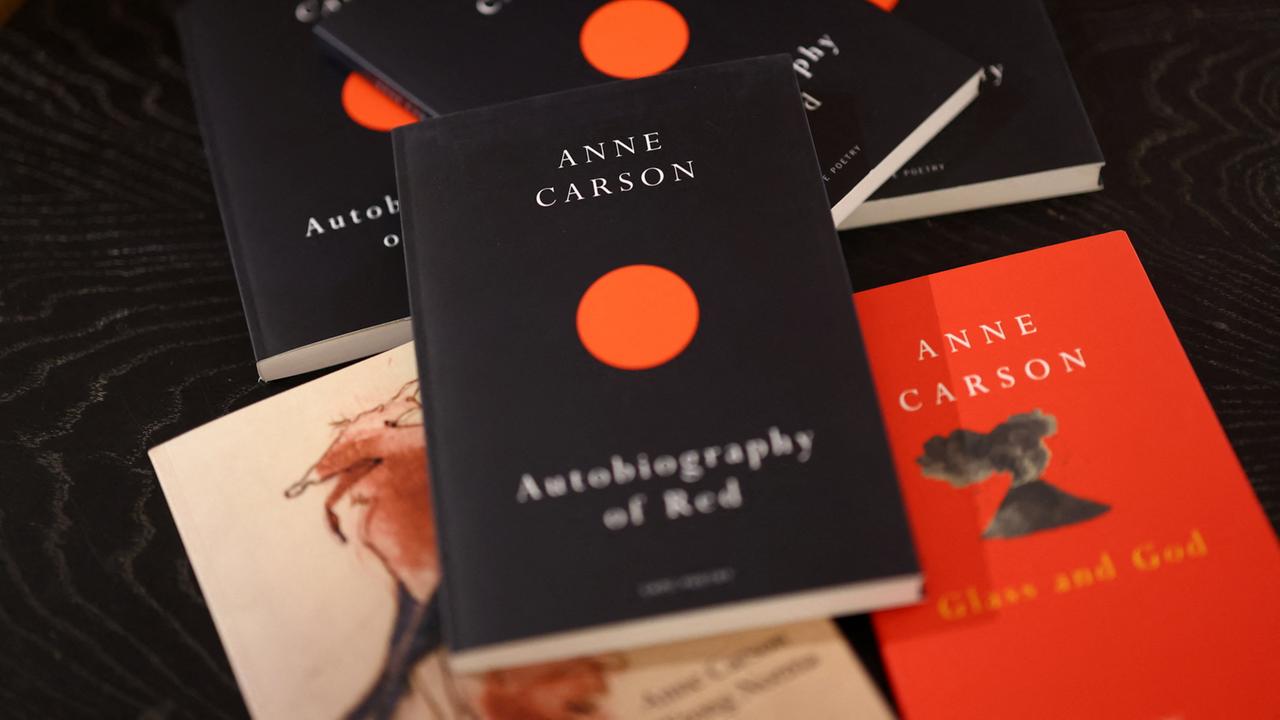
For Carson, this is not merely an academic footnote; it is the engine of her creativity. She views the act of writing as a process of constant questioning, where fixed meanings are treated with suspicion. Her books—such as the landmark Autobiography of Red—do not merely tell stories; they interrogate the very nature of storytelling. They are characterized by their formal instability, where lines drift across the page, text gives way to visual diagrams, and the narrative voice shifts fluidly between scholarly essay, verse, and dramatic dialogue.
A Life of Intellectual Wanderlust: Chronology
Anne Carson’s trajectory has been as non-linear as her prose. Born in 1950 in Toronto, Canada, she pursued an education steeped in the classics, yet her academic path was marked by a characteristic refusal to settle. She famously interrupted her studies in classics at the University of Toronto multiple times, enrolling in a diverse array of courses, searching for a synthesis of knowledge that standard curricula could not provide.
- The Formative Years: Her deep immersion in Ancient Greek, particularly the works of Sappho and the tragedians, provided the foundation for her later experiments.
- 1986: Publication of Eros the Bittersweet, a work that established her reputation as a formidable scholar capable of weaving erotic desire, philosophy, and literary analysis into a seamless whole.
- 1998: The release of Autobiography of Red, a novel in verse that re-imagined the myth of Geryon as a modern, lonely queer youth. It became an instant classic of contemporary literature.
- 2000s–2010s: A period of prolific output, including the "TV Men" poems and numerous theatrical adaptations, cementing her status as a "punk-philosopher" who brings the ancient world into direct, often shocking, contact with the modern day.
- 2026: Awarded the Nobel Prize in Literature, recognizing her singular voice in world letters.
The Revaluation of the Ancient: Supporting Data and Themes
Carson’s influence is perhaps best understood through her obsession with the Greek poet Stesichoros, whom she champions as the "inventor of the adjective." In her view, before Stesichoros, literature suffered from a lack of nuance: beauty was absolute, death was binary, and desire was a monolith. By introducing the descriptive, layered adjective, Stesichoros allowed the complexities of human existence to rise to the surface.
This obsession with nuance permeates her work. In her poetry, legendary figures like Hektor, Antigone, and Lazarus are stripped of their heroic pedestals. They are presented as vulnerable, confused, and often haunted individuals. When she explores the resurrection of Lazarus, she avoids the theological tropes of miracle, focusing instead on the existential horror of being pulled back into a life one had already left behind. She asks the reader: Was he happy to return? The lack of an answer is the point. The doubt remains, and in that space, the reader is invited to reside.
The Performance of Thought: Implications and Reception
Carson’s impact extends far beyond the printed page. She is widely considered a "live event," a performer whose readings are as much about the presence of the mind as they are about the text itself. In a recent appearance in Berlin, she mesmerized an audience of 700 with a lecture on the creation of the universe, claiming to have "taken notes" before the galaxies formed.
This persona—part academic, part provocateur—has influenced a generation of writers who seek to break the "fourth wall" of literature. Her work implies that the reader is not a passive consumer but a co-investigator. By forcing the reader to engage with gaps in the text, erratic formatting, and shifts in perspective, she ensures that the act of reading is an active, demanding, and ultimately transformative process.
The critical response has been overwhelmingly consistent: she is a "poet’s poet" who has successfully bridged the gap between the ivory tower and the experimental stage. Her translations of Greek classics are performed globally, often interpreted through a lens that emphasizes their contemporary relevance. Whether she is placing Marilyn Monroe alongside Helen of Troy in Norma Jean Baker of Troy or inviting us to consider why Godot never arrived, Carson is constantly building bridges across millennia.
A Call to "Selberdenken": Conclusion
If there is a core mandate to Anne Carson’s oeuvre, it is the imperative to "think for oneself" (Selberdenken). She often remarks that it is the author’s duty to pay attention to the "small things"—the minor details in an ancient myth, the seemingly insignificant reaction of a side character—that reveal the structural fractures in our own world.
In Autobiography of Red, she highlights the unnecessary violence of Herakles killing Geryon’s small dog. Why mention the dog? Why acknowledge the collateral damage of mythic "heroism"? By focusing on the small, the discarded, and the painful, Carson compels her readers to do the same in their own lives.
As she accepts the Nobel Prize, the literary world acknowledges that we are in the presence of a rare mind—one that does not seek to provide final answers, but rather to sharpen the questions. Her work stands as a testament to the idea that literature is not a place to hide from the complexities of the world, but the very place where we go to confront them. Anne Carson does not offer the comfort of certainty; she offers the invigorating, dangerous, and essential gift of doubt. Her books are an invitation to look at the world—as she does—with the eyes of a creature both ancient and intensely, brilliantly modern.
In the landscape of 21st-century literature, Anne Carson remains an outlier, a disruptor, and a cartographer of the infinite spaces between what we think we know and what we actually feel. As the Nobel committee has recognized, her work does not just reflect our world; it expands it, one doubt at a time.