Introduction: The Metaphor of the Pool
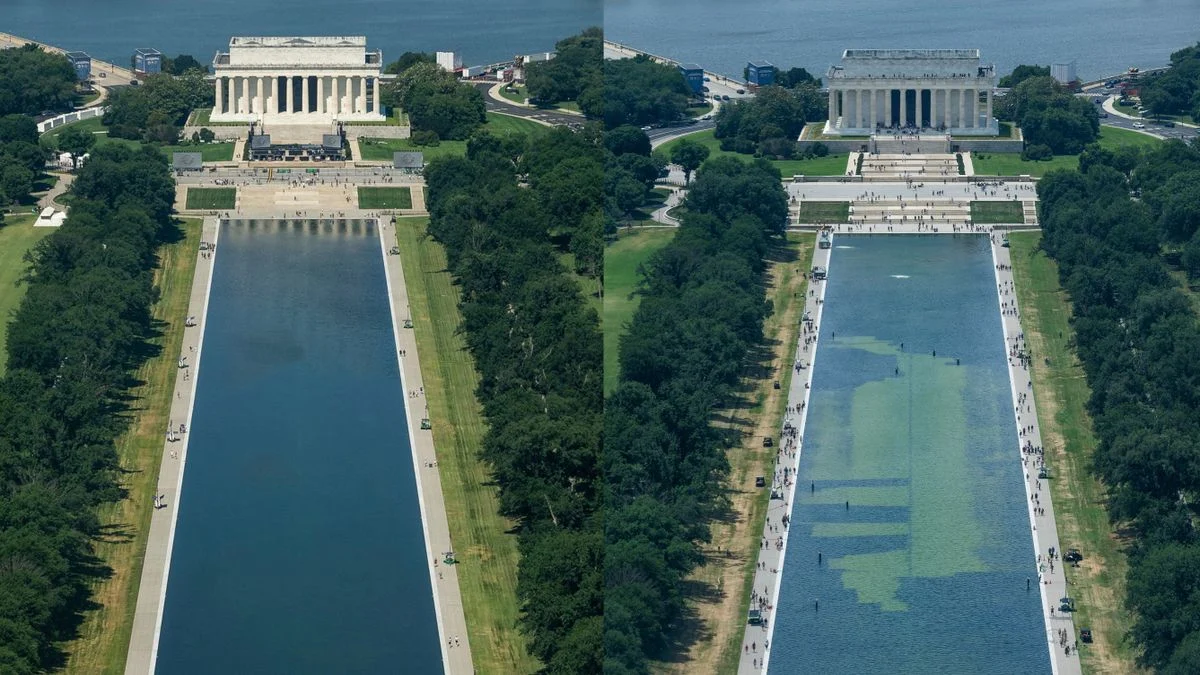
In the architecture of American power, few symbols are as potent as the Reflecting Pool in Washington, D.C. It is a site of civic introspection, a mirror for the nation’s aspirations, and a stage for its most profound historical moments. Recently, however, the term has taken on a metaphorical significance within the corridors of cultural commentary, specifically regarding the political evolution of Donald Trump. From the "royal blue" optimism of his 2016 ascent to the murky, "algae-green" stagnation of his current political landscape, the image of a pool—once clear and transformative, now clouded by ideological sediment—serves as an apt lens through which to view the former president’s trajectory.
This article examines the transition of Trump’s brand, his messaging, and the environmental shifts within the American political ecosystem that have transformed his "Reflecting Pool" from a platform of perceived clarity into a basin of polarized, dense complexity.
I. Main Facts: The Aesthetic of Entrenchment
Donald Trump’s political journey has never been static. In the early days of his primary campaign in 2015 and 2016, his aesthetic was one of aggressive, bold colors—a "royal blue" confidence that promised to restore a mythic American past. He was an outsider, a disrupter who commanded the surface of the political pool, creating ripples that unsettled the establishment.
Today, that imagery has darkened. Analysts observe a shift from the expansive, outward-looking populism of his early rallies to a more insular, "algae-green" defensive posture. This represents a narrowing of the political focus: where once there was a desire to reflect a broad swath of American sentiment, there is now an intensification of the base, leading to a "bloom" of hyper-partisan loyalty that is increasingly difficult to penetrate.
The "Reflecting Pool" of his current campaign is characterized by:
- The Consolidation of Narratives: A move away from broad policy appeals toward a singular focus on grievances and institutional distrust.
- Aesthetic Signaling: The shift in visual and rhetorical branding, mirroring a move from "Make America Great Again" as a future-oriented project to a retrospective defense of a perceived "stolen" past.
- The "Algae" Effect: The accumulation of legal challenges, social polarization, and historical revisionism that has created a thick, viscous environment for his supporters to navigate.
II. Chronology: From Clarity to Complexity
2015–2016: The Royal Blue Phase
When Trump descended the golden escalator at Trump Tower, the water was clear. He promised a "clean sweep" of Washington. The tone was defiant, celebratory, and undeniably vibrant. His branding relied on primary colors and simple, resonant slogans that caught the light of public attention like a pristine mirror.
2017–2020: The Turbulence of Governance
The presidency brought the first signs of sediment. The constant cycle of breaking news, executive orders, and social media firestorms created a churn in the water. The "Reflecting Pool" began to lose its stillness. The constant agitation meant that the reflection of his policies was often distorted by the sheer velocity of his actions.
2021–Present: The Algae-Green Stagnation
Post-2020, the political environment surrounding Trump has shifted into a deeper, more stagnant hue. The "algae-green" represents the toxicity of the current discourse. The events of January 6th, the subsequent legal indictments, and the persistent claims of election fraud have created an environment where the reflection of reality is obscured. For his supporters, this is a protective layer; for his critics, it is a sign of decay.
III. Supporting Data: The Metrics of Polarization
To understand the "algae-green" phenomenon, one must look at the data regarding partisan divide. According to recent polling from the Pew Research Center and Gallup, the gap between Republican and Democratic perceptions of truth has never been wider.
- Institutional Trust: In 2016, a plurality of Americans across the spectrum believed in the fundamental integrity of democratic institutions. By 2024, that figure has plummeted, with a significant majority of Trump supporters expressing total distrust in the judiciary, the press, and the electoral process.
- Media Consumption: The "algae" is fed by siloed information ecosystems. Data shows that those who consume news primarily from Trump-aligned outlets inhabit a different reality-frame, characterized by high levels of internal consistency and near-zero exposure to opposing arguments.
- Emotional Intensity: The "thickness" of the political pool is measurable through sentiment analysis on social media platforms. The language has shifted from descriptive and policy-focused to moralistic and existential, suggesting a deep-seated fear that keeps the water "murky."
IV. Official Responses and Institutional Perspectives
The Trump Campaign’s Stance
Representatives for the former president argue that the "darkening" of the pool is not a sign of stagnation, but a sign of a "battle-hardened" movement. They view the legal and political opposition as an external pollution of the system. "The President is simply responding to a corrupt establishment that has tried to stifle the will of the people," said a campaign spokesperson. From their perspective, the "algae" is actually a protective barrier—a way to preserve the movement against external forces.
The Institutional Critique
Conversely, historians and political scientists argue that the shift represents a dangerous erosion of the democratic "commons." Dr. Elena Vance, a historian of American political rhetoric, notes: "When a leader stops trying to reflect the nation as a whole and begins to cater only to a specific, hardened segment of the population, the democratic pool loses its ability to serve as a shared space. It becomes a private pond, accessible only to those who accept the current, clouded reality."
V. Implications: What Lies Beneath?
The transition from "royal blue" to "algae-green" carries profound implications for the future of the United States.
1. The Erosion of Shared Reality
The most significant implication is the loss of a common baseline. When the political reflecting pool is no longer clear, citizens can no longer see themselves or their neighbors in the reflection. This leads to a state of permanent alienation, where political victory is seen as the only means of survival.
2. The Risk of Stagnation
A pool covered in algae cannot support a diverse ecosystem. Similarly, a political movement that is purely defensive and insular risks intellectual and strategic stagnation. By rejecting new information and doubling down on past grievances, the movement limits its potential to grow or adapt to new global realities.
3. The Challenge for the Next Election
The 2024 election cycle serves as the ultimate test of this "Reflecting Pool." Can the electorate see past the murkiness, or will the "algae-green" narrative become the permanent state of American politics? The outcome will determine whether the nation attempts to clear the water or continues to descend into a deeper, more divisive stagnation.
Conclusion: Clearing the Reflection
The metaphor of the Reflecting Pool reminds us that democracy requires transparency. A pool is only as useful as its ability to provide a clear image of the entity looking into it. Donald Trump’s political journey, from the bright, disruptive royal blue of his emergence to the complex, sedimented green of his current entrenchment, serves as a mirror for the nation’s own internal struggles.
The challenge ahead for the American public is to recognize the distortions in the pool. Whether one supports or opposes the former president, the necessity of restoring a clear, shared reality—one that allows for objective assessment and national reflection—remains the most critical task of the era. Until the "algae" is addressed, the image of the country will remain trapped in the murky waters of division, unable to reflect the true potential of its people.
This article is a contribution to our ongoing series on the evolution of political aesthetics in the 21st century. For full access to our digital archive, expert analysis, and in-depth political reporting, subscribe to our premium digital edition today.