The administrative layer connecting Germany’s state ministries of education to individual schools is often invisible to the public. Known as the Schulaufsicht (school inspectorate/supervision), this vital tier of governance serves as the direct superior to school leadership and the final point of escalation for parents when local conflicts remain unresolved. However, a landmark study from the University of Erfurt has pulled back the curtain on this often-overlooked profession, revealing a system defined by unsustainable workloads, a lack of professional preparation, and a profound disconnect between the mandated duties of the office and the realities on the ground.
The study, which surveyed 231 school supervisors across five German federal states, represents the most comprehensive analysis of this workforce to date. Commissioned by the Heraeus Bildungsstiftung and the Wübben Stiftung Bildung, the findings paint a picture of a profession in crisis: characterized by long hours, fragmented responsibilities, and a persistent "wish vs. reality" gap that hampers the ability of supervisors to actually improve the quality of education.
The Core Mandate: Balancing Control and Development
By law, the Schulaufsicht is a hybrid office. Its legal mandate is broad, theoretically encompassing two distinct pillars: administrative control—ensuring that schools comply with state regulations, laws, and ordinances—and pedagogical support, which involves coaching, school development, and educational consulting.
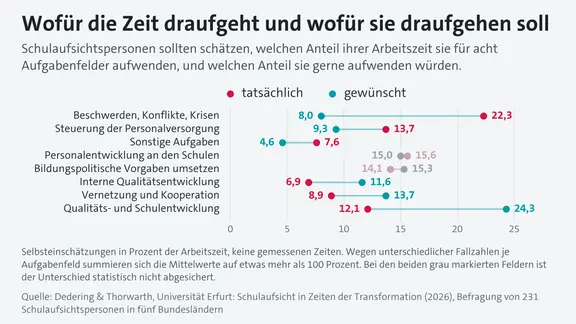
However, the reality of the daily routine is heavily skewed. According to the data, school supervisors spend an average of 22.3% of their time on "crisis management"—a category that includes handling parent complaints, mediating intense conflicts between staff and leadership, and navigating the complexities of disciplinary proceedings. Conversely, efforts aimed at long-term school development and pedagogical quality assurance account for a mere 12.1% of their working hours.
This distribution is not a matter of preference but a reflection of systemic pressure. When asked how they would like to distribute their time, the participants’ responses were a mirror image of their actual situation. They expressed a strong desire to dedicate 24.3% of their time to school development, while wishing to reduce the burden of reactive conflict management to just 8%. This significant, statistically validated discrepancy highlights a systemic failure: the current structure forces experts in education to function as administrative firefighters rather than strategic architects of the school system.
Chronology of the Inquiry: Shedding Light on the Invisible Tier
The research, led by Professor Kathrin Dedering at the University of Erfurt, took place over the winter months of 2025. The urgency of the project was born out of the recognition that while school principals and teachers are frequently studied, the supervisors who oversee them remain an academic "black box."
- November – December 2025: The online survey was conducted across five anonymized German federal states. With a response rate of 53%, the study captured the voices of 231 professionals.
- January – August 2026: The research team synthesized the qualitative and quantitative data, categorizing the findings into workload, professionalization, and structural reach.
- September 2026: The final report was published, providing a sobering baseline for policymakers.
The timing of the survey is significant. Following years of pandemic-related strain and ongoing demographic shifts, the demands placed upon the Schulaufsicht have intensified. The data suggests that the "firefighting" nature of the role has become the default mode of operation, leaving little room for the proactive mentorship that school leaders desperately require.
Supporting Data: The Burden of Reach and Time
The study provides granular detail on the sheer scale of the supervisors’ remit. On average, one supervisor is responsible for 38 schools. However, averages fail to capture the extreme disparities in the field.
Extreme Caseloads
While approximately 50% of respondents manage 20 schools or fewer, a significant segment faces much heavier loads. Nearly one-third of the participants oversee between 21 and 40 schools. Most alarming are the 11.7% of respondents who are responsible for more than 60 schools. In extreme outliers, the reported responsibility reached as high as 800 schools—an impossible figure that raises questions about what "supervision" means in such a context.
The Myth of the "Presence"
Effective supervision requires physical presence, yet the data indicates this is severely lacking. On average, a supervisor visits a school just 4.3 times per academic year. An overwhelming majority (86.3%) visit any given school five times or fewer per year. When asked if this frequency is sufficient, nearly half (49.1%) of the respondents answered "no," citing a lack of time as the primary constraint. It is telling that not a single respondent claimed to visit schools "too often."
Hours and Exhaustion
The intensity of the role is further evidenced by the reported working hours. The average respondent logs 45.6 hours per week. When compared to the 40-hour average for full-time employees in Germany as reported by the Federal Statistical Office, it is clear that school supervisors are working significantly beyond the standard capacity. This sustained overtime contributes to a high-pressure environment where reactive crisis management inevitably displaces proactive strategic planning.
Structural Deficiencies: A Lack of Professionalization
Perhaps the most startling finding of the Erfurt study is the lack of systematic induction for new hires. Education, by its nature, requires deep pedagogical expertise, yet 57.6% of those surveyed reported receiving no formal, structured training when they entered their current role.
Professional development, to the extent that it exists, is largely informal. While 88.3% of participants engaged in peer-to-peer exchange over the past year—a testament to the reliance on personal networks—only 63.2% participated in formal seminars or training programs. There is a clear appetite for change; nearly 70% of respondents requested more training, a figure that rises to 77.9% among those with five years of experience or less. This indicates that the system is not only failing to support the current cohort but is also neglecting the professional growth of the next generation of leadership.
Furthermore, the demographic data suggests an impending leadership crisis. Over 90% of the respondents are older than 45, with nearly half falling into the 55–64 age bracket. Given the lack of formal induction and the high pressure of the role, the imminent retirement of this generation poses a significant risk to the continuity and stability of the school oversight system.
Implications: The Need for Reform
The implications of the study are profound. By anchoring the Schulaufsicht in a cycle of reactive conflict management, the current system is effectively stifling the potential for school improvement.
The "Gatekeeper" Problem
The study reveals that 99.6% of supervisors identify "conflicts and crises" as the primary reason for their contact with schools. This creates a psychological barrier: principals and teachers are more likely to view the school inspectorate as a source of stress or an authority to be feared, rather than a partner in pedagogical development.
Policy Recommendations
Based on the findings, the researchers imply that a fundamental restructuring is necessary:
- Workload Realignment: States must reduce the number of schools per supervisor to allow for meaningful, regular visits and pedagogical support.
- Formal Induction Paths: The high rate of "learning on the job" must be replaced by rigorous, standardized professional training programs for those entering the inspectorate.
- Prioritization of Development: Legislators need to clarify the role of the supervisor. If schools are to improve, the Schulaufsicht must be incentivized and staffed to prioritize quality development over administrative bureaucracy.
Final Reflections
The University of Erfurt study confirms what many in the education sector have long suspected: the administrative backbone of the German school system is brittle. By failing to provide the Schulaufsicht with the time, training, and resources to focus on their core pedagogical mission, state authorities are inadvertently perpetuating a system that reacts to problems rather than preventing them.
As the current generation of supervisors nears retirement, the time for reform is now. If Germany aims to modernize its education system, it must start by modernizing the office that holds the system together. Without a shift from crisis management to strategic school development, the cycle of exhaustion and underperformance is likely to continue, leaving schools to navigate their challenges in isolation.