For parents, teachers, and students, the "Schulaufsicht"—the school supervisory authority—is often a nebulous, bureaucratic entity. It is the destination for unresolved grievances, the final arbiter when local school leadership reaches a dead end, and the direct supervisor of principals. Yet, despite its pivotal role in the German education system, it has long operated in the shadows, largely shielded from academic scrutiny.
A landmark study conducted by the University of Erfurt has finally pulled back the curtain. By surveying 231 school supervisory officials across five German federal states, a research team led by Kathrin Dedering has produced the most comprehensive analysis of this profession to date. The findings reveal a workforce stretched to its limits, burdened by administrative firefighting, and profoundly disconnected from their own professional aspirations.
The Core Mandate: Caught Between Control and Development
The German school system is characterized by a "dual mandate" for its supervisory staff. According to state laws, these officials are tasked with both the "hard" work of administrative control—ensuring legal compliance and handling disciplinary matters—and the "soft" work of pedagogical support, such as fostering school development and quality assurance.
However, the University of Erfurt study highlights a systemic "reality gap." While the formal job description suggests a balanced approach, the day-to-day existence of a supervisor is dominated by crisis management.
The Burden of Conflict
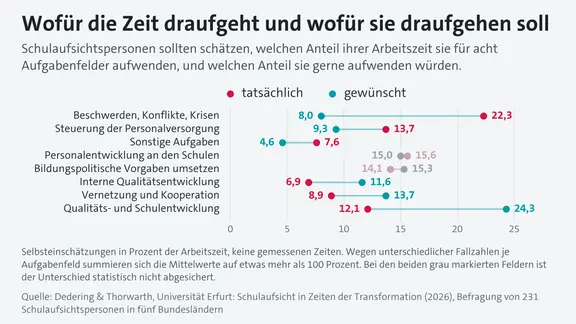
The data is stark: 99.6% of respondents cite conflict, crisis management, and parent complaints as the primary catalysts for their interactions with schools. This reactive mode of operation consumes 22.3% of their total working time. In contrast, time dedicated to substantive quality development and pedagogical mentorship accounts for a meager 12.1%.
When asked what they wish their working life looked like, the respondents painted a completely different picture. They desire a role where school development takes center stage (24.3% of time) and where conflict management is relegated to a smaller, more manageable 8%. The statistical significance of this disconnect suggests that the current structure of the school supervisory authority is not merely inefficient—it is actively preventing the very improvement of schools it was designed to oversee.
A Chronology of Bureaucratic Drift
To understand how the system reached this point, one must look at the evolution of the role over the last few decades.
- The Traditional Era: Historically, the school supervisor was an inspector. The primary focus was on ensuring that schools followed state-mandated curricula and administrative procedures.
- The Modernization Push: Following the PISA shocks of the early 2000s, there was a concerted effort across German states to pivot toward "school autonomy." The expectation was that supervisors would become "coaches" for school leaders, guiding them through the complexities of decentralized management.
- The Present Reality: The study conducted in late 2025 reveals that while the mandate has shifted toward "coaching," the workload has not been adjusted to accommodate it. Instead, as schools have gained more autonomy, the complexity of legal challenges, parental litigation, and personnel crises has exploded. The supervisor is now trapped between the high-level goal of systemic reform and the ground-level necessity of putting out fires.
Supporting Data: The Statistics of Overload
The survey provides a granular look at the sheer scale of the challenge. The average supervisor is responsible for 38 schools, but this number masks extreme disparities.
The Numbers Behind the Burnout
- The Caseload Extremes: While 50% of respondents manage 20 schools or fewer, a significant segment (11.7%) is responsible for more than 60 institutions. In extreme, outlier cases, some officials are tasked with overseeing up to 800 schools. The study does not specify the nature of these roles, but the sheer volume suggests that "supervision" in these instances is reduced to little more than checking boxes.
- The Frequency Gap: Officials visit each school an average of 4.3 times per year. A vast majority (86.3%) visit five times or fewer. Nearly half of the respondents (49.1%) believe this is insufficient, and when asked why they don’t visit more often, 75% point to a lack of time.
- The Overworked Professional: The average working week for a school supervisor stands at 45.6 hours—significantly higher than the 40-hour average for full-time employees in Germany.
These figures paint a picture of a profession in crisis. The "supervisor" is often physically unable to maintain a meaningful presence at the schools they oversee, leaving them to manage relationships through emails and phone calls triggered by emergencies rather than proactive engagement.
The Missing Foundation: Einarbeitung and Training
Perhaps most concerning is the lack of systematic professionalization for those entering the role. Joining the ranks of school supervision is often a transition from a teaching or administrative role into a position of high authority, yet 57.6% of participants reported receiving no formal, structured onboarding or "Einarbeitung."
This gap in training is filled—or left empty—by informal peer-to-peer exchanges. While 88.3% of respondents reported speaking with colleagues to navigate the demands of the job, there is a clear hunger for formal training. 69.3% explicitly requested more professional development, a figure that rises to 77.9% among those with less than five years of experience. The aging workforce (90% are over 45, with half between 55 and 64) suggests that a massive turnover is looming. Without a systemic overhaul of how these professionals are trained and onboarded, the system risks a total loss of institutional memory.
Official Responses and Stakeholder Perspectives
While the study was commissioned by the Heraeus Bildungsstiftung and the Wübben Stiftung Bildung—two private foundations—the implications are being felt across the political spectrum.
Educational ministries in the five anonymous states have largely remained cautious. Privately, many acknowledge the validity of the data, noting that the "Supervision vs. Support" dichotomy is the single most debated topic in regional education ministries. However, a significant barrier remains: the political cost of re-organizing the administration.
Critics of the current system point out that the "supervision" role is frequently used by ministries to shift blame. When a school fails, the supervisory authority is the first target of public ire. By keeping the supervisory load high and the focus on "reactive crisis management," the state effectively creates a buffer that protects the ministry from the systemic failures of the schools themselves.
Implications: A System in Need of Reform
The University of Erfurt study is more than just a collection of data; it is a call to action. The current configuration of the German school supervisory system is unsustainable. The implications are three-fold:
- Pedagogical Stagnation: As long as supervisors spend 22% of their time on conflicts and only 12% on development, schools will remain stuck in a cycle of reacting to problems rather than proactively building quality.
- Leadership Vacuum: School principals are currently supervised by people who do not have the time to mentor them. This exacerbates the existing crisis in school leadership, where the pressure on principals is leading to burnout and early retirement.
- Inequity of Support: The massive variance in caseloads (ranging from 20 to 800 schools) means that the quality of support a school receives is essentially a postcode lottery. A school in a district with a manageable supervisory ratio thrives; a school in an overstretched district is left to fend for itself.
The Path Forward
To bridge the gap between "wish and reality," the study suggests that states must move away from the "one-size-fits-all" approach to supervision. This includes:
- Standardized Onboarding: Creating a nationwide standard for professionalizing new supervisors.
- Workload Caps: Establishing a maximum ratio of schools per supervisor to ensure that pedagogical support can actually happen.
- Prioritization: Allowing supervisors to delegate administrative and legal tasks to specialized teams, freeing up the pedagogically trained experts to do what they were hired for: improving the quality of education.
The "silent architects" of the German school system are speaking up. Their message is clear: they are ready to do the work of building a better, more robust school system, but they are currently being held hostage by a structure that prioritizes paperwork over people. Whether policymakers will heed this evidence-based warning or continue to allow the system to drift remains the defining question for the coming academic year.