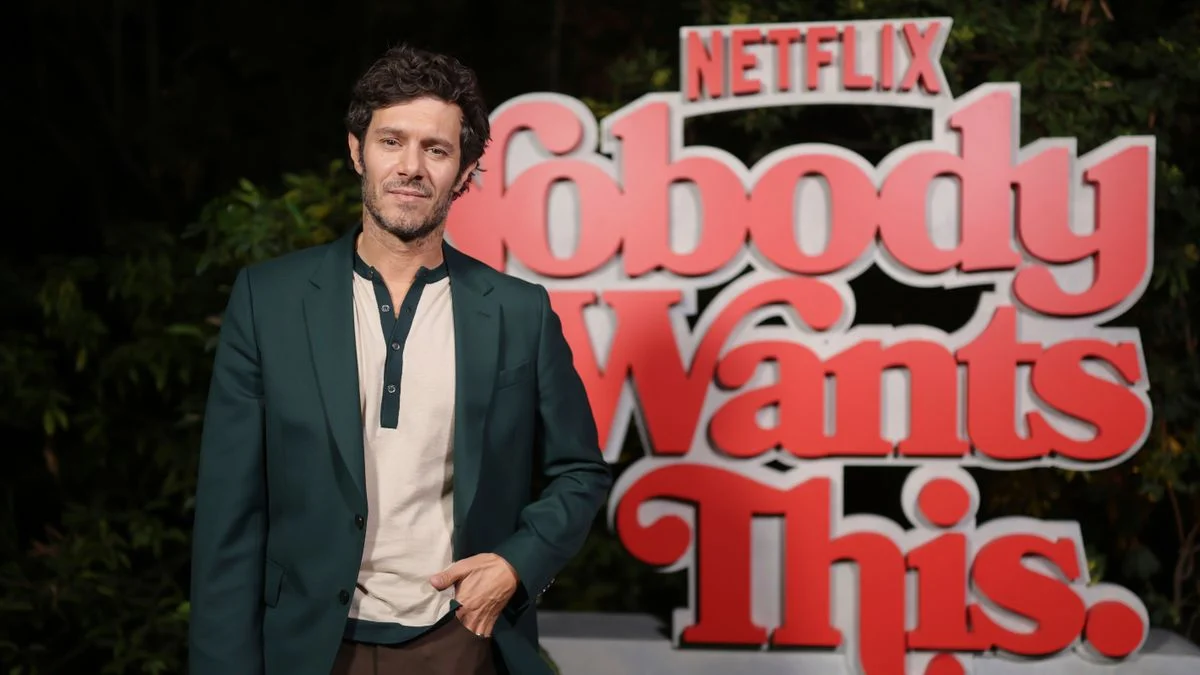
The intersection of celebrity culture, personal political conviction, and deeply sensitive geopolitical conflicts has once again created a friction point in Hollywood. Adam Brody, the 46-year-old actor whose career has been defined by iconic portrayals of Jewish characters—most notably the lovable Seth Cohen in The O.C. and the introspective Rabbi Noah Roklov in the recent Netflix hit Nobody Wants This—has found himself at the center of a firestorm.
His recent remarks regarding the ongoing war in Gaza have not only sparked intense public debate but have also created a visible rift within the creative team and cast of his current series. This article examines the trajectory of these comments, the responses from his colleagues, and the broader implications for the entertainment industry in an era of heightened political polarization.
The Catalyst: A Candid Interview in GQ
The controversy began when Adam Brody, known for his reserved demeanor, engaged in an unusually candid profile with GQ magazine. During the interview, the conversation drifted from his career resurgence to his personal views on the war in Gaza.
In a departure from the typical "celebrity-on-press-tour" script, Brody did not shy away from the topic. He explicitly characterized the military actions taken by the State of Israel in Gaza as a genocide and voiced his support for a "free Palestine." Beyond his critique of current Israeli state policy, Brody expressed a nuanced, albeit controversial, hope: that a change in the Israeli government could lead to a correction of the nation’s current political trajectory.
The reaction was immediate. Within hours of the interview’s publication, Brody’s comments had been amplified across social media platforms, drawing sharp condemnation from various quarters, including some Jewish advocacy groups and fellow industry professionals who viewed his language as not only factually inflammatory but morally misguided given the history of the region.
Chronology of a Growing Divide
To understand the intensity of the current reaction, one must look at the timeline of the show’s production and the subsequent public discourse.
- Pre-Release (Late 2023–Early 2024): Nobody Wants This was positioned as a lighthearted romantic comedy, focusing on the cultural collision between a Jewish rabbi and a non-Jewish podcaster. At this stage, the show was widely celebrated for its positive, modern depiction of Jewish identity.
- The GQ Profile (Late 2024): The publication of the interview served as the primary disruptor. By labeling Israel’s actions as "genocide," Brody stepped out of the character of Rabbi Noah and into the role of a political activist, creating a dissonance for fans who viewed his onscreen persona as a representative of Jewish community values.
- The Internal Response (Weeks Following): As the backlash intensified, the show’s creator, Erin Foster, was forced to address the issue in various podcast appearances and interviews.
- Escalation (The Current Phase): The critique reached a fever pitch when veteran actress Tovah Feldshuh, who plays the role of Brody’s mother in the series, publicly rebuked his choice of words, marking a significant "on-set versus off-set" collision.
The Creator’s Balancing Act: Erin Foster’s Perspective
Erin Foster, the creative force behind Nobody Wants This, has faced the unenviable task of defending her casting choices while maintaining the integrity of her show—a series she has explicitly described as a "love letter to Judaism."
In a recent podcast appearance, Foster was asked to navigate the tension between her lead actor’s views and the show’s reception among Jewish audiences. Her response was a masterclass in professional diplomacy: "Everyone has a right to a different opinion. I think our set resembles the dinner tables across the world, where people debate, discuss, and disagree. I like Adam very much, but I disagree with him. And that is okay."
However, Foster did not stop at simply defending free speech. She recognized the pain caused by the discourse. Addressing her audience directly, she stated, "As the creator of the show, I want to say to our Jewish fans: I see you, I hear you, and I understand how you feel." She emphasized that her intention in creating the show was to provide a positive, modern depiction of Jewish life at a time when, in her view, such representations are rare in global media.
Foster’s own history with the topic provides context. In 2021, she took to social media to call for a two-state solution, writing, "Nothing that is currently happening in Israel/Palestine is acceptable. Palestinians deserve to live in peace and without fear. Just as the Jews do." Her stance has remained focused on coexistence, a position that contrasts sharply with the binary, often inflammatory language used by more polarized voices in the debate.
Tovah Feldshuh’s Sharp Rebuttal
The most significant escalation occurred when Tovah Feldshuh, a revered figure in the acting community and a vocal advocate for Jewish issues, broke ranks to condemn Brody’s rhetoric. Speaking to the New York Post, Feldshuh did not mince words.
"To accuse the Jewish people of genocide is absurd," Feldshuh stated. "That comes straight from Hitler’s playbook. You turn the victim into the perpetrator."
Feldshuh’s comments carry weight precisely because she is a part of the show’s internal family. Her assertion that these claims are particularly damaging when they come from "Jews themselves" highlights the internal struggle within the Jewish community regarding the war in Gaza. For many, the use of the term "genocide" to describe Israel’s military actions is seen as a historical revisionist tool, designed to weaponize the memory of the Holocaust against the state established to prevent its recurrence.
Implications: The High Cost of Celebrity Political Discourse
The Brody-Feldshuh controversy is a microcosm of a broader phenomenon in Hollywood: the "political litmus test." In an age where audiences are increasingly concerned with the personal ethics of the artists they consume, the boundary between an actor’s performance and their private life has effectively vanished.
1. The Burden of Representation
Adam Brody has spent decades playing "the nice Jewish boy." When an actor occupies a specific cultural niche, the audience often conflates the character with the man. When that man holds views that are seen as antithetical to the identity he portrays, the sense of betrayal among the audience is magnified.
2. The Fragmentation of "The Set"
Hollywood sets are traditionally environments where "the work comes first." However, as political divides become more existential, the ability to maintain a "neutral" professional space is eroding. When a mother-son duo (in the context of the script) are publicly at war regarding the definition of genocide, the show’s promotion and the audience’s suspension of disbelief are fundamentally altered.
3. The Shrinking Space for Nuance
The discourse surrounding the war in Gaza has become notoriously binary. As shown by Erin Foster’s attempt to bridge the gap, there is a desire for a "middle way"—supporting the safety of both Palestinians and Jews. Yet, the media environment often forces figures like Brody and Feldshuh into diametrically opposed corners, making nuanced discussion almost impossible.
4. Future Challenges for Streaming Platforms
Netflix and other platforms must now contend with the reality that their intellectual property can be instantly compromised by the political statements of their stars. This raises questions about morality clauses in contracts and the extent to which studios should—or can—police the private speech of their talent.
Conclusion: A Reflective Moment for the Industry
The controversy surrounding Nobody Wants This is far more than a "celebrity feud." It reflects the deep, painful, and often irreconcilable divisions that the war in Gaza has unearthed within Western society.
While Adam Brody exercises his right to political expression, and Tovah Feldshuh exercises her right to condemn what she views as dangerous rhetoric, the audience is left to navigate the wreckage. For fans of the show, the experience is now inextricably tied to the knowledge that behind the scenes, the "dinner table" is far from harmonious.
Ultimately, the situation serves as a stark reminder that in a globalized, hyper-connected world, no one—not even the stars of a lighthearted rom-com—can remain insulated from the most intense geopolitical debates of our time. Whether this leads to a more mature dialogue or further alienation remains to be seen, but for now, the gap between the screen and the reality of the Middle East has never seemed wider.