Introduction: A Strategic Pivot Toward the Indo-Pacific
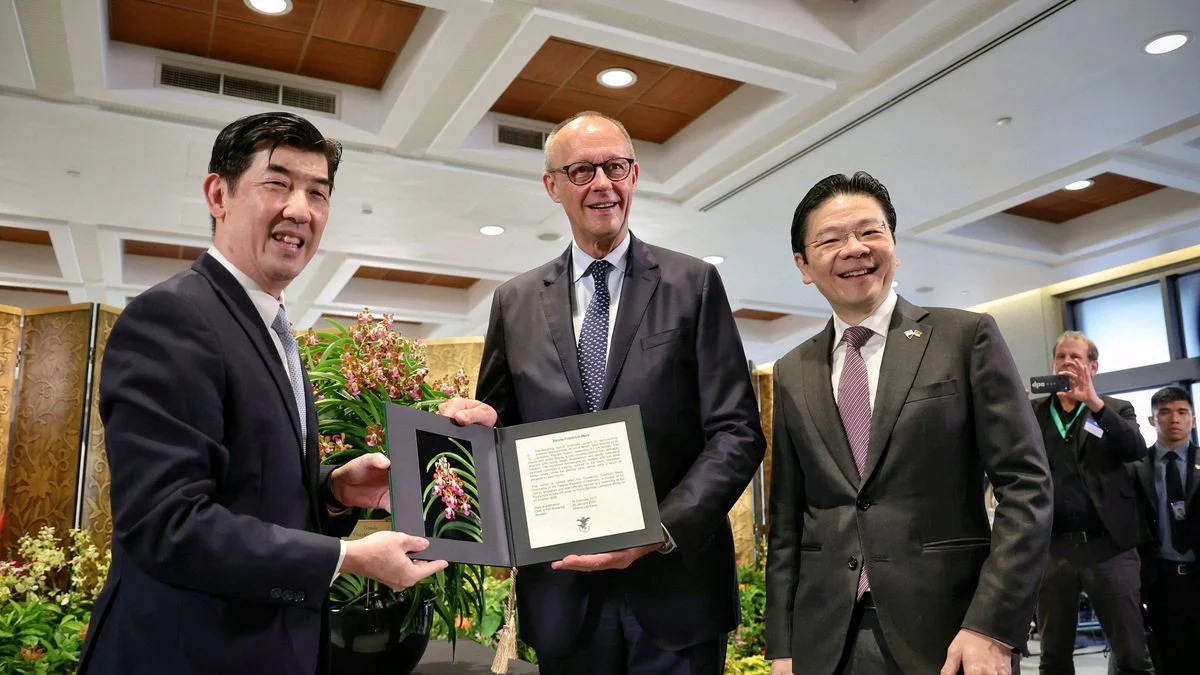
In a significant diplomatic push aimed at reshaping Europe’s economic geography, CDU leader and German Chancellor Friedrich Merz has set his sights on the burgeoning markets of the Indo-Pacific. During a high-profile visit to Singapore, Merz articulated a vision for a more integrated global trade architecture, proposing that the European Union should actively pursue a comprehensive free trade agreement (FTA) with the Comprehensive and Progressive Agreement for Trans-Pacific Partnership (CPTPP).
This proposal represents a departure from the EU’s traditional focus on bilateral agreements, suggesting instead a "bloc-to-bloc" strategy that could link the two most dynamic economic regions of the world. By targeting the twelve nations of the CPTPP—which encompass nearly 600 million people and represent a significant portion of global GDP—Merz is positioning Germany and the EU to play a more proactive role in defining the rules of global commerce in the 21st century.
The Core Proposal: Bridging the EU and the CPTPP
During a keynote address in Singapore, a global hub for finance and trade, Merz called for a paradigm shift in how the EU approaches international trade. His core argument is that the current model of individual bilateral treaties is too fragmented to address the complexities of modern, highly integrated global supply chains.
"Let us work together toward a major interregional agreement with the members of the Trans-Pacific Partnership," Merz declared. His proposal envisions a framework that would simplify the regulatory environment for businesses operating across these diverse markets. The CPTPP, which was formally established in 2018, serves as a gold standard for modern trade agreements, covering areas ranging from digital trade and intellectual property to labor standards and environmental protections.
By aligning the EU—a market of 480 million people—with the CPTPP, Merz believes the two entities could create a unified trade zone that commands more than one-third of the global economy. Such an alliance would provide a counterweight to the economic dominance of China and the protectionist tendencies observed in other parts of the world.
Chronology: From Regional Agreements to Global Integration
To understand the significance of Merz’s proposal, one must view it against the backdrop of recent trade developments:
- 2016-2018: The TPP (Trans-Pacific Partnership) undergoes a transformation after the United States withdraws. In 2018, the remaining eleven members—Australia, Brunei, Canada, Chile, Japan, Malaysia, Mexico, New Zealand, Peru, Singapore, and Vietnam—sign the CPTPP.
- 2021-2023: The EU intensifies its efforts to negotiate bilateral deals with key Indo-Pacific partners. Negotiations move forward with Indonesia, the Philippines, India, and Australia, while existing agreements with nations like Vietnam and Japan are monitored for their economic impact.
- 2023: The United Kingdom officially accedes to the CPTPP, signaling that the agreement is expanding beyond its original Pacific-rim footprint and is becoming a global trade standard.
- 2024: Chancellor Merz’s current visit to Singapore serves as the catalyst for his "Global Trade Integration" initiative, moving the conversation from individual deals to a broad, multi-regional partnership.
Supporting Data: The Economic Logic
The economic justification for Merz’s proposal is rooted in the sheer scale of the markets involved. The CPTPP members represent a diverse cross-section of the global economy, spanning five continents.
The Scale of the Opportunity
- CPTPP Demographics: The twelve member states combined host approximately 600 million residents.
- ASEAN Demographics: The Association of Southeast Asian Nations (ASEAN) encompasses 11 member states with nearly 700 million people.
- EU Reach: The European Union, with 27 member states, accounts for approximately 480 million people.
Combined, a potential EU-CPTPP-ASEAN integration would link over 1.7 billion consumers. Merz argues that by "linking" existing bilateral agreements—such as those currently in progress with Indonesia, the Philippines, India, and Malaysia—the EU can eliminate the "spaghetti bowl" effect of overlapping, inconsistent trade rules. By standardizing these regulations, European firms could leverage more efficient production chains, reducing costs and increasing the competitiveness of European exports in Asia.
The Long-Term Goal: An EU-ASEAN Partnership
While the immediate focus of Merz’s diplomatic efforts is the CPTPP, he made it clear that this is merely a stepping stone toward a grander objective: a comprehensive free trade agreement between the EU and the ASEAN bloc.
ASEAN represents one of the fastest-growing economic regions in the world. However, negotiating a single agreement with eleven distinct nations, each with its own domestic political pressures and economic priorities, is a monumental task. Merz’s strategy is to use the CPTPP as a template. By first engaging with CPTPP members, the EU can establish a foundational set of rules that can later be expanded to encompass the entirety of the ASEAN market.
Official Responses and Political Challenges
While the business community has largely welcomed the Chancellor’s ambition, the proposal faces significant political hurdles within the European Union.
The Competence Question
A crucial point of reality must be addressed: the power to negotiate and conclude trade agreements does not reside with the German government. Under the Treaty on the Functioning of the European Union, the European Commission holds the exclusive mandate to negotiate trade deals on behalf of all 27 member states.
Therefore, Merz’s proposal must be viewed as a call to action for the European Commission and the European Council. His rhetoric is intended to galvanize support among other EU leaders, arguing that Germany—the EU’s largest economy—is prepared to spearhead the political heavy lifting required to get these negotiations off the ground.
Internal EU Tensions
Within the EU, there is historically a split between "free traders" and those concerned about the impact of international competition on European agriculture and domestic industries. Critics of the proposal argue that a wide-ranging agreement with the CPTPP could lead to an influx of low-cost imports, potentially undermining European farmers. Merz, however, maintains that the era of protectionism is a luxury the EU cannot afford. He argues that if Europe does not actively shape the trade standards of the Indo-Pacific, it will be forced to accept standards set by other global powers.
Implications: A New Era for German Foreign Policy
The implications of Merz’s initiative are profound, affecting both economic strategy and geopolitical positioning.
1. Reducing Economic Dependency
A central theme of German foreign policy in the post-pandemic era is the diversification of supply chains. By strengthening ties with the CPTPP and ASEAN, the EU reduces its reliance on any single market, particularly China. This "de-risking" strategy is central to the German government’s broader economic security doctrine.
2. Setting Global Standards
Trade agreements are not merely about tariffs; they are about setting rules for the digital economy, environmental protection, and data privacy. By aligning with the CPTPP, the EU would essentially be "exporting" its high regulatory standards to the Pacific. This would ensure that as these economies grow, they do so in a manner compatible with European values and legal frameworks.
3. Geopolitical Relevance
In an age of renewed geopolitical competition, trade is the primary tool of statecraft. By proposing a bridge to the Pacific, Merz is signaling that Europe intends to remain a relevant player in the Indo-Pacific. This is a direct response to the "Pivot to Asia" initiated by the United States over a decade ago. Merz’s vision suggests that Europe should not be a passive observer of Asian growth but an active partner in its institutional development.
Conclusion: The Road Ahead
Friedrich Merz’s proposal for an EU-CPTPP trade alliance is a bold exercise in economic diplomacy. While the path to such a massive agreement is fraught with legal complexity and political friction, the logic behind the proposal is compelling. In an increasingly fragmented global economy, the ability to build, maintain, and harmonize trade relationships across vast distances is the defining challenge for leaders in the 21st century.
As the German Chancellor continues his tour, the focus will shift to how European partners and the European Commission respond to this challenge. Whether this proposal gains traction as a formal policy objective or remains a visionary goal, it has successfully shifted the discourse in Berlin and Brussels toward the necessity of deep, structural engagement with the Indo-Pacific. The era of hesitant, bilateral trade deals may be coming to an end, replaced by a push for large-scale, interregional cooperation that defines the future of global prosperity.