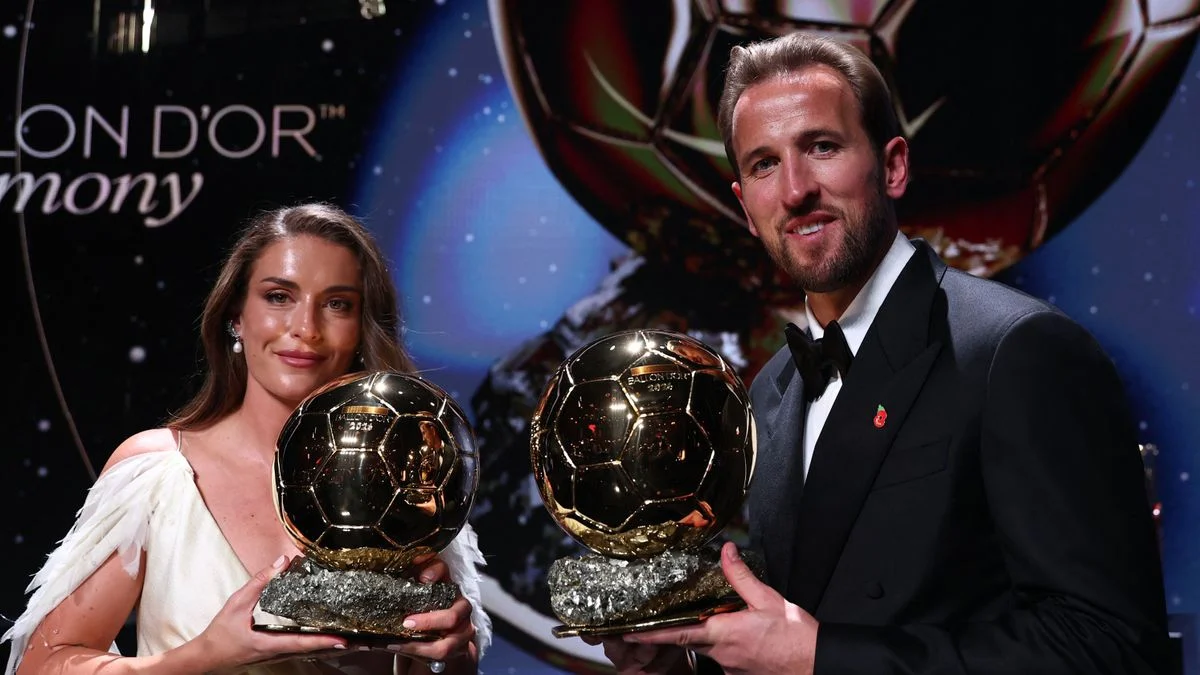
In a glittering ceremony held in the heart of London, the footballing world paused to witness the crowning of its greatest individual talents. Harry Kane, the prolific talisman of FC Bayern Munich, and Alexia Putellas, the visionary midfielder of the London City Lionesses, were officially unveiled as the winners of the 2024 Ballon d’Or. The prestigious award, widely considered the pinnacle of individual achievement in the sport, brought together icons of the game, coaches, and tacticians to celebrate a year defined by tactical evolution and sheer athletic brilliance.
For Kane, the accolade represents the realization of a lifelong dream, while for Putellas, it marks a historic third triumph, solidifying her status as one of the most decorated players in the history of the women’s game.
The Coronation: A Local Hero and a Global Icon
The atmosphere at the London venue was electric as the golden trophies were presented. For Harry Kane, 33, the night was particularly poignant. Having returned to his home city to accept the award, the England captain appeared visibly overwhelmed when his name was called.
"Wow," Kane exclaimed upon taking the stage, the heavy golden trophy gleaming under the spotlight. "I am almost speechless. I can imagine how difficult the decision was this year, as there are so many outstanding players competing at the absolute highest level."
For Kane, whose career has been defined by clinical finishing and an unyielding work ethic, the Ballon d’Or serves as a validation of his transition to the Bundesliga and his continued dominance on the international stage. His ability to anchor the attack for Bayern Munich while maintaining a world-class output has set him apart from his peers.
Simultaneously, Alexia Putellas, 32, made history. Since her high-profile summer transfer from FC Barcelona to the London City Lionesses, Putellas has navigated the pressures of a new league with grace and tactical intelligence. By securing her third Ballon d’Or, she has pulled level with her Spanish teammate Aitana Bonmatí, sparking a friendly yet intense rivalry that continues to elevate the standard of women’s football globally.
A Chronology of Excellence: How the Night Unfolded
The ceremony followed a meticulous trajectory, honoring not just the players, but the architects behind their success. The evening began with a celebration of the rising stars, shifting quickly to the coaching staffs who have implemented the tactical shifts defining modern football.
The awards were distributed in a sequence that highlighted the deep talent pool currently dominating the European landscape. As the evening progressed, it became increasingly clear that Spain—and the influence of Spanish tactical philosophies—was the central theme of the night.
- The Youth Vanguard: The evening opened with the recognition of the game’s future. While Bayern Munich’s Lennart Karl was a strong contender for the "Best Talent" award, the trophy went to Lamine Yamal, whose meteoric rise has captivated the footballing world. Similarly, the women’s "Best Talent" award went to Vicky López of FC Barcelona, highlighting the club’s continued excellence in youth development.
- Tactical Masterminds: The coaching awards underscored the dominance of Spanish football. Luis de la Fuente, the architect of Spain’s successful World Cup campaign, was named the Best Men’s Coach. On the women’s side, Pere Romeu of FC Barcelona received the honor, reflecting the club’s enduring consistency at the top of the UEFA Women’s Champions League.
- The Guardians of the Goal: The goalkeeping awards were a clean sweep for the Spanish contingent. Unai Simón, the bedrock of the Spanish men’s national team, was named the best goalkeeper, while Cata Coll of FC Barcelona took home the women’s prize.
- The Grand Finale: The night culminated in the reveal of the Ballon d’Or winners. The anticipation was palpable as the final votes were tallied, leading to the standing ovation for both Kane and Putellas.
Supporting Data: The Statistics of Success
The selection of the winners was based on a rigorous analysis of performance data across the 2023/2024 season. For Harry Kane, the criteria were his goal-scoring record, his influence on Bayern Munich’s domestic and European campaigns, and his leadership of the England national team. Despite the fierce competition from younger forwards, Kane’s consistency—often scoring at a rate of more than one goal per game—made him the statistically superior choice for the selection committee.
For Alexia Putellas, the metrics centered on her transition to the London City Lionesses. Her pass completion rate, her ability to dictate the tempo of the game in the final third, and her pivotal role in key league matches provided the empirical evidence for her selection.
In the broader context of the awards, the prominence of Spanish players is supported by the data regarding the recent successes of Spanish clubs and national teams. With the men’s national team winning the World Cup and FC Barcelona’s women’s team maintaining a stranglehold on European competition, the prevalence of Spanish winners was, in many ways, an inevitable reflection of current footballing dominance.
For German football, the night provided a mixed perspective. While Bayern Munich’s influence remains strong, only one German professional—Klara Bühl—made the final shortlist for the major awards. Bühl’s 12th-place finish is a testament to her individual talent, but it also signals a potential need for a broader rejuvenation of German talent within the global elite rankings.
Official Responses and The Football Community
The reactions following the ceremony were as varied as the attendees themselves. Club officials from FC Bayern praised Kane’s professionalism and dedication, noting that the Ballon d’Or is the culmination of years of hard work.
"Harry represents everything we strive for at this club," a Bayern spokesperson remarked. "His humility in the face of such a massive achievement is exactly why he is a leader."
On the other side of the English Channel, the London City Lionesses expressed their pride in hosting a Ballon d’Or winner. "Alexia has brought a level of sophistication to our squad that is unmatched," said the club’s manager. "Her influence extends beyond her own statistics; she makes every player around her better."
The social media sphere was similarly active, with legends of the game congratulating the winners. Former Ballon d’Or recipients lauded the technical maturity of both Kane and Putellas, noting that the award has evolved from simply rewarding the "top scorer" to honoring the most influential figures on the pitch.
Implications: A New Era for the Sport
The results of this year’s Ballon d’Or have significant implications for the future of football.
1. The Shift in Power Dynamics:
The dominance of Spanish football, both in coaching and on the pitch, suggests that the "Spanish style"—characterized by high possession, intricate passing, and high-pressing defensive structures—remains the gold standard. Clubs around the world will likely continue to look toward La Liga for coaching talent and tactical inspiration.
2. The Longevity of the "Veterans":
With Kane (33) and Putellas (32) taking home the top prizes, the narrative that football is an exclusively "young man’s game" has been challenged. The success of these two players proves that tactical intelligence, physical conditioning, and leadership can allow players to remain at the absolute peak of the game well into their thirties.
3. The Growing Global Impact of the Women’s Game:
The fact that the ceremony treated the men’s and women’s awards with equal weight and spectacle reflects the ongoing professionalization and commercial growth of women’s football. As players like Putellas continue to move between major European leagues, the global visibility of the women’s game is expected to reach new heights.
4. The Challenge for German Football:
For the German football establishment, the result is a clear call to action. While the Bundesliga remains a premier destination for talent, the lack of German players in the final rankings suggests a need for increased investment in grassroots development and the nurturing of young players who can compete with the current Spanish and international hegemony.
Conclusion: Beyond the Golden Ball
As the lights dimmed in London and the attendees departed, the legacy of the 2024 Ballon d’Or ceremony began to solidify. Harry Kane and Alexia Putellas have etched their names into the history books, not just for the goals they scored or the passes they completed, but for the way they have navigated the complexities of the modern game.
The evening was more than a celebration of individual excellence; it was a snapshot of a sport in flux, where tactical sophistication and historical pedigree collide. As the next season begins, the golden trophies will serve as both a milestone for the winners and a challenge to the rest of the footballing world: to adapt, to evolve, and to strive for the level of excellence that defined this night in London.
For the fans, the ceremony served as a reminder of why football remains the world’s most compelling spectacle. In the end, it was not just about the winners, but about the enduring pursuit of perfection on the pitch—a pursuit that continues, regardless of who holds the golden ball.