By Sports Desk
Updated: October 25, 2026 | 12:11 PM
The 2026 Frankfurt Marathon will be remembered as a race of tactical masterclasses, unpredictable environmental challenges, and the emergence of a new sensation in German long-distance running. In a gripping contest that saw elite athletes battling both each other and the elements, Germany’s own Amanal Petros secured a hard-fought second-place finish, while newcomer Blanka Dörfel stunned the sporting world with a debut performance that places her among the fastest German women in history.
The Main Facts: A Duel in the Streets of Frankfurt
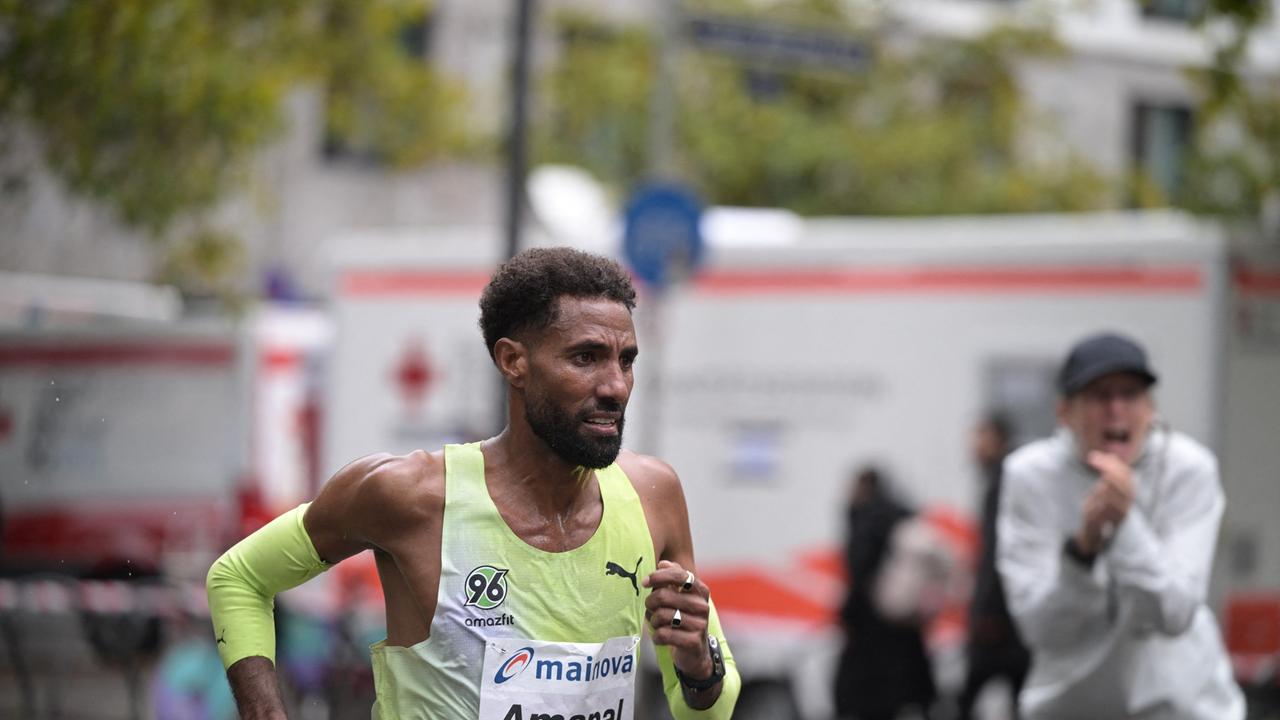
On a Sunday morning defined by persistent rain and challenging course conditions, the Frankfurt Marathon reached a fever pitch. In the men’s elite field, Amanal Petros, representing Hannover 96, proved his status as a world-class contender. Crossing the finish line at the iconic Festhalle in 2:05:46 hours, Petros took the silver medal, finishing just 20 seconds behind Ethiopia’s Jirata Denki, who claimed the victory in 2:05:26. Kenya’s Benard Biwott completed the podium with a time of 2:06:23.
For the women, the day belonged to 24-year-old Blanka Dörfel. Making her highly anticipated debut over the 42.195-kilometer distance, the reigning German 10,000-meter champion delivered a masterclass in endurance. Finishing in 2:20:46, she claimed second place behind Ethiopia’s Zeineba Yimer, who clocked 2:19:45. Dörfel’s time was not only a massive personal milestone but a historic marker, positioning her as the second-fastest German woman ever to run the marathon, trailing only the legendary German record held by Irina Mikitenko (2:19:19).
A Chronology of the Race
The Morning Start: Battling the Elements
The race began under ominous skies. Heavy rainfall greeted the field at the start line, creating treacherous conditions throughout the city. The primary challenge for the runners was not just the pace, but the accumulation of deep puddles that tested their footing and tactical rhythm from the very first kilometer.
The Mid-Race Surge
As the race progressed toward the 30-kilometer mark, the field began to thin. It was at this juncture that Amanal Petros decided to make his move. Launching a decisive attack, he pushed the pace, forcing the lead pack to break. Initially, only Kenya’s Benard Biwott could track the German’s acceleration. However, the eventual winner, Jirata Denki, remained composed, bridging the gap as the lead duo navigated the final stretches of the course.
The Bizarre Obstruction
The race took a dramatic and somewhat chaotic turn in the final kilometers. As Petros led the charge toward the finish, a food delivery worker suddenly appeared on the race course, positioned directly on the ideal racing line. The 31-year-old Petros, clearly frustrated by the dangerous encroachment, gestured wildly and made physical contact with the rider to clear his path. This minor, yet jarring, disruption briefly broke the momentum of the frontrunners.
The Final Sprint
In the closing stages, Petros managed to drop Biwott, but he could not hold off the late-race surge from Denki. The Ethiopian athlete utilized his final reserves of energy to overtake the German, securing the win as they entered the Festhalle.
Supporting Data: Performance Analysis
The performance of the German contingent was deep and consistent. Beyond Petros, Richard Ringer put in a commendable shift, crossing the line in 2:07:07 for a fifth-place finish. Samuel Fitwi rounded out a strong showing for the home nation, taking seventh in 2:08:57.
For the women, the statistics underscore the scale of Blanka Dörfel’s achievement. Her 2:20:46 is a benchmark for future talent in Germany. Analysis of her split times suggests that despite the grueling conditions and the "cold footbath" she described at the finish, her pacing remained remarkably disciplined. In comparison to historical standards, her debut has sent shockwaves through the athletics community, as she effectively bypassed years of gradual improvement to immediately challenge national records.
Official Responses and Reflections
In the immediate aftermath of the race, the athletes were candid about the difficulty of the day.
Amanal Petros, who had entered the race with the ambitious goal of challenging the European record of 2:03:36, showed grace in defeat. Speaking to the Hessischer Rundfunk microphone, he reflected on the tactical nature of the race. "I have given everything I had," Petros stated. "The rain and the puddles made the conditions very tough from the start. In the final kilometers, I simply lacked the extra bit of power required to fend off Denki."
Blanka Dörfel, clearly overwhelmed by her own performance, provided insight into her strategy. "The last five kilometers were extremely difficult. It felt like a cold footbath," she laughed. When asked about her surprise at the result, she added, "I always run by feel. I don’t look at the watch constantly. This experience has given me a lot of confidence; I truly believe I can go faster in my next outing."
The Implications: What This Means for 2026 and Beyond
A New Era for German Women’s Running
Dörfel’s performance effectively changes the landscape for German long-distance running. By coming within 87 seconds of a 17-year-old national record on her debut, she has signaled to the federation and the international circuit that she is a force to be reckoned with. Her potential for growth, given her age and relative lack of experience at the marathon distance, suggests that the German record might be under serious threat in the coming seasons.
Petros and the Elite Circuit
For Amanal Petros, the 2026 Frankfurt Marathon serves as both a disappointment regarding the record books and a confirmation of his status among the world’s elite. Finishing second in a race with such high-caliber international competition validates his training program and his tactical acumen. Despite the missed record, he remains the standard-bearer for German men’s marathoning.
Logistics and Safety
The incident with the delivery worker on the course has sparked discussions regarding marathon security and traffic management. While the event organizers maintain that the course was secured to the highest standards, the presence of a civilian vehicle—or in this case, a delivery bike—on the race route during the final kilometers of an elite race raises questions about the protocols for cordoning off city centers. It is expected that race organizers will conduct a thorough review of the course management to ensure such risks are mitigated in future iterations of the Frankfurt Marathon.
Conclusion
The 2026 Frankfurt Marathon will be remembered not just for the clock, but for the resilience shown by the athletes. Through rain, tactical chess matches, and unexpected obstacles, the race produced stories of human endurance that resonated with the thousands of spectators lining the streets. As the dust settles, the focus shifts to the upcoming major marathons, where the names Amanal Petros and Blanka Dörfel will undoubtedly be at the top of the scouting lists for organizers and rivals alike. The sport of long-distance running in Germany has found a new source of inspiration, and the future of the Frankfurt Marathon looks brighter than ever.