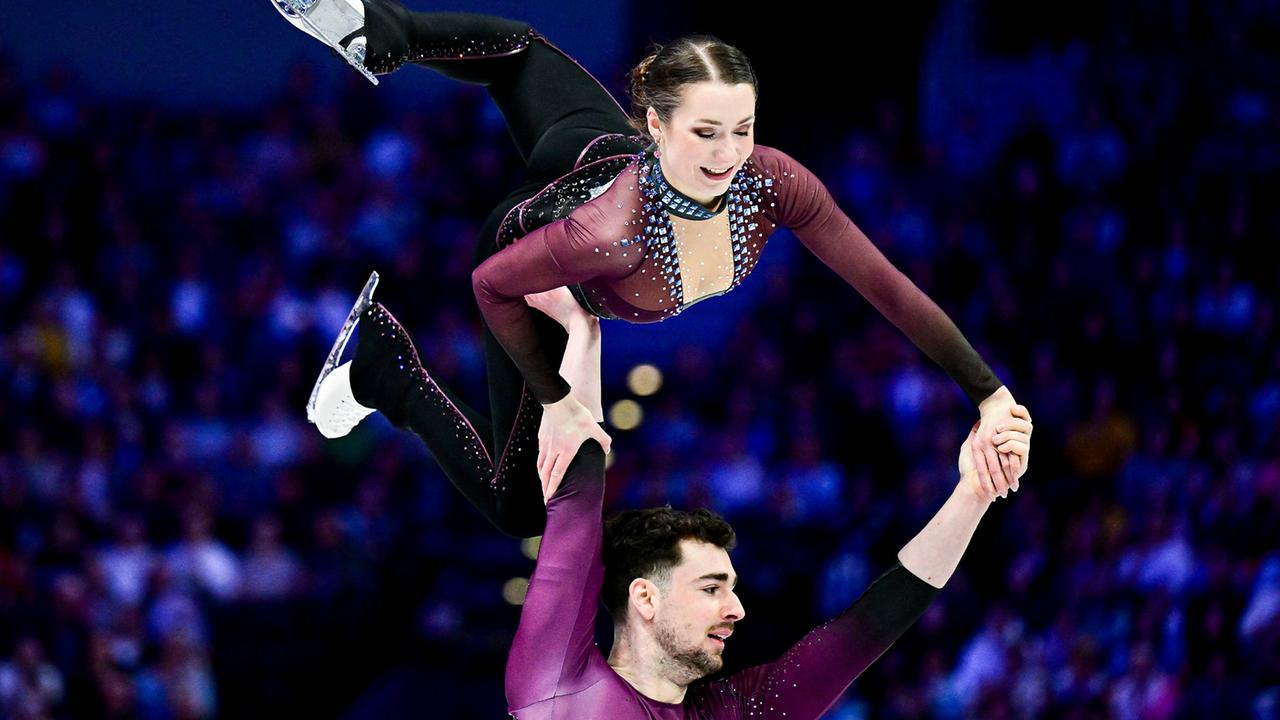
ANGERS, France – In a display of fortitude and artistic progression, the German pair skating duo of Annika Hocke and Robert Kunkel clinched a hard-fought bronze medal this weekend at the International Skating Union (ISU) Grand Prix in Angers, France. The result marks a significant turning point for the Berlin-based athletes, who have spent the early weeks of the season navigating both physical recovery and a tactical restructuring of their training regime.
The performance in Angers serves as a vital indicator of the pair’s competitive readiness as they navigate the Olympic cycle. Despite facing a formidable field of international competitors, Hocke and Kunkel’s ability to maintain their composure under pressure proved sufficient to secure a spot on the podium, finishing with a total score of 179.74 points.
A Chronology of the Angers Performance
The competition began on Saturday evening, with the short program setting the stage for the weekend’s events. Hocke and Kunkel delivered a disciplined and technically sound routine, which garnered 67.03 points. This score positioned them comfortably in third place heading into the decisive free skate, providing the pair with a necessary psychological cushion.
On Sunday, the duo took to the ice for their long program, set to a high-energy "Queen" medley. The choreography, designed to highlight both the power and the intricate footwork of the pair, was met with enthusiasm by the French crowd. However, the technical path to the podium was not without its hurdles.
During the execution of their elements, the pair encountered a minor setback when Hocke under-rotated the triple Salchow, resulting in it being scored as a single jump. Furthermore, the fluidity of some landings was compromised, leading to slight deductions from the judging panel. Despite these technical imperfections, the artistic integrity of their program—combined with their high-level lifts and spins—allowed them to accrue 112.71 points in the free skate.
By the conclusion of the event, the leaderboard reflected the high caliber of the competition. The gold medal was secured by the Georgian pair Anastasia Metelkina and Luka Berulawa, who dominated the field with a total score of 204.65. The silver medal went to the neutral-flag pair Aleksandra Boikowa and Dimitri Koslowskii, who finished with 197.66 points. Hocke and Kunkel’s 179.74 points successfully held off the remaining challengers, solidifying their position in the top three.
Technical Analysis: Beyond the Scoreboard
To understand the trajectory of Hocke and Kunkel, one must look past the final digits on the scoreboard. Their performance in Angers was a testament to their adaptability. The transition to the Berlin training center and the mentorship of their new coach, Nolan Seegert—a veteran of the sport and former partner of Minerva Haase—has introduced a new technical philosophy to the pair’s repertoire.
The Role of Technical Difficulty
In modern pair skating, the gap between the podium and the remainder of the field is often defined by the "Base Value" of the technical elements. Hocke and Kunkel have been working to stabilize their triple jumps, a task made significantly harder by Hocke’s recent health challenges.
The "Queen" medley program requires an immense amount of stamina. The choreography is front-loaded with complex transitions that force the skaters to maintain a high heart rate while preparing for high-risk jumps. The decision to perform this specific program reflects a desire to move away from safer, more conservative routines in favor of those that showcase technical ambition. While the error on the Salchow was costly, the fact that they remained on the podium despite this confirms that their overall technical baseline is strong enough to compete at the international level.
Physical Conditioning and Injury Management
The context of the season’s start cannot be overstated. Annika Hocke’s recovery from a syndesmosis ligament injury—a notorious injury for figure skaters due to the extreme pressure placed on the ankles during jumps and landings—has been the primary narrative of their training cycle.
The syndesmosis, which connects the tibia and fibula, requires stability and precision to heal correctly. Returning to competition at the Grand Prix level so shortly after such an injury demonstrates a high level of medical management and physical conditioning. The team’s focus has been on "smart training" rather than "heavy training," prioritizing the longevity of the ankle over raw repetition.
The Structural Shift: Training in Berlin
The move to the Berlin training center marks a homecoming and a strategic pivot. By working under Nolan Seegert, Hocke and Kunkel are leveraging a partnership that bridges the gap between traditional German skating styles and the evolving international standards set by the ISU.
Seegert’s influence is reportedly centered on improving the "skating skills" component of their scores—the aspect of figure skating that rewards edge quality, flow, and musical interpretation. For a pair that has historically relied on technical execution, this shift in focus is intended to raise their "Program Component Scores" (PCS). In Angers, while the technical scores were hampered by the Salchow error, the PCS scores remained resilient, suggesting that the judges are responding positively to their refined stylistic approach.
Implications for the Season Ahead
The bronze medal in Angers is more than just a piece of hardware; it is a vital accumulation of Grand Prix points. These points determine eligibility for the Grand Prix Final, the most exclusive event on the circuit. While a podium finish is excellent, Hocke and Kunkel remain focused on the broader goal: the European and World Championships.
The Finlandia Trophy Challenge
Their next engagement at the Finlandia Trophy in Helsinki, scheduled for mid-November, will be a critical litmus test. The Finnish competition typically attracts a dense field of skaters looking to secure their final points for the season. For Hocke and Kunkel, Helsinki will be about consistency. If they can replicate the consistency of their short program in Angers while stabilizing the landings in their free skate, they will be in a strong position to challenge for higher placements later in the year.
Strategic Adjustments
Looking toward the spring, the duo faces a choice regarding their technical content. They must decide whether to continue pushing the triple-jump envelope—which carries high risk—or to refine their current program to ensure near-flawless execution. Given the margins between the silver and bronze medalists in Angers, it is clear that clean skating is currently being rewarded as heavily as high-difficulty elements.
The Broader Landscape of German Figure Skating
German figure skating has experienced a period of transition, with a need for new leaders on the international stage. Hocke and Kunkel have stepped into this role with professionalism and maturity. Their presence on the podium provides a morale boost to the German skating community and proves that the domestic training infrastructure is capable of producing world-class athletes.
Furthermore, the rise of competitors like Metelkina and Berulawa signals that the sport is trending toward higher-speed, more athletic skating. Hocke and Kunkel’s ability to compete with such emerging powerhouses indicates that they are keeping pace with the rapid evolution of the sport.
Conclusion
As the dust settles on the ice in Angers, the narrative surrounding Annika Hocke and Robert Kunkel is one of resilience. Having navigated injury, coaching changes, and the intense scrutiny of a Grand Prix environment, they have emerged as a stronger, more cohesive unit.
The road to the top of the podium is rarely linear. For this German pair, the bronze in France is not just an end result; it is a foundation. With the Finlandia Trophy on the horizon and their training in Berlin continuing to bear fruit, Hocke and Kunkel have signaled to the rest of the world that they are not just competitors—they are contenders who are learning to thrive under the bright lights of the international stage. As they move forward, the focus will undoubtedly shift to refining their technical consistency, ensuring that when they return to the ice in Helsinki, they do so not just with talent, but with the tactical precision required to turn bronze into something even brighter.