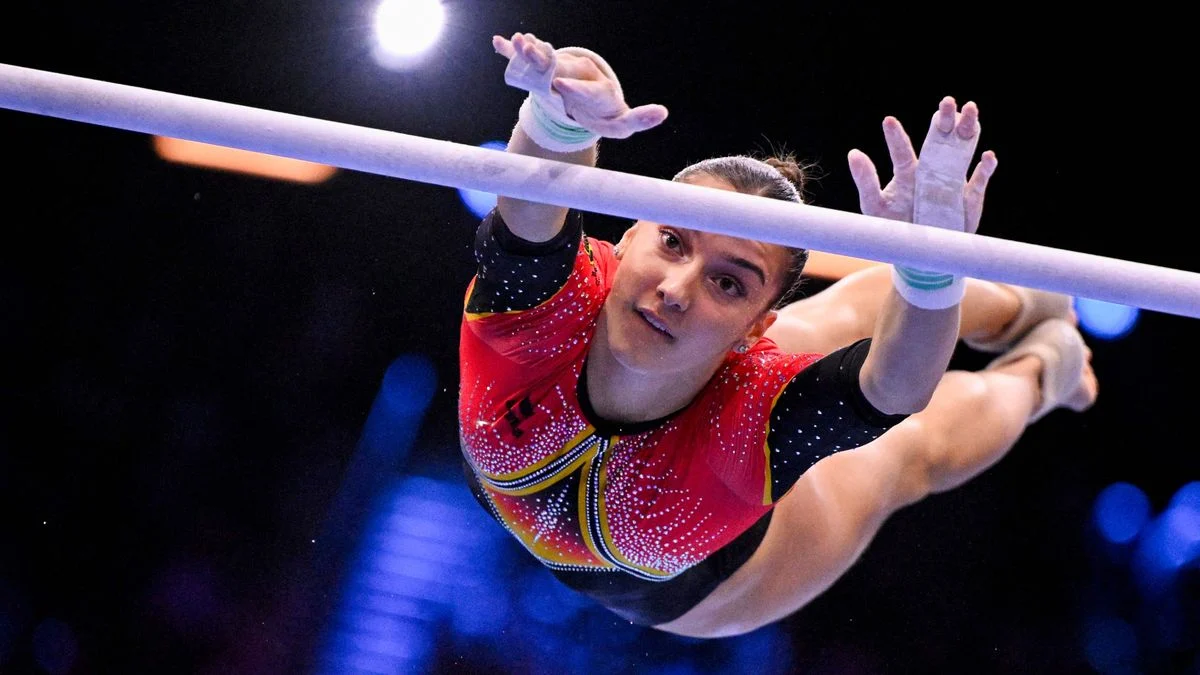
ROTTERDAM – The gymnastics world has witnessed the emergence of a new global force. In a stunning display of poise, technical precision, and athletic maturity, 18-year-old German sensation Helen Kevric has etched her name into the history books, securing a silver medal on the uneven bars at the World Gymnastics Championships in Rotterdam.
For the MTV Stuttgart gymnast, this achievement represents the pinnacle of a meteoric rise that has captivated the sport over the last twelve months. In a final contested by the world’s elite, Kevric delivered a masterful performance, proving that her European Championship title earlier this year was no mere fluke, but the beginning of a storied international career.
The Main Facts: A Podium Performance
The uneven bars final in Rotterdam was billed as a high-stakes showdown, and it did not disappoint. Facing a field of world-class specialists, Kevric maintained her composure to post a score of 14.833. This score, a testament to her technical cleanliness and difficulty, was enough to secure the silver medal, placing her firmly between the sport’s current titan and a reigning world champion.
The gold medal was claimed by Algeria’s Kaylia Nemour, the reigning Olympic champion and title defender, who demonstrated once again why she is currently in a league of her own, finishing with a commanding 15.333. The bronze went to the USA’s Skye Blakely, the reigning all-around world champion, who tallied 14.600.
For the German team, which has faced a challenging transition period following recent retirements and injuries, Kevric’s medal is a beacon of hope. It marks the first World Championship medal for the German women’s team since Pauline Schäfer-Betz captured silver on the balance beam in 2021, and it firmly establishes Kevric as the current face of German gymnastics.
Chronology: The Path to the Rotterdam Podium
The journey to this silver medal began long before the final apparatus was set up in the Rotterdam arena. Kevric’s ascent has been defined by steady progress and a relentless work ethic.
The Qualification Phase
Kevric entered the Rotterdam Championships with the eyes of the gymnastics community upon her. Following her breakthrough gold medal at the European Championships in August, expectations were high. She wasted no time in confirming her status as a contender, finishing the qualification round in second place. Her performance in the qualifiers signaled to the field that she was not merely looking to gain experience, but to compete for the highest honors.
The Final Routine
In the final, the pressure was palpable. Eight of the world’s most talented gymnasts stood ready to execute their routines. Kevric, performing with the calm of a seasoned veteran, executed her routine with near-flawless precision. Her transitions were fluid, her pirouettes tight, and her dismount—the final hurdle—was stuck with the clinical accuracy that has become her trademark.
As the score flashed on the screen, a 14.833, it was clear that she had done enough to hold off the chasing pack. While Nemour’s score remained out of reach, Kevric successfully navigated the challenge of competitors like Blakely, ensuring her place on the podium.
Supporting Data: The Numbers Behind the Success
To understand the magnitude of Kevric’s achievement, one must look at the data. Her progression from the national circuit to the global stage has been characterized by a consistent increase in her "D-score" (difficulty) while maintaining an elite-level "E-score" (execution).
- Final Score Breakdown: 14.833 (Silver)
- Performance Comparison:
- Kaylia Nemour (Gold): 15.333
- Helen Kevric (Silver): 14.833
- Skye Blakely (Bronze): 14.600
Kevric’s performance is particularly notable when compared to the broader context of the German team’s output at these Championships. While the men’s and women’s teams struggled to reach team finals, and individual all-around results were sparse—with Timo Eder finishing 14th in the men’s all-around—Kevric stood as a solitary pillar of excellence. Her ability to isolate her focus and perform under the immense pressure of a solo apparatus final highlights a psychological resilience that often separates top-tier gymnasts from the rest of the pack.
Official Responses and Perspectives
The gymnastics community has been quick to praise the young German. Following the medal ceremony, the atmosphere was one of mutual respect.
Regarding the gold medalist, Nemour, Kevric showed maturity beyond her years. "She is a fierce and incredibly strong athlete," Kevric remarked in a post-event interview. This mutual respect is emblematic of the current climate in women’s gymnastics, where the level of difficulty is rising rapidly, and athletes often find themselves pushing one another to new heights.
For the German Turner-Bund (DTB), the reaction is one of profound relief and excitement. For several years, the federation has been searching for a successor to the generation of gymnasts who carried the flag throughout the 2010s. In Kevric, they have found an athlete who not only possesses the physical talent to compete with the likes of Nemour and Blakely but also the mental discipline to represent the nation on the world stage for years to come.
Implications: What This Means for the Future
The implications of Kevric’s silver medal are far-reaching, both for her personal trajectory and for the German gymnastics program.
A Catalyst for Development
This medal serves as a proof-of-concept for the German training system. It demonstrates that with the right focus and technical preparation, German athletes can still reach the podium despite the overwhelming dominance of nations like the United States, China, and the rising power of Algeria led by Nemour. The DTB will likely use this momentum to bolster funding and support for the next generation of junior athletes, pointing to Kevric as the blueprint for success.
Kevric’s Career Trajectory
At 18, Kevric is at the beginning of her prime. The uneven bars is a notoriously technical apparatus, one that favors those who can maintain consistency over long training cycles. By securing a silver medal at this age, she has signaled to the world that she is a perennial contender. The focus now shifts to whether she can expand her repertoire to the other apparatuses. If she can bring her consistency to the balance beam or the floor exercise, she could quickly evolve from an "uneven bars specialist" into a true all-around threat for future European and World Championships.
The Global Landscape
The dominance of Kaylia Nemour at these championships, combined with Kevric’s surge, suggests a shift in the global balance of power. The sport is becoming increasingly decentralized, with individual stars from diverse nations challenging the traditional hegemony of gymnastics superpowers. For the fans, this represents a golden age of competition, where the outcome of an apparatus final is rarely a foregone conclusion until the final dismount is stuck.
Conclusion: A New Chapter
As the lights dim on the Rotterdam arena, the image that remains is not just the scoreboard, but the sight of Helen Kevric standing tall on the podium. She has navigated the pressure of her debut World Championship, conquered her nerves, and delivered for her country when it mattered most.
Her silver medal is more than just a piece of metal; it is a validation of the thousands of hours spent in the gym in Stuttgart. It is a promise of what is to come. For Germany, a nation with a rich gymnastics heritage, Helen Kevric represents the dawn of a new, bright chapter. As she returns home, she does so not only as a European champion but as a world-class silver medalist, ready to take on whatever challenges the international circuit presents next. The world of gymnastics will be watching her every move from here on out.