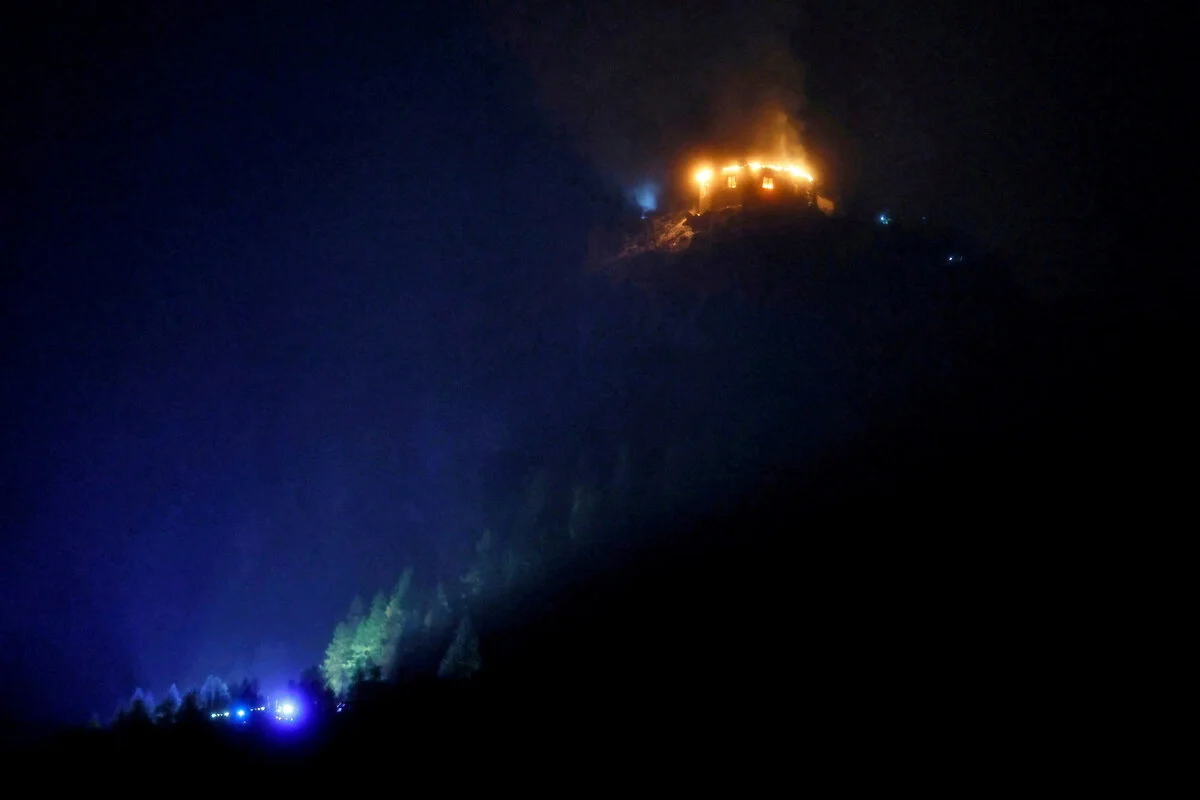
BERCHTESGADEN, Bavaria – A devastating fire has largely destroyed the iconic Kehlsteinhaus, internationally known as the "Eagle’s Nest," a historically charged mountain retreat situated high above Berchtesgaden on the Obersalzberg. The blaze, which erupted on the night leading into Saturday, has prompted a major police investigation, with authorities strongly suspecting arson and confirming the arrest of a suspicious individual. Firefighting efforts at the 1,838-meter-high landmark have been ongoing for hours, grappling with the challenging alpine terrain and the sheer scale of the inferno.
The incident marks a profound blow to a site of immense historical significance and a popular tourist destination, drawing hundreds of thousands of visitors annually. While initial reports indicate no human casualties, the structural damage to the building, a chilling remnant of the Nazi era that has since been transformed into a public restaurant and educational site, is extensive. The criminal police in Traunstein have taken charge of the investigation, seeking to uncover the full circumstances behind this destructive act.
Chronology of a Catastrophe
The alarm was first raised late on Friday evening, around 9:52 PM, when emergency services received reports of a fire at the remote mountain location. Police Headquarters Oberbayern Süd confirmed that the first responders were met with a large-scale fire that had already engulfed significant portions of the Kehlsteinhaus. The isolated and elevated position of the building presented immediate and formidable challenges for the responding fire brigades.
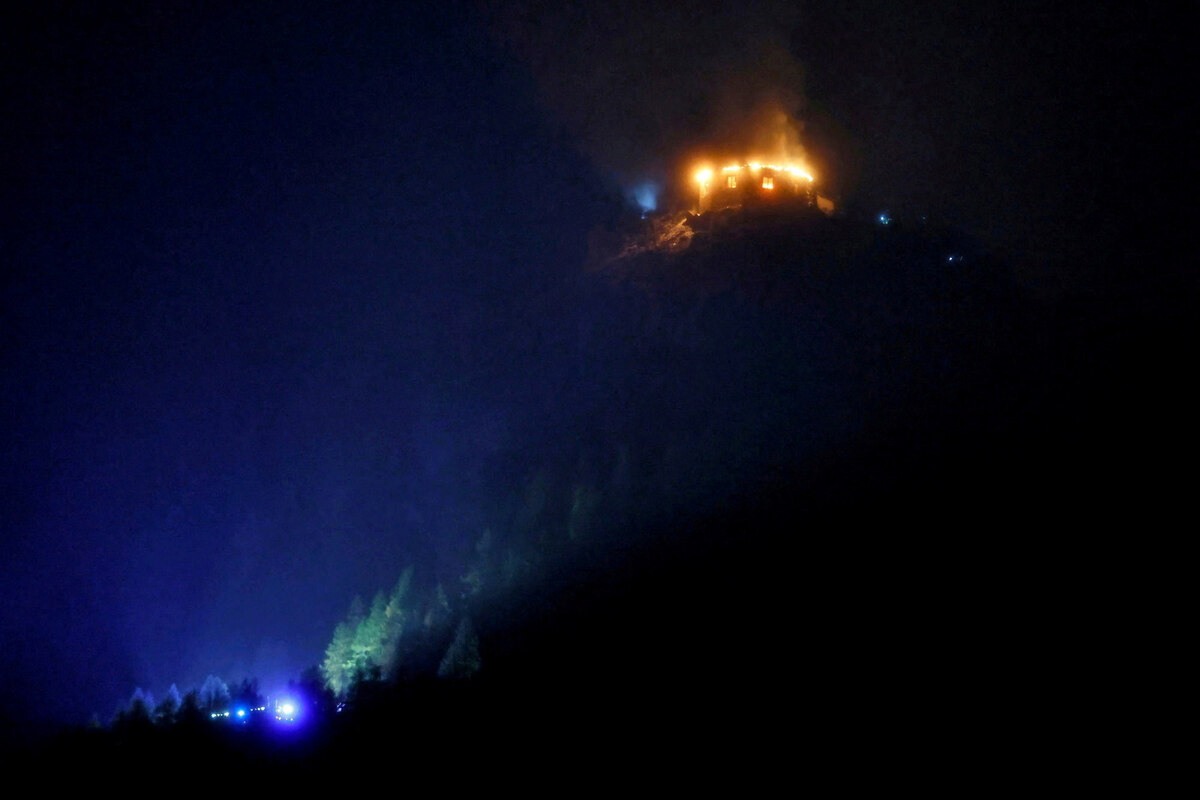
Throughout the night and into Saturday morning, dozens of firefighters from various local departments battled the flames under arduous conditions. Access to the Kehlsteinhaus is typically restricted to specialized buses operating on the Kehlstein line, navigating a steep, winding road and five tunnels over a 20-minute ascent. This logistical hurdle complicated the deployment of heavy equipment, water supply, and personnel. Fire crews had to contend with the altitude, the limited infrastructure, and the inherent dangers of fighting a large structure fire in a remote mountain environment.
As Saturday morning dawned, thick plumes of smoke continued to emanate from the charred remains of the building. The surrounding area was immediately cordoned off by authorities, not only to facilitate firefighting operations but also to secure the potential crime scene. Entry to the affected area remained restricted to emergency personnel equipped with heavy breathing apparatus, underscoring the hazardous conditions and the ongoing challenges in thoroughly assessing the damage and searching the premises. The restaurant, thankfully, had not been open to the public on Friday, a circumstance that likely averted a potentially tragic loss of life.
Investigation Underway: Focus on Arson and a Suspect
From the outset, police have treated the fire as highly suspicious, quickly moving to investigate potential arson. According to information obtained by dpa from investigative circles, authorities in Bavaria believe they have apprehended the likely perpetrator of the large fire on Obersalzberg. There are strong indications that a motorcyclist, who was detained in the vicinity of the Kehlsteinhaus shortly after the fire erupted, is responsible for setting the blaze. The arrest was first reported by the "Bild" newspaper and subsequently confirmed by dpa.
The specific details surrounding the arrest, including the identity of the suspect and any potential motive, have not yet been released to the public as the investigation is in its early stages. The Kriminalpolizei (Criminal Investigation Department) in Traunstein, a regional authority, has assumed control of the case, indicating the seriousness and complexity of the inquiry. Investigators will now focus on forensic analysis of the scene, interviewing the suspect, and piecing together the events that led to the devastating fire. The remote location and the extensive damage caused by the fire are expected to make the investigative process particularly challenging, requiring meticulous work to gather evidence and establish a clear timeline.

A Symbol of a Dark Past: The Kehlsteinhaus and Obersalzberg
The Kehlsteinhaus is not merely a mountain restaurant; it is a profound historical artifact inextricably linked to one of the darkest chapters in human history. Built between 1937 and 1938, it was commissioned by Martin Bormann, Adolf Hitler’s private secretary, as a 50th birthday gift for the Führer. Perched precariously on a ridge at 1,838 meters, it was intended as a political representation venue, a "Tea House" where Hitler could entertain dignitaries and host informal gatherings away from the public eye.
However, historical records indicate that Hitler himself rarely visited the Kehlsteinhaus, reportedly due to his fear of heights and a general dislike for the high-altitude, exposed location. Instead, it was more frequently used by other members of the Nazi elite, including Bormann, Hermann Göring, and Heinrich Himmler, for relaxation and private parties. It was part of a larger, heavily fortified and restricted complex on the Obersalzberg, which served as Hitler’s southern residence and a key center of Nazi power. This sprawling compound included the Berghof, Hitler’s personal mountain home, and numerous other buildings for the Nazi leadership and their staff.
After World War II, the Obersalzberg complex, including the Kehlsteinhaus, was initially occupied by American forces. The Kehlsteinhaus itself, remarkably, survived the Allied bombings that heavily damaged other parts of the Obersalzberg. In 1952, the Bavarian state government took control of the property and, in a deliberate move to prevent it from becoming a pilgrimage site for neo-Nazis, decided to lease it to a private company to be operated as a mountain restaurant. This transformation aimed to demystify the site, turning it into a publicly accessible attraction that simultaneously offered breathtaking panoramic views of the Bavarian Alps.
Today, the Kehlsteinhaus, often referred to as "Eagle’s Nest" by international visitors, serves as a poignant reminder of Germany’s past. While its primary function is that of a popular tourist restaurant, its historical context is not ignored. Nearby, the "Dokumentation Obersalzberg" museum provides a critical and comprehensive educational exhibition about the history of the Obersalzberg during the Nazi regime, actively confronting visitors with the atrocities committed under Hitler’s rule. This dual approach – tourism and critical historical education – has been a cornerstone of how Germany manages its difficult historical sites. The fire thus impacts not only a scenic viewpoint but also a vital component of this complex process of remembrance and education.

Challenges for Emergency Services and Damage Assessment
The battle against the fire at Kehlsteinhaus was an extraordinary undertaking for the emergency services. The altitude of 1,838 meters (approximately 6,030 feet) means significantly lower atmospheric pressure and often more challenging weather conditions, including stronger winds that can rapidly spread flames. The sheer logistical effort involved in transporting personnel, equipment, and especially water to such a remote and high-lying location is immense. Fire engines and water tenders would have struggled with the steep gradients and narrow mountain roads, necessitating the potential reliance on shuttle systems or even helicopters for water drops, though such details were not immediately confirmed.
The structure of the Kehlsteinhaus itself, originally built with robust stone and timber, would have presented varying degrees of resistance to the fire. However, the intensity of a large blaze can compromise even the sturdiest materials. The police and fire department’s initial assessment that no one was injured is a testament to the fact that the restaurant was closed, preventing human presence at the time of the inferno. However, the subsequent requirement for heavy breathing apparatus for personnel entering the site underscores the presence of toxic fumes and unstable structural elements, making detailed damage assessment a perilous and time-consuming process. The extent of the destruction will require structural engineers to evaluate whether any part of the original building can be salvaged or if a complete demolition and reconstruction would be necessary.
Implications and Future of the Site
The destruction of the Kehlsteinhaus carries significant implications, both for local tourism and for Germany’s ongoing engagement with its historical memory. As a major draw for international visitors, particularly from the United States, the "Eagle’s Nest" generates substantial revenue for the Berchtesgaden region. Its closure, potentially for an extended period, will undoubtedly impact local businesses reliant on tourist traffic.
More profoundly, the fire raises questions about the future of this unique historical site. Will the Kehlsteinhaus be rebuilt to its original specifications, serving again as a restaurant and viewpoint? Or will its charred remains be preserved as a stark reminder of the destructive power of both fire and, metaphorically, the ideology it once represented? Any decision regarding reconstruction or preservation will likely spark public debate, involving historical preservationists, local authorities, and the broader public. The Bavarian state, as the owner, will face a complex choice, balancing economic considerations with the solemn responsibility of maintaining a site of such critical historical importance.

The Zweckverband Bergerlebnis Berchtesgaden (Berchtesgaden Mountain Experience Association), which manages the site, notes that while the Kehlsteinhaus was meant to be a place of political representation during the Nazi era, its actual significance to the regime was "minor." This perspective emphasizes the importance of confronting the myth surrounding such sites. The fire, whether accidental or intentional, has irrevocably altered this landmark, forcing a re-evaluation of its role and presentation.
As the investigations continue and the full extent of the damage becomes clear, the Kehlsteinhaus stands as a somber monument. Its destruction by fire, potentially an act of arson, adds another layer of complexity to a place already burdened with a challenging past, ensuring that its story, now with this latest dramatic chapter, will continue to be told and debated for generations to come. The incident serves as a stark reminder of how historical sites, even those meant to educate and commemorate, remain vulnerable to both natural disaster and human intent.