By Sports Desk | October 24, 2026
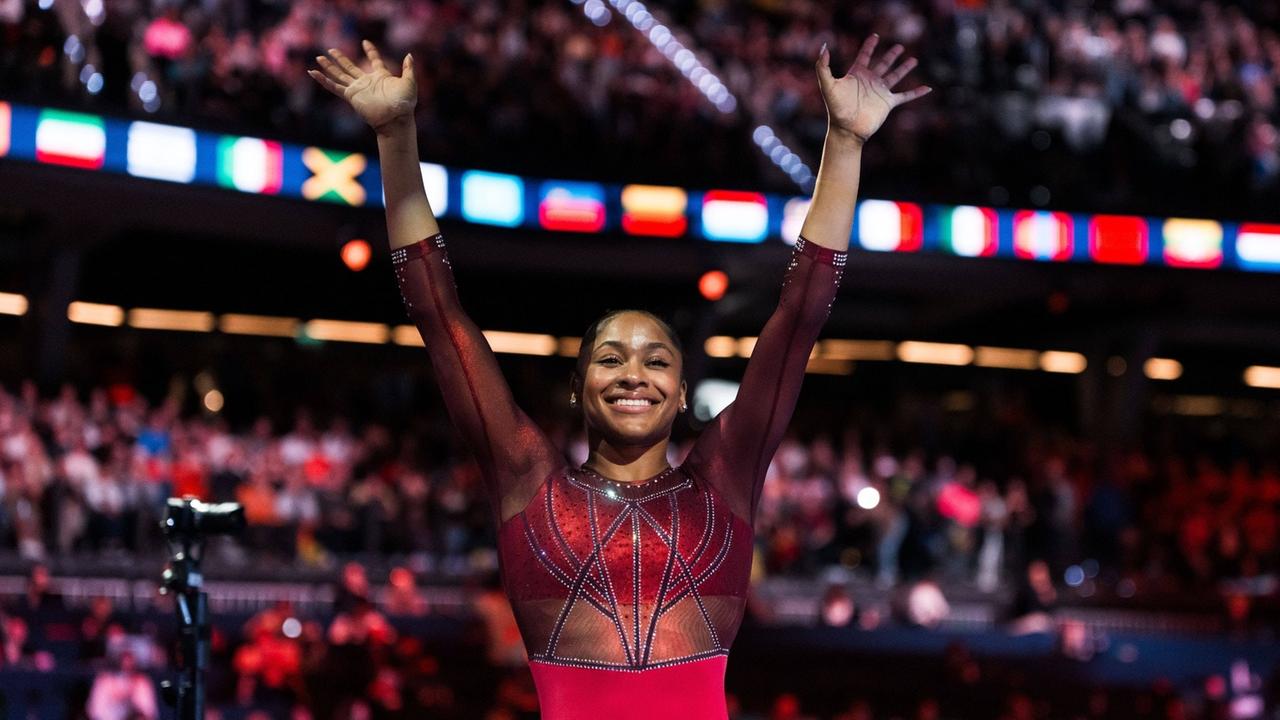
The Ahoy Arena in Rotterdam bore witness to a historic and emotionally charged evening on October 23, 2026, as the World Gymnastics Championships reached its apex in the women’s individual all-around final. In a competition defined by the narrowest of margins and a tragic turn of events for one of the sport’s brightest stars, American gymnast Skye Blakely emerged as the new World Champion, securing her place in the pantheon of gymnastics elite.
For the 21-year-old Blakely, the gold medal represents the culmination of years of rigorous training and mental fortitude. Her victory, underscored by a total score of 55.733, highlighted her consistency across all four apparatuses—vault, uneven bars, balance beam, and floor exercise. However, the narrative of the night was inextricably linked to the heartbreak of Algerian phenom Kaylia Nemour, whose quest to secure the first-ever all-around medal for Africa ended in a agonizingly close fourth-place finish.
The Championship Podium: A Hard-Fought Victory
In the absence of the Russian defending champion, Angelina Melnikova—who was unable to attend the championships due to visa restrictions—the field was wide open for a new generation of gymnasts to stake their claim. Blakely seized the opportunity with both hands, delivering a performance characterized by poise and technical precision.
The silver medal was claimed by Russia’s Ljudmila Roschtschina, who finished with 55.199 points, maintaining a strong presence throughout the rotation. Rounding out the podium was China’s Ke Qinqin, who demonstrated exceptional poise on the beam and bars to secure the bronze with a score of 55.032.
For the German team, the evening was one of reflection. Lea Marie Quaas, the nation’s top prospect in this category, had narrowly missed qualification for the final, serving as the designated reserve. While the German camp was absent from the medal ceremony, the focus has already shifted to the upcoming apparatus finals, where hope remains high.
A Crucial Misstep: The Tragedy of Kaylia Nemour
The most gripping story of the night unfolded around Kaylia Nemour. Entering the competition as the clear favorite and the top qualifier, the 19-year-old carried the expectations of a continent on her shoulders. The atmosphere in the arena was electric as she approached the vault, her first apparatus.
In a moment that left the crowd in stunned silence, disaster struck. Nemour, usually a picture of technical perfection, misjudged her approach to the vault. Failing to connect properly with the springboard, she was forced to abort her intended high-difficulty vault, instead performing a simplified exercise reminiscent of a warm-up drill.
The immediate aftermath was palpable. After landing the simplified vault, Nemour stood on the mat, visibly devastated. The loss of difficulty points was catastrophic; she conceded 1.4 points compared to her qualification performance. Despite her subsequent "heroic" attempt to claw back the deficit—including a world-class performance on the uneven bars, her signature apparatus—the damage had been done. She finished with 54.998 points, missing the bronze medal by a heartbreaking margin of just 0.034 points.
Chronology of the Final
The rotation began with high stakes. With Nemour’s error at the start, the leaderboard fluctuated significantly throughout the evening.
- Rotation 1 (Vault): Blakely established an early lead with a clean, high-difficulty vault. Nemour’s error shifted the momentum, forcing the rest of the field to adjust their strategies.
- Rotation 2 (Uneven Bars): Nemour began her recovery process, delivering the best bars routine of the night. However, the points lost on the vault meant she was climbing a mountain that proved too steep to summit.
- Rotation 3 (Balance Beam): Blakely remained unflappable. While others faltered under the mounting pressure of the final, her ability to remain centered on the beam solidified her position at the top of the standings.
- Rotation 4 (Floor Exercise): The final rotation saw the leaders consolidate their positions. Blakely’s floor routine was not only artistic but technically sound, putting the score out of reach for the chasing pack.
Technical Analysis and Supporting Data
The statistics from the evening highlight the unforgiving nature of the all-around format. The scoring system at these World Championships heavily rewards the "difficulty score" (D-score), and once Nemour’s D-score dropped due to the vault incident, her path to the gold became mathematically improbable without significant errors from the leaders.
Blakely’s average execution score remained high throughout the four rotations, a testament to her stability. Conversely, the density of the field was evidenced by the gap between second and fourth place—a mere 0.201 points separated the silver medalist from Nemour. This razor-thin margin underscores the necessity for absolute perfection in every single element of the routine.
Perspectives from the Arena
The gymnastics community has rallied around Nemour following her narrow miss. Helen Kevric, the 18-year-old German European Champion, expressed her profound respect for the Algerian gymnast during a press briefing. "I have huge respect for her," Kevric said. "She is an extremely intense and powerful athlete, and I find what she is doing for her nation and the sport truly admirable."
Nemour, despite her disappointment, maintained a sense of perspective. Reflecting on the broader impact of her performance, she noted that her presence and that of the Algerian team—which participated in the team competition for the first time—was a victory in itself. "This is already our medal," she remarked, referring to the progress of the five-member squad that placed 20th in the qualifying rounds, a milestone for Algerian gymnastics.
Implications for the Future
The results in Rotterdam set the stage for a compelling future for women’s artistic gymnastics. Skye Blakely’s ascent to the world throne signals a shift in the global balance of power, with the United States reinforcing its depth in the sport.
For Kaylia Nemour, the Rotterdam experience will likely serve as a catalyst for future success. Her ability to nearly reach the podium despite a catastrophic start to the competition demonstrates a level of mental resilience that is rarely seen in athletes of her age. The rivalry between herself and emerging talents like Helen Kevric—who will face off again in the uneven bars final this Saturday—is expected to define the competitive landscape for years to come.
Furthermore, the international gymnastics community continues to grapple with the geopolitical realities of sport. The absence of the Russian delegation, due to the visa hurdles faced by athletes like Angelina Melnikova, has reignited discussions regarding the role of political climate in international competition. While the athletes in the arena focused on their performance, the empty spaces in the draw served as a reminder of the complex world in which these championships take place.
As the championships move toward the individual apparatus finals, the focus shifts to the technical specialists. With the all-around crown now firmly on the head of Skye Blakely, the sport moves forward, enriched by the drama of the last 24 hours and the promise of the rising stars who proved that in gymnastics, the difference between glory and disappointment is measured in mere thousandths of a point.