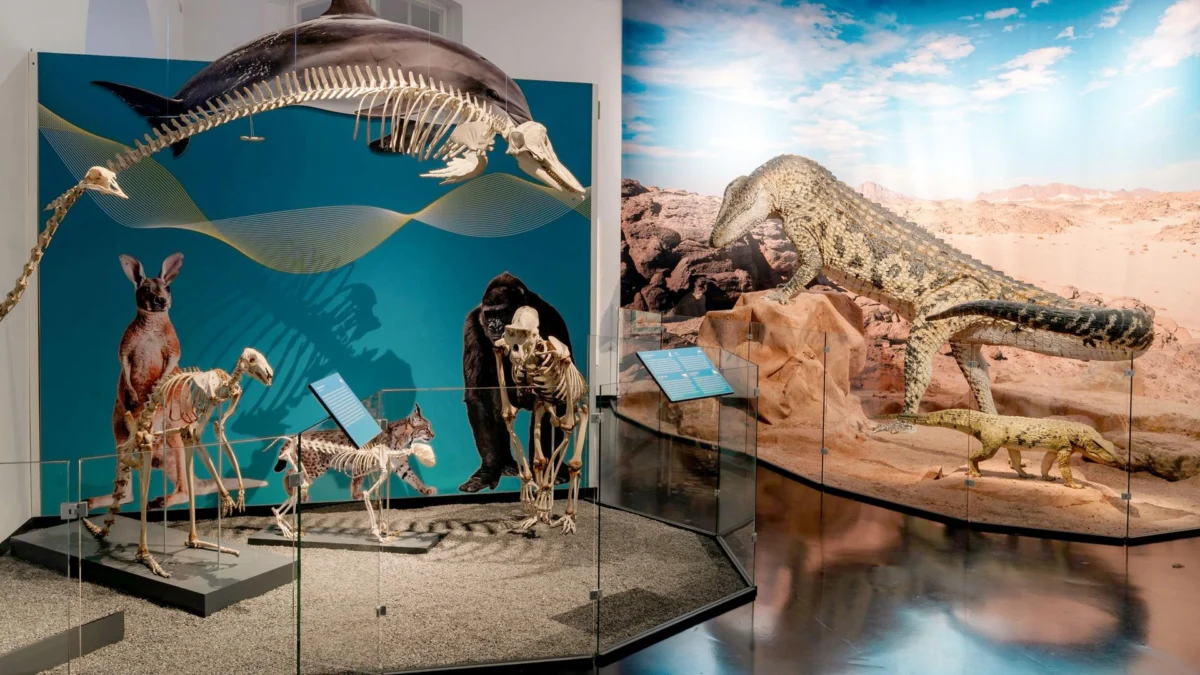
In the heart of Kassel, a new exhibition is challenging our perception of the natural world, stripping away common misconceptions to reveal the raw, evolutionary mechanics of life. Titled "Höher, Schneller, Weiter" (Higher, Faster, Further), the latest special exhibition at the Natural History Museum Kassel invites visitors to step out of their human-centric view of physics and into the complex, often surprising world of animal locomotion.
From the surprising aquatic prowess of the lethargic sloth to the terrestrial origins of the mighty whale, the exhibition serves as a masterclass in adaptation. It is a journey through the mechanics of flight, swimming, and running, framed by the evolutionary pressures that have forced species to innovate or perish.
Main Facts: The Anatomy of Movement
The exhibition is not merely a collection of taxidermy and fossils; it is a narrative exploration of how biology solves the problems of environment and survival. Whether an animal is hunting, fleeing, or engaging in elaborate courtship displays, its method of movement is the result of millions of years of fine-tuning.
The core premise of "Higher, Faster, Further" is to explore the "why" behind the "how." Why does a cheetah possess the specific physiology of a sprinter? Why do certain species favor energy conservation over raw speed? By presenting models, skeletal structures, and stuffed specimens, the museum provides a tangible bridge between abstract evolutionary theory and observable reality.

Key takeaways highlighted in the exhibition include:
- The Evolutionary Reversal: Contrary to popular belief, whales did not always belong to the sea. The exhibition details their descent from Pakicetus, a furry, wolf-like ungulate that once roamed the land.
- The Myth of the Superlative: While the exhibition celebrates speed and height, it emphasizes that "better" in nature does not always mean "faster." The sloth, for instance, is showcased not for its speed, but for its masterful, unexpected swimming ability—an adaptation that serves its specific ecological niche perfectly.
- Physics in Motion: Visitors are encouraged to physically engage with the exhibits, testing their own vertical leap against the jump of a wild boar or their sprinting ability against the biomechanics of a rabbit.
Chronology: From Concept to Exhibit
The creation of an exhibition of this scale is a feat of logistical and intellectual engineering. According to Project Manager Mirella Hofmeister, the process began exactly one year prior to the opening, requiring a multidisciplinary approach that blended scientific research with aesthetic design.
Phase 1: Research and Conceptualization
The initial months were dedicated to rigorous scientific vetting. The team had to curate a narrative that was both scientifically accurate and accessible to the public. "It’s about connections and complexity," Hofmeister notes. The team spent months deciding which species best represented the diversity of locomotion, ensuring that the exhibition would not just list records, but explain the environmental pressures that led to those traits.
Phase 2: Design and Fabrication
Once the narrative arc was established, the focus shifted to the physical construction of the space. This involved the delicate preparation of biological specimens, the crafting of interactive stations, and the design of digital touchscreens that offer deeper dives into the migratory patterns of birds and the acoustics of animal calls.

Phase 3: The Assembly
In September, the museum transitioned into the intensive build phase. The team successfully constructed the entire exhibition in just five weeks—a pace that reflects the exhibition’s own theme of speed and efficiency. The installation was timed to provide a comprehensive look at evolutionary biology for the Kassel community, with the exhibition scheduled to run until April 25, 2027.
Supporting Data: The Mechanics of Evolution
To understand why a creature moves the way it does, one must look at the skeletal and muscular changes that occurred over millennia. The exhibition highlights the transition of limb placement in various species. In many mammals, the migration of legs from the side of the body to a position directly underneath the torso was a critical turning point in evolutionary history, allowing for more efficient, faster, and sustained movement.
The Cheetah’s Savanna Blueprint
The cheetah is the exhibition’s primary case study for specialized evolution. Hofmeister explains the connection clearly: "Why is the cheetah the fastest land animal on Earth? Because it lives in the savanna, where it makes sense to run and hunt prey that is also built for flight." The exhibition uses the cheetah to demonstrate that physical form is a direct reflection of ecological necessity.
The "Pakicetus" Connection
One of the most striking educational segments focuses on the cetacean lineage. By presenting the Pakicetus—a hoofed mammal—the museum visually demonstrates how the transition from land to water required a total overhaul of the mammalian frame. This is intended to force the visitor to reconsider the rigid categories we place animals in today.

Official Responses and Curatorial Vision
Mirella Hofmeister, the driving force behind the exhibition, views the project as a way to trigger long-term learning through wonder. "We want to fulfill expectations, certainly," she says. "But when there is that element of surprise—when you see something entirely new—it remains in the memory much longer than something that is already known."
The curatorial team was conscious of the need to balance spectacle with substance. By incorporating the "Olympic" theme—a nod to the motto Citius, Altius, Fortius (Faster, Higher, Stronger)—the museum taps into a universal human interest in competition, while simultaneously subverting it by showing that in nature, the "weakest" or "slowest" creature is often the one best adapted to its home.
Implications: The Future of Museum Engagement
"Higher, Faster, Further" is part of a broader trend in European museum culture: the shift from passive observation to active participation. By including interactive stations where visitors can measure their own physical capabilities against those of the natural world, the Natural History Museum Kassel is fostering a deeper empathetic connection between the visitor and the animal kingdom.
A Lesson in Adaptation
The broader implication of the exhibition is a lesson in humility. In a modern world defined by human technological speed, the exhibition reminds us that animals have been perfecting their own "technologies" of motion for millions of years. The exhibition suggests that biodiversity is not just a collection of species, but a collection of solutions to the fundamental problems of life.

Long-Term Educational Value
With a duration spanning until 2027, the exhibition is positioned to be a cornerstone of the regional educational curriculum. Its tiered entry pricing—offering free access to children under six and reduced rates for students—ensures that it remains a resource for all levels of society.
As visitors leave the museum, the takeaway is intended to be more than just trivia about how high a kangaroo jumps. It is a newfound awareness of the interconnectedness of form and function. When a child learns that a whale once walked on land, or that a sloth is a swimmer, the walls between "us" and "nature" begin to dissolve.
In an era where the pace of environmental change is outstripping the pace of biological adaptation for many species, "Higher, Faster, Further" offers a timely reflection on the resilience and the fragility of the natural world. It serves as a reminder that every movement, whether the dash of a predator or the slow climb of a sloth, is a victory of evolution that deserves our study, our respect, and our protection.
Visitor Information:
- Exhibition Höher, Schneller, Weiter
- Venue: Natural History Museum, Kassel
- Closing Date: April 25, 2027
- Admissions: Free for children under 6; €3 for students; €5 for adults.