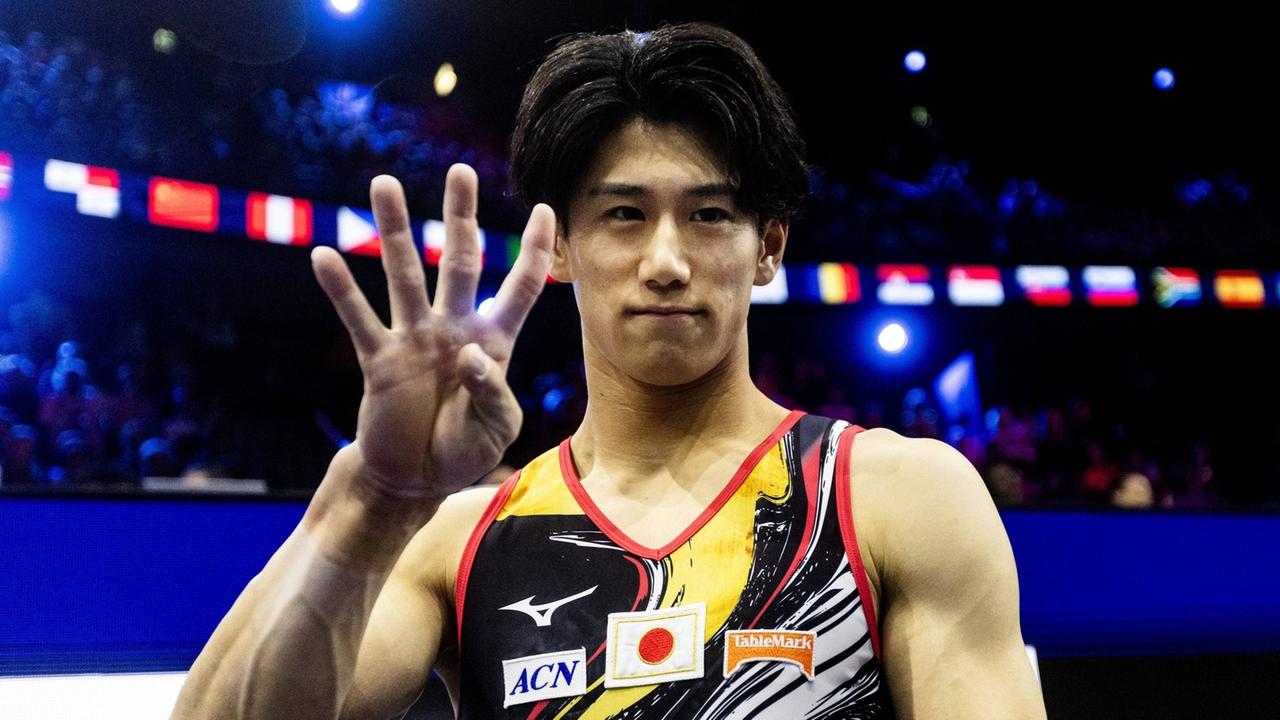
ROTTERDAM – The Ahoy Arena in Rotterdam played host to a display of athletic perfection this week, as Japan’s Daiki Hashimoto solidified his status as the preeminent force in men’s artistic gymnastics. In a display of technical precision and unwavering composure, the 25-year-old superstar secured his fourth consecutive individual all-around world title, further etching his name into the annals of sporting history.
For the German contingent, the tournament proved to be a narrative of mixed emotions: while individual progress was marked by promising performances from young talents like Timo Eder, the broader structural challenges facing the German national team remain a point of concern for federation leadership.
The Reign of the Monarch: Hashimoto’s Dominance
Daiki Hashimoto’s victory in Rotterdam was not merely a win; it was a statement. With a commanding total of 85.998 points, Hashimoto outperformed a field of the world’s elite, navigating the six apparatuses—floor, pommel horse, rings, vault, parallel bars, and horizontal bar—with a blend of grace and high-difficulty execution that has become his trademark.
This latest gold medal in the all-around category puts Hashimoto in direct comparison with his legendary compatriot, Kohei Uchimura. Uchimura, widely considered the greatest gymnast of all time, secured six consecutive world titles during his peak. At 25, Hashimoto is proving that he possesses the longevity and the competitive hunger required to challenge that historic benchmark.
Beyond his individual accolades, Hashimoto had already anchored the Japanese team to a gold medal earlier in the week, reinforcing the notion that Japan remains the tactical and technical gold standard in modern men’s gymnastics. His victory in the all-around serves as the crown jewel of his performance in the Netherlands, confirming his total control over the sport’s most challenging discipline.
Chronology of the Final: A Battle for the Podium
The all-around final in Rotterdam was a grueling test of endurance and focus. While Hashimoto pulled away in the latter half of the competition, the battle for the remaining podium spots was fierce and, at times, surprising.
- The Opening Rounds: The competition began with a flurry of activity on the floor and pommel horse. Hashimoto set an early tempo, scoring high on the floor, while challengers from China and Great Britain struggled to match his consistency.
- The Mid-Competition Pivot: By the third rotation, the focus shifted to the rings. Here, the physical demand of the sport became apparent as several athletes faltered under the pressure of the judges’ stringent execution requirements. Hashimoto maintained a steady buffer, never allowing his lead to slip below a comfortable margin.
- The Decisive Vault and Parallel Bars: The latter stages saw a surge from China’s Yang Haonan, who vaulted his way into contention. However, Hashimoto’s performance on the parallel bars effectively ended the suspense. His ability to stick landings that other athletes barely saved provided the separation required to secure the title.
- The Final Countdown: Heading into the horizontal bar, the crowd in Rotterdam knew the outcome was largely decided. Hashimoto’s routine was a masterclass in rhythm, culminating in a final score that silenced any remaining doubt about his supremacy.
Supporting Data: The Final Standings
The competitive landscape of the 2026 World Championships revealed a shifting hierarchy in global gymnastics.
- Gold: Daiki Hashimoto (JPN) – 85.998
- Silver: Yang Haonan (CHN) – 84.199
- Bronze: Joe Fraser (GBR) – 83.531
The margin of victory for Hashimoto—nearly two full points over the silver medalist—highlights the gap between the current world champion and the rest of the pack. Yang Haonan’s silver medal performance was a surprise to many analysts, marking a significant breakthrough for the Chinese athlete on the world stage. Meanwhile, Joe Fraser’s bronze medal for Great Britain underscored the growing depth of European gymnastics, providing a much-needed morale boost for the home crowd.
The German Perspective: Growth Amidst Difficulty
For Germany, the Rotterdam championships were a study in the contrast between individual development and team stagnation. Timo Eder, the 21-year-old Ludwigsburg native, emerged as the focal point of the German effort.
Eder’s performance in the all-around final was a marked improvement over his qualifying round. By increasing his total score by more than 1.1 points, Eder demonstrated the capacity to perform under the bright lights of a major final. His score of 79.632 earned him 14th place, a respectable result given the world-class field.
Eder’s Technical Breakthrough
Eder’s highlight of the evening was his performance on the vault. Facing the pressure of an international audience, Eder successfully executed a high-difficulty triple twist, a maneuver that has been a point of focus in his training throughout the year.
"I am satisfied; all exercises went through well," Eder noted in a post-event interview with Sportschau. Regarding the new vault, he added: "I was very happy that I committed to it and succeeded. The step toward the triple twist is extremely difficult, both physically and mentally. I feel a great sense of relief."
Official Responses and Strategic Implications
While Timo Eder was rightfully praised for his personal growth, the German national team’s overall performance painted a more somber picture. The team failed to qualify for the team final, finishing 15th overall—a result that has sent shockwaves through the coaching staff.
The Bundestrainer’s Assessment
Bundestrainer Jens Milbradt did not mince words regarding the team’s current standing. While he lauded Eder’s individual stability, he categorized the team’s collective outcome as "sobering."
"Timo has had a very stable competition," Milbradt stated. "Moving from 23rd in the qualifiers to 14th in the final is a huge step up. From that perspective, we can be very satisfied with this evening. However, the team result remains disappointing."
The Road to Los Angeles 2028
The implications of this performance are significant as the federation looks toward the 2028 Olympic Games in Los Angeles. Milbradt highlighted that the stability and execution quality currently exhibited by the German squad are insufficient for Olympic-level contention.
"We have to be honest with ourselves," Milbradt added. "The level of the world’s elite is pulling away. If we want to participate in the team event in Los Angeles, we need to significantly improve our execution scores and our overall consistency. We are currently not where we need to be."
The challenge for the German federation now is two-fold: supporting the development of individual talents like Eder while implementing a more rigorous training structure to elevate the performance of the squad as a whole. The reliance on individual peaks is not a sustainable model for team qualification.
Looking Ahead: The Future of the Sport
As the dust settles in Rotterdam, the gymnastics world is left to ponder the next chapter of the sport. Daiki Hashimoto shows no signs of slowing down, yet the emergence of athletes like Yang Haonan suggests that the landscape could shift as we approach the next Olympic cycle.
For Germany, the path forward is clear but arduous. The transition from a team in decline to one capable of competing with the giants of Japan and China will require a fundamental reassessment of their training methodologies and a renewed commitment to the technical foundations that define modern gymnastics.
The 2026 World Championships in Rotterdam will be remembered as the moment Hashimoto solidified his legend, but for the German team, it will serve as a definitive benchmark—a baseline from which they must build, or risk being left behind in the race for Olympic glory.