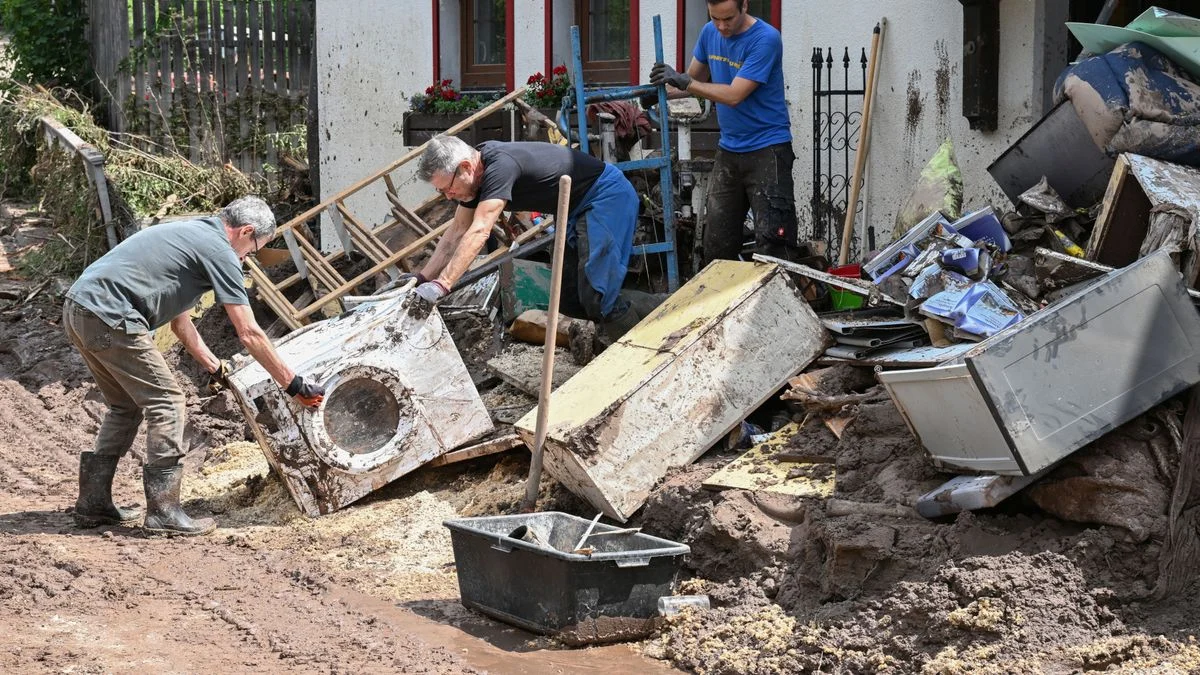
Berlin – For decades, the implicit social contract in Germany has been clear: when extreme weather strikes, the state steps in to mitigate the financial fallout for citizens. However, in the face of accelerating climate change and increasingly frequent natural catastrophes—from the catastrophic Ahrtal floods of 2021 to escalating storm and wildfire risks—the federal government is preparing to rewrite the rules.
A new legislative proposal, spearheaded by Justice Minister Stefanie Hubig and Finance Minister Lars Klingbeil (both SPD), signals a paradigm shift. The government is drafting plans for a mandatory elementar-damage insurance (Elementarschadenversicherung) for all residential property owners, effectively ending the era of reliance on emergency government aid.
The Core Proposal: A Mandatory Safety Net
The draft legislation, currently circulating within the ministries, aims to integrate coverage for natural hazards—such as flooding, flash floods, landslides, and earthquakes—directly into residential building insurance policies.
Under the current system, standard residential building insurance covers risks like fire, tap water damage, and storm/hail. However, "elemental" hazards are typically excluded or require a costly, voluntary add-on. Consequently, more than 40 percent of German homes remain uninsured against flood and other natural disasters.
Key Provisions of the Draft:
- Automatic Expansion: Existing policies will be automatically extended to include elemental coverage. Should a homeowner fail to opt-out or respond to an insurance provider’s offer, the expanded coverage will kick in automatically after one year.
- The Deductible Models: The government is considering two distinct tiers of coverage. The primary model would cap personal liability for the homeowner at 20,000 euros. A secondary, more affordable "minimum insurance" option is being explored, which would involve higher premiums for the insurer but require the homeowner to cover up to 100,000 euros in damages out-of-pocket.
- Protecting Tenants: To prevent the burden of these new premiums from being passed entirely onto renters, the government is exploring a legal framework to prohibit landlords from shifting the costs of these mandatory insurance premiums onto their tenants.
A Chronology of Crisis and Policy Shift
The push for this legislation did not emerge in a vacuum. It is the result of years of mounting pressure on the German fiscal system and the realization that the "emergency aid" model is unsustainable in the long term.

- 2021 (July): The Ahrtal Turning Point. The catastrophic floods in Western Germany served as a tragic wake-up call. Despite the sheer scale of destruction, insurance penetration in the affected regions remained stagnant. Three years later, only about 42 percent of homes in the hard-hit state of Rhineland-Palatinate possess elemental coverage—a marginal increase from 37 percent prior to the disaster.
- 2022–2025: Rising Climate Volatility. Successive summers of record-breaking heat, combined with localized extreme rainfall, have forced the federal government to confront the rising costs of climate adaptation.
- October 2026: The Legislative Breakthrough. Following internal debate, the SPD-led initiative for a mandatory system reached a critical phase, aiming to harmonize private risk-pooling with national climate resilience strategies.
The Economic Reality: Supporting Data
The financial argument for mandatory insurance rests on the uneven distribution of risk and the high cost of inaction.
Currently, the cost of an elementar-damage add-on ranges between 92 and 200 euros annually for an average home, depending heavily on the region and the specific "risk zone" (Gefahrenklasse). However, these prices are expected to climb as climate modeling becomes more precise.
The Financial Risk Landscape
The insurance industry has long warned that the "socialization of losses"—where the taxpayer covers uninsured victims—is no longer feasible. According to industry insiders, the threat is not just to individual homeowners but to the stability of the broader mortgage market.
- The "Uninsurability" Trap: Experts warn that as specific areas become increasingly vulnerable to wildfires, coastal erosion, or flooding, private insurers may stop offering policies altogether.
- Financial Contagion: If properties become uninsurable, their market value will plummet. Since most homes are financed through bank loans, a massive wave of property devaluation could destabilize the banking sector, echoing the mechanics of the 2008 global financial crisis. By forcing a nationwide risk pool, the government hopes to maintain the insurability of properties that would otherwise be abandoned by the private market.
Official Responses and Industry Skepticism
The reaction from the German Insurance Association (GDV) has been one of cautious, if measured, skepticism. While the industry supports the goal of broader coverage, they argue that insurance alone is not a panacea.
Jörg Asmussen, Chief Executive Officer of the GDV, noted: "It is correct to ensure that more buildings are insured against natural hazards. However, a mandatory insurance policy does not prevent a single drop of rain or a single storm."

The insurance industry’s primary concern is long-term viability. Asmussen emphasizes that for the system to remain affordable over the next two decades, it must be paired with:
- Strict Prevention: Building codes must be updated to mandate flood-resistant construction in high-risk zones.
- State Reinsurance: For extreme, "black swan" events that exceed the industry’s capacity to pay out, the government must act as a backstop—a "reinsurer of last resort"—as outlined in the current coalition agreement.
Implications: A New Era for Homeowners
If passed, this legislation will fundamentally alter the relationship between the German citizen, the property market, and the state.
For the Homeowner:
The most immediate change will be a shift in the monthly budget. Property owners will need to account for the mandatory premium as a fixed cost of ownership, similar to property taxes. While this may feel like an additional financial burden, it removes the existential risk of total financial ruin following a natural disaster.
For the Housing Market:
Property prices will likely reflect the "true" environmental cost of a location. A house in a flood-prone valley will become more expensive to own than one on higher ground, as insurance premiums will be tied to risk exposure. This could lead to a slow migration of investment away from high-risk zones, potentially forcing a restructuring of regional urban planning.
For the State:
The government stands to gain significant fiscal relief. By offloading the cost of disaster recovery onto the insurance market, the federal and state budgets are protected from the unpredictable, multi-billion-euro outlays that have characterized recent years. However, this comes at the cost of political leverage; the government will no longer be the primary benefactor to disaster victims, which may change the public’s perception of the state’s role in times of crisis.

Conclusion: The Path Forward
As the draft moves toward the parliamentary debate phase, the central challenge remains balancing affordability with the necessity of risk coverage. The government’s proposal to potentially subsidize or create a "minimum insurance" tier acknowledges that low-income homeowners should not be forced out of their properties by rising premiums.
The debate is no longer about if the state should help, but how the market can be structured to handle the inevitable reality of a changing climate. Whether this mandatory insurance will succeed in insulating the German economy from the ravages of nature remains to be seen, but one thing is certain: the era of relying solely on the state to clean up after the storm is drawing to a close.