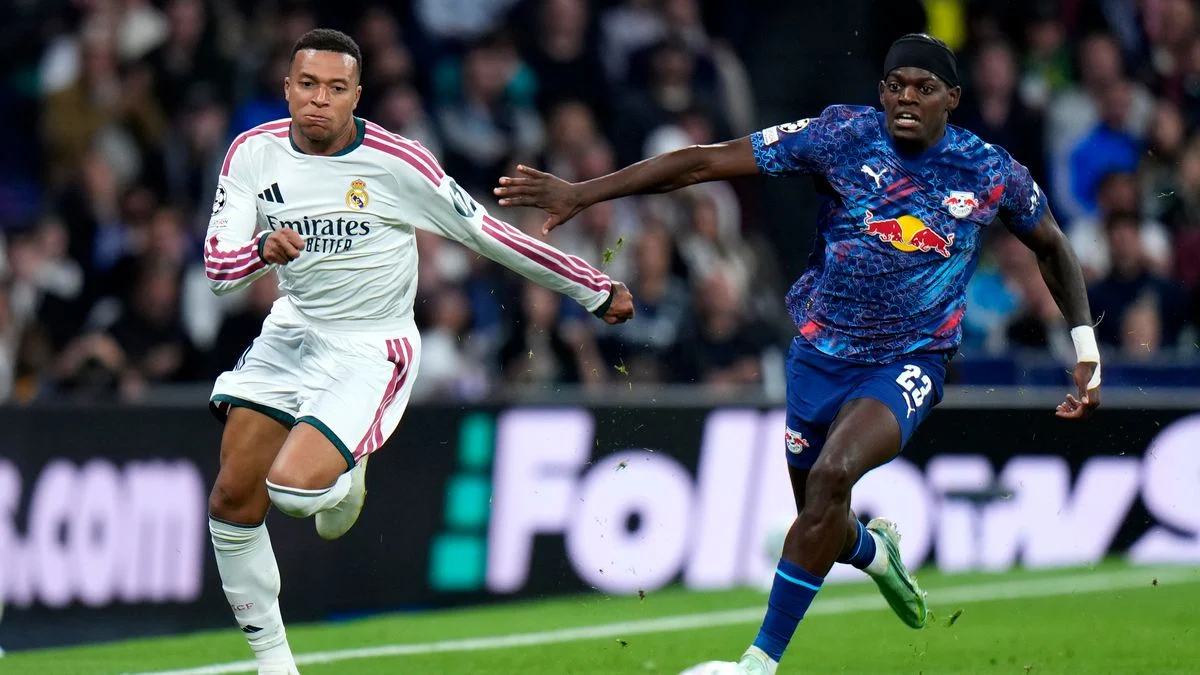
The hallowed turf of the Estadio Santiago Bernabéu served as the stage for a compelling Champions League clash between European royalty and a determined RB Leipzig side looking to salvage their reputation. In a match that encapsulated both the promise of tactical bravery and the ruthless clinical nature of elite football, Real Madrid emerged as 4:1 victors, handing Martin Demichelis’ men a reality check that was as much about individual brilliance as it was about defensive fragility.
For RB Leipzig, the evening began with a defiant intent to put the memory of their 1:6 humiliation in Munich behind them. Yet, by the time the final whistle blew before 80,000 spectators, the scoreline served as a sobering reminder of the gulf that remains between the Bundesliga outfit and the current masters of the European game.
Chronology of the Conflict: From Optimism to Collapse
A Bold Opening Stanza
The narrative of the match did not reflect the lopsided final score in the opening twenty minutes. Under the tactical guidance of Martin Demichelis, Leipzig approached the contest with a high-pressing intensity that visibly unsettled Real Madrid’s rhythm. The visitors were compact, aggressive, and clearly hungry to silence the skeptics.
As early as the 7th minute, Romulo broke through the Madrid defensive line, only to be neutralized by a robust—and arguably controversial—shoulder check from Antonio Rüdiger. The referee’s decision to wave play on was the first indication that this would be a night where Leipzig would need to be physically and mentally tougher than their hosts.
The pivotal moment of the first half arrived in the 28th minute. A perfectly weighted through-ball found Romulo in acres of space. With only Thibaut Courtois to beat, it seemed the script was destined for an upset. However, the Belgian shot-stopper produced a world-class reflex save, a moment of individual brilliance that arguably prevented a complete shift in the momentum of the tie.
The Turning Point: Silva Breaks the Deadlock
Real Madrid’s patience, a hallmark of their Champions League pedigree, eventually bore fruit. As the clock ticked toward the interval, the pressure from Vinícius Júnior and Kylian Mbappé became suffocating. The RB Leipzig defense, which had held firm for 44 minutes, finally buckled.
A chaotic sequence saw RB keeper Marteen Vandevoordt forced into a double-save, only for the ball to spill into the path of Bernardo Silva. Silva, clinical as ever, slotted home the opener. Despite a "monster save" from Vandevoordt against Vinícius just before the whistle to keep the deficit at a single goal, the psychological damage was done.
The Second-Half Avalanche
If the first half was a tactical struggle, the second was an exhibition of speed and clinical finishing. Within seven minutes of the restart, Real Madrid doubled their lead. Kylian Mbappé, acting as the orchestrator, rose to head a cross against the grain of Vandevoordt’s movement. The ball fell perfectly for Arda Güler, who tapped it into an empty net.
The final ten minutes descended into a flurry of activity. Mbappé finally added his name to the scoresheet in the 82nd minute, essentially putting the game to bed at 3:0. While Tidiam Gomis managed a consolation goal for the Germans in the 85th minute, the evening’s final sting came from an unlikely source: former Leipzig player Yan Diomande, who curled in a spectacular effort to cement the 4:1 final score.
Tactical Breakdown: Where the Game Was Won and Lost
The Demichelis Dilemma
Martin Demichelis arrived in Madrid knowing that his defensive structure was under immense scrutiny following the Munich debacle. In this match, he opted for a high-line approach that aimed to compress the midfield and stifle the supply to Mbappé and Vinícius.
For 40 minutes, it worked. The defensive discipline displayed by the Leipzig backline was significantly improved compared to their domestic form. However, the lack of a "Plan B" became apparent once the first goal was conceded. As Leipzig pushed players forward in search of an equalizer, the gaps at the back widened, leaving their central defenders isolated against the sheer pace of the Madrid frontline.
The Madrid Machine
Carlo Ancelotti’s side demonstrated exactly why they are perennial favorites for the competition. They did not need to dominate possession to dominate the game. Instead, they relied on:
- Transition Speed: When Leipzig lost the ball, Madrid countered with lethal precision.
- Individual Quality: The ability of players like Mbappé and Silva to find half-yards of space in a crowded box proved the difference between a goalless draw and a four-goal haul.
- Goalkeeping Security: Thibaut Courtois remains the bedrock of this team. His save in the 28th minute was the match’s "sliding doors" moment.
Supporting Data and Statistical Overview
The match statistics paint a picture of a game that was closer than the score suggests in terms of opportunity, but miles apart in terms of execution.
| Metric | Real Madrid | RB Leipzig |
|---|---|---|
| Goals | 4 | 1 |
| Expected Goals (xG) | 2.8 | 1.2 |
| Shots on Target | 9 | 4 |
| Possession | 58% | 42% |
| Successful Tackles | 14 | 19 |
The data confirms that while Leipzig fought hard—evidenced by their tackle success rate—they were simply outclassed in the final third. Real Madrid’s efficiency in front of goal remains their most potent weapon.
The Broader Landscape: A Busy Night in Europe
The Champions League fixtures provided a flurry of results that further complicate the league phase standings. Elsewhere, the drama was palpable:
- Bayern Munich vs. Arsenal (2:2): A high-octane draw that proved both sides have defensive vulnerabilities despite their attacking prowess.
- Lille OSC vs. Galatasaray (2:4): An entertaining shootout that highlighted Galatasaray’s resurgence in European competition.
- Aston Villa vs. Viking Stavanger (3:1): Villa continues their impressive form, signaling their intent to be a dark horse in the tournament.
- Inter Mailand vs. Shakhtar Donetsk (1:0): A gritty, professional win for the Italians, typical of their disciplined European approach.
Of particular note for followers of German football, Cesc Fàbregas’ side (currently featuring former Hertha Berlin defender Marc-Oliver Kempf) continues to thrive, sitting comfortably on six points after three matchdays. Their tactical consistency contrasts sharply with the volatility currently seen at RB Leipzig.
Implications: What Lies Ahead for Leipzig?
The defeat in Madrid leaves RB Leipzig at a critical juncture. While the loss was expected against a side of Madrid’s caliber, the manner of the collapse in the final ten minutes will concern the coaching staff.
For the Manager
Martin Demichelis is under immense pressure to find consistency. The "two faces" of the team—one that competes at the highest level for periods and another that crumbles under pressure—must be reconciled if Leipzig is to progress from the league phase. The reliance on young players like Romulo and Gomis is a positive, but they lack the experience to navigate the closing stages of high-stakes European ties.
For the Club
The financial and prestige implications of these results are significant. With the new Champions League format rewarding consistency across eight games, Leipzig cannot afford to drop points in their upcoming fixtures against mid-tier opponents. The focus must now shift to shoring up the defense, potentially in the upcoming transfer window, as the current squad depth appears insufficient to cope with injuries and the physical demands of playing twice a week at this level.
As the squad heads back to Germany, they do so with the knowledge that they can play with the best, but they currently lack the "killer instinct" that turns brave starts into famous victories. The journey in Europe continues, but the margin for error has now effectively vanished.