By Financial News Desk
The exuberance that has defined the global stock markets for the better part of the last eighteen months is currently facing a stern reality check. At the heart of the latest market turbulence—which has seen the Dow Jones, S&P 500, and Nasdaq endure significant selling pressure—is a profound reassessment of the Artificial Intelligence (AI) investment thesis. As investors digest a week of heavy losses, particularly among semiconductor giants and tech-heavy indices, the narrative is shifting from unbridled optimism to cautious skepticism.
With more than a trillion dollars in market value erased from US chip companies in just a few days, market participants are asking a fundamental question: Is this merely a temporary consolidation after an overheated run, or is the "AI bubble" finally beginning to deflate?

The Core Conflict: Scaling Expectations vs. Real-World Revenue
The central tension driving the current sell-off is the discrepancy between the massive capital expenditures (CapEx) currently being funneled into AI infrastructure and the tangible, profit-generating revenue that companies are actually seeing.
For months, the stock market has been fueled by the "pick-and-shovel" narrative—the idea that regardless of which AI applications succeed, the companies providing the hardware (GPUs, high-performance processors, and advanced memory) would remain winners. However, as the latest earnings cycle progresses, that consensus has fractured.
The Problem of Diminishing Returns
Analysts are increasingly worried that the hyper-scale cloud providers—such as Microsoft, Google, and Amazon—are spending billions on AI hardware without a clear roadmap for monetization. If these massive data center investments do not translate into significant enterprise productivity gains or subscription growth within the next few quarters, the demand for high-end chips could plummet.
Furthermore, there is a growing fear of "stranded assets." If the current generation of AI-specialized chips becomes obsolete or insufficient due to rapid technological iteration, the massive investments in hardware could result in significant, multi-billion-dollar write-downs, further weighing on corporate balance sheets.
A Chronology of the Recent Sell-Off
The current downward trajectory did not happen in a vacuum. It is the result of a compounding series of events that began at the start of the week and accelerated through Thursday.
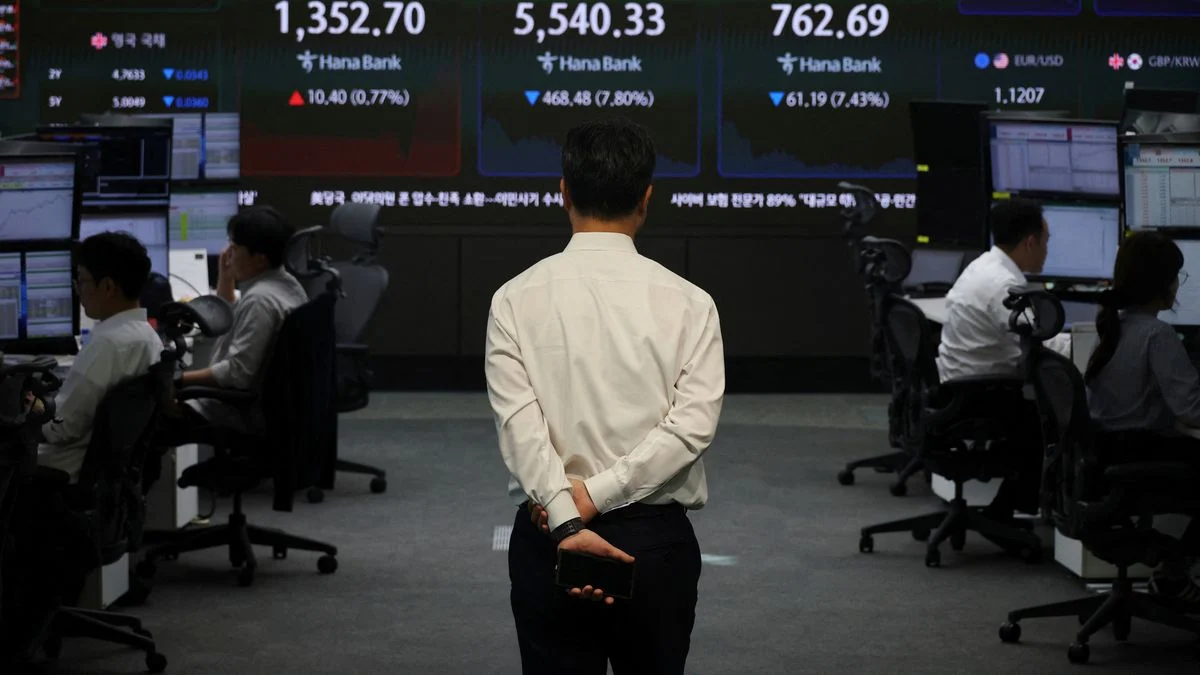
- Monday: The Initial Shock: Global markets were rattled by a confluence of poor manufacturing data from the United States and underwhelming labor market reports. This triggered a widespread "risk-off" sentiment, with the Nikkei in Japan suffering its worst day since 1987, which rippled across the Pacific to Wall Street.
- Tuesday: The Tech Contagion: While initial losses were broad-based, Tuesday saw the focus shift sharply to the semiconductor sector. Concerns over the long-term sustainability of AI-related hardware demand led to a sharp rotation out of growth stocks.
- Wednesday: The Fed’s Stance: Market participants held their breath for clarity on interest rates. While the Federal Reserve maintained its current trajectory, the combination of stubborn inflation data and signals that rate cuts might be delayed or less aggressive than anticipated kept bond yields high. High interest rates are the enemy of growth-oriented tech stocks, as they increase the cost of capital for future expansion.
- Thursday: Deepening Losses: By Thursday, the selling pressure was institutional. Investors began abandoning positions in major chipmakers, leading to the cumulative loss of over $1 trillion in market capitalization across the semiconductor industry.
Supporting Data: By the Numbers
To understand the magnitude of this correction, one must look at the data provided by financial analysts and tracking services like Bloomberg.
The Trillion-Dollar Wipeout
The semiconductor sector, which had been the primary engine of the S&P 500’s record-breaking performance in early 2024, has seen a total evaporation of over $1 trillion in valuation within just seven trading days. This represents a massive withdrawal of liquidity from the sector that has defined the post-pandemic recovery.
The Inflation Factor
The consumer price index (CPI) and producer price index (PPI) data released in conjunction with these market moves indicate that inflation is proving to be "sticky." This has forced bond yields upward. When the risk-free rate (typically represented by the 10-year Treasury yield) rises, the discounted present value of future earnings for growth stocks decreases. Because tech valuations are predicated on long-term growth, the sudden rise in interest rates has caused an automatic and mechanical re-rating of these companies’ share prices.
The View from the Street: Official Responses and Expert Analysis
The reaction from the investment community has been split between those who view this as a healthy "cooling off" period and those who fear structural weakness.

Institutional Perspective
"The market is moving from a phase of ‘AI excitement’ to a phase of ‘AI execution,’" says one prominent hedge fund analyst. "For the last year, you could buy anything with an AI tag and see the stock price rise. Now, the market is demanding to see the receipts—actual revenue, actual margin expansion, and clear ROI on these hardware investments."
The "Higher-for-Longer" Reality
Central bank watchers note that the Federal Reserve is currently trapped between two competing mandates. On one hand, they need to cool inflation that refuses to drop to the 2% target. On the other, they are aware that the cooling labor market could signal a recession. The market’s current volatility is a direct response to this uncertainty. If the Fed keeps rates high, companies will struggle to finance the massive capital investments required for the next wave of AI development.
Structural Implications: What Happens Next?
The market is currently entering a period of "price discovery." When euphoria gives way to fear, the pendulum often swings too far in the opposite direction.

1. Shift in Portfolio Allocation
We are likely to see a rotation from high-growth tech stocks into value-oriented sectors that are less sensitive to interest rate fluctuations. Utilities, consumer staples, and healthcare are becoming increasingly attractive as defensive plays against a potential economic slowdown.
2. The "Survival of the Fittest" for Tech
Not all tech companies will be treated equally. Those with strong balance sheets, high cash flow, and defensible "moats" in the AI space will likely recover. However, smaller or mid-sized tech firms that relied on cheap debt to fund AI R&D will likely face a liquidity crunch. We may see a wave of consolidation, where industry giants acquire smaller innovators at discounted valuations.
3. The Macroeconomic Cross-Currents
The future of the market rests on three pillars:

- Inflation Control: If inflation continues to surprise on the upside, the Federal Reserve will have no choice but to maintain high interest rates, which will continue to pressure tech multiples.
- Employment Data: If the US labor market shows signs of cracking, it will signal that the economy is heading toward a recession. In such a scenario, even the strongest tech companies will see their valuations compressed.
- AI Monetization: The most important indicator for the next year will be the earnings reports from the "hyperscalers." We need to see that the billions spent on chips are finally turning into software revenue that justifies the cost of the underlying infrastructure.
Conclusion: A Necessary Correction or a Warning Sign?
The current turmoil on the Wall Street stage is a reminder that markets are ultimately governed by the laws of supply, demand, and interest rates. The "AI Gold Rush" was characterized by a belief that the laws of gravity did not apply to tech valuations. This week’s losses serve as a blunt reminder that they do.
While the long-term potential of Artificial Intelligence remains arguably the most transformative technological shift of the 21st century, the path to widespread adoption is never linear. The current correction is not necessarily a signal of the end of the AI era, but rather a maturation process. Investors are moving from the dream of what could be, to the reality of what is.
For the retail investor and the institutional fund manager alike, the coming months will require a shift in strategy. The era of "growth at any price" is being replaced by a more disciplined, value-conscious approach. As the dust settles, the companies that can prove their worth in a high-interest-rate environment will emerge as the true leaders of the next market cycle.

Until then, the markets remain in a state of high sensitivity, watching the bond market and incoming economic data with unprecedented vigilance. The trillion-dollar question remains: how much of this sell-off is a correction of price, and how much is a re-evaluation of the future itself? As we look toward the next quarterly cycle, the answer will define the trajectory of the global economy for years to come.