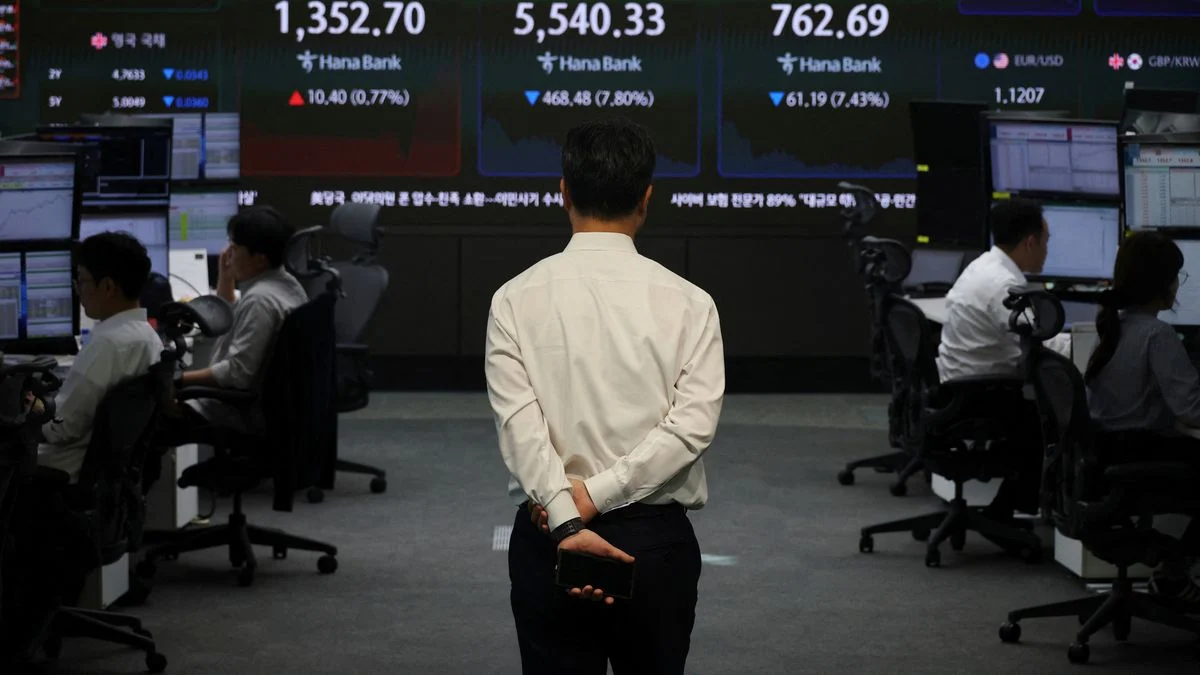
The global financial landscape is currently grappling with a severe bout of volatility as Asian markets concluded a catastrophic trading session, marked by deep, systemic losses. The sell-off, which has sent shockwaves through major indices from Tokyo to Seoul, is primarily driven by an intersection of macroeconomic pressures and a fundamental reassessment of the high-growth technology sector. As the optimism surrounding Artificial Intelligence (AI) faces a reality check, investors are questioning whether the current valuations of tech giants are sustainable in a high-interest-rate environment.
The Core Catalyst: Inflationary Pressures and Monetary Policy
The primary spark for this market turbulence is the recent, unexpectedly strong surge in United States inflation data. This development has fundamentally altered the narrative surrounding the Federal Reserve’s monetary policy trajectory. Where markets had previously priced in a path toward interest rate stability or potential cuts, the sticky nature of US inflation has reignited fears that the Federal Reserve may be forced to keep interest rates elevated for a longer duration—or even hike them further—to combat inflationary pressures.
High interest rates represent a "double-edged sword" for growth-oriented sectors. For companies in the technology and AI space, capital-intensive investments and future earnings are heavily discounted against interest rates. When rates rise, the present value of future cash flows diminishes, and the cost of debt financing increases significantly. This creates a challenging environment for companies that rely on high growth expectations to justify their premium valuations.
Chronology of the Sell-off
The contagion began in the United States, where the tech-heavy Nasdaq index closed down by nearly two percent on Wednesday. This initial weakness served as a harbinger for the Asian trading session, which saw the sentiment rapidly deteriorate.
As markets opened across the Pacific, the impact was immediate and severe. Japan and South Korea, which house some of the world’s most critical semiconductor and electronics manufacturers, bore the brunt of the selling pressure. By the closing bell, key indices in these regions had plummeted, with some recording double-digit intraday volatility and closing between five and 7.5 percent lower.
This was not a uniform retreat; it was a structural rotation out of high-beta tech assets. The speed and volume of the selling indicated a departure from the typical "profit-taking" behavior seen in bullish cycles. Investors moved aggressively to reduce exposure, signaling a potential shift in risk appetite that extends beyond mere portfolio rebalancing.
Data and Sectoral Impact: The AI "Correction"
The focus of the rout was squarely on the AI ecosystem. In Tokyo, companies central to the artificial intelligence supply chain faced a brutal revaluation.
- Chip Equipment Manufacturers: Advantest, a bellwether for the chip manufacturing sector, saw its shares crater by approximately 15 percent. Similarly, Tokyo Electron, another cornerstone of the global semiconductor equipment market, slumped by eight percent.
- The Investment Arms: SoftBank, the investment conglomerate that has poured billions into the AI startup landscape, saw its share price drop by 10 percent, reflecting investor anxiety regarding the viability of its underlying portfolio companies in a tightening credit environment.
These declines are emblematic of a broader skepticism. As Charu Chanana, an investment strategist at Saxo Bank, noted, the market is not necessarily doubting the long-term utility or demand for artificial intelligence. Instead, the current crisis is one of price discovery. "Investors are increasingly asking what price they should pay for this growth when interest rates are high and potentially rising," Chanana observed. The "AI premium"—the massive valuation multiple investors have been willing to pay for exposure to the technology—is being rapidly stripped away.
Expert Analysis: A "True Correction" or Temporary Dip?
The severity of the market reaction has prompted a wave of concern among analysts regarding the long-term stability of the current bull market. Thomas Altmann, a portfolio manager at the asset management firm QC Partners, was explicit in his assessment of the sell-off.
"These are not classic profit-taking moves," Altmann stated. "This is a genuine concern regarding a massive correction. In instances of classic profit-taking, the speed of the sell-off would be significantly lower."
Altmann’s analysis points to a "de-risking" mindset, where institutional investors are preemptively exiting positions to mitigate the risk of a wider market breakdown. The core issue, according to Altmann, is that the high valuations of tech stocks—which were previously justified by the assumption of a "soft landing" and falling interest rates—are now being viewed through the lens of rising costs and a tightening macroeconomic environment.
Furthermore, the failure of positive corporate news to arrest the slide is being viewed as a grim indicator. Andreas Lipkow, a chief analyst at the brokerage CMC Markets, highlighted the performance of the Taiwanese semiconductor giant TSMC. Despite reporting surprisingly strong quarterly results, the company’s stock and the broader sector failed to find a floor.
"When even good news is no longer bought, but instead utilized as an opportunity for exit, that is a clear warning signal for the markets," Lipkow remarked. This behavior suggests that the market has reached a state of "exhaustion," where the price of assets is no longer determined by individual company performance, but by the overwhelming pressure of macroeconomic headwinds.
Macroeconomic Implications and Future Outlook
The current situation poses several critical questions for the global economy. If the "AI trade" continues to unwind, it could trigger a wider liquidity crunch. As tech valuations deflate, the collateral value of many companies decreases, potentially leading to margin calls and further forced liquidations.
1. The Monetary Policy Trap
The Federal Reserve is now in a precarious position. If they maintain high rates to combat inflation, they risk triggering a deeper recession by strangling the growth sectors that have fueled the stock market’s recovery over the last two years. If they pivot too early, they risk a resurgence of inflation that could be even more difficult to contain.
2. The Revaluation of AI
The AI sector is currently undergoing a "valuation reset." While the potential for the technology remains, the transition from "hypothetical growth" to "realized earnings" is being demanded by the market. Companies that cannot demonstrate clear paths to profitability under higher interest rates will likely continue to see their share prices languish.
3. Investor Sentiment and Risk Off
The market is entering a phase of increased sensitivity. Investors are now hyper-focused on macroeconomic indicators—CPI reports, labor market data, and central bank commentary—rather than individual company product launches or partnerships. This transition to a macro-driven market typically results in higher volatility and lower trading volumes, as participants adopt a "wait and see" approach.
4. Global Interconnectedness
The sharp decline in Asian markets underscores the interconnected nature of global finance. Because major players like TSMC, Advantest, and Tokyo Electron are critical nodes in the global supply chain, their performance dictates the health of the entire tech ecosystem. A sustained downturn in Asia will inevitably put downward pressure on Western tech giants, potentially leading to a synchronized global sell-off.
Conclusion: A New Reality for Markets
The events of the past 24 hours have fundamentally altered the narrative of the 2024 trading year. The era of blind optimism regarding high-growth tech stocks appears to be hitting a wall of macroeconomic reality. As interest rates remain the primary variable in the valuation equation, the market’s tolerance for high-priced growth will continue to be tested.
While some market participants maintain a degree of equanimity, suggesting that this is merely a healthy consolidation after a period of irrational exuberance, the signals from the ground are clear. The combination of sticky inflation and the resulting monetary tightening has created a hostile environment for the very stocks that were expected to lead the global economic engine forward.
As we look toward the coming weeks, the focus will remain on the Federal Reserve’s communications and the ability of tech companies to prove their resilience in the face of cooling demand and rising capital costs. For now, the sentiment remains cautious, and the "AI euphoria" has been replaced by a sober, and perhaps more rational, assessment of risk. The market is no longer asking if AI will change the world; it is asking how much that change will cost in a world where capital is no longer free.