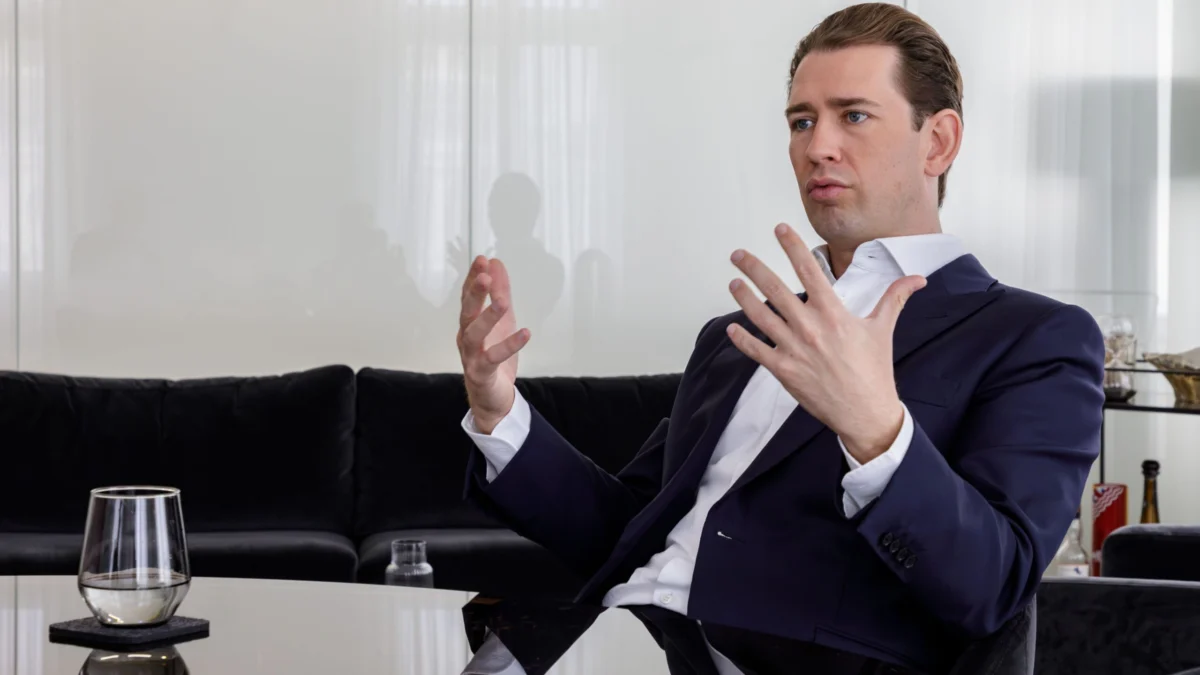
Berlin/Vienna – In a striking intervention that underscores the growing anxieties surrounding Germany’s political and economic trajectory, former Austrian Chancellor Sebastian Kurz has offered a stark assessment of the nation’s current state. Speaking in an interview, Kurz, who successfully led Austria’s conservative ÖVP through multiple election victories, cast a critical eye on Germany’s sister party, the Christian Democratic Union (CDU), and its struggle to maintain its status as a "Volkspartei" (catch-all party). More broadly, Kurz painted a picture of a Germany grappling with its most turbulent political period since World War II, attributing the majority of its challenges to internal, "homemade" policies rather than external pressures.
Kurz’s comments resonate deeply within a European landscape where Germany has long been considered the unwavering anchor of stability and economic might. His diagnosis points to a confluence of factors: a contentious economic policy potentially leading to deindustrialization, a long-overdue modernization of state structures, excessive bureaucracy, and an "ungesteuerte Migration" (uncontrolled migration) that has, in his view, strained social systems without enhancing security. This critique from a prominent conservative figure in a neighboring country offers a potent reflection on the challenges facing Europe’s largest economy and its traditional political forces.
Germany’s Shifting Sands: From Stability Anchor to Turbulence
For decades, Germany embodied economic resilience, political predictability, and a robust social market economy that served as a model for much of Europe. Its post-war reconstruction, driven by industrial prowess and social consensus, cemented its role as the continent’s engine. However, Sebastian Kurz now observes a profound shift. "Deutschland war jahrzehntelang der Stabilitätsanker Europas. Jetzt erleben wir die politisch unruhigste Zeit seit dem Zweiten Weltkrieg," he stated, highlighting a sentiment increasingly shared by both domestic and international observers.
This perceived instability is multifaceted. Politically, the current "Ampel" (traffic light) coalition of Social Democrats (SPD), Greens, and Free Democrats (FDP) has been marked by internal disagreements and fluctuating public approval, struggling to project a unified vision amidst multiple crises. Economically, Germany faces headwinds from inflation, high energy prices, and a global slowdown, prompting questions about its long-term industrial competitiveness. Socially, debates around integration, identity, and the future of the welfare state have become increasingly polarized, reflected in the rise of populist parties like the Alternative for Germany (AfD).
While Kurz acknowledges external factors such as the war in Ukraine, the Iran conflict, and shifts in U.S. foreign policy as contributors to global uncertainty, he emphatically states that "der Großteil ist aus meiner Sicht hausgemacht" – the majority, in his view, is self-inflicted. This distinction is crucial, framing Germany’s current predicaments not merely as reactions to global events but as consequences of its own strategic choices and policy implementation.
The CDU’s Existential Battle: A "Volkspartei" in Peril
At the heart of Kurz’s initial prompt was the struggle of Germany’s CDU to remain a "Volkspartei." Traditionally, a "Volkspartei" like the CDU or SPD aimed to represent a broad spectrum of society, transcending specific class or regional interests to achieve electoral majorities. For decades, the CDU, often in alliance with its Bavarian sister party, the CSU, successfully occupied the political center, adapting to societal changes while maintaining core conservative values. Angela Merkel’s long chancellorship, though marked by significant shifts towards the political center, largely preserved this status.
However, the post-Merkel era has witnessed a significant fragmentation of the German political landscape. The CDU/CSU’s electoral performance in the 2021 federal election marked its worst result since 1949, leading to its ousting from government. Since then, the party has grappled with defining its identity, appealing to younger voters, and regaining lost ground, particularly against the Greens on environmental issues and the AfD on migration and cultural identity.
The concept of "Volkspartei" itself is under immense pressure across Europe. Shifting demographics, increasing individualization, and the rise of issue-specific parties have eroded the broad appeal of traditional political behemoths. Kurz’s own ÖVP, while successful under his leadership, also underwent a significant rebranding to connect with a new generation of voters and address contemporary concerns. His observation of the CDU’s plight, therefore, comes from a place of direct experience with similar challenges. He implicitly asks whether the CDU’s decline is merely an internal party issue or a symptom of the deeper societal and political fissures he identifies within Germany.
Kurz’s "Homemade" Critiques: A Deep Dive into Germany’s Internal Challenges
Sebastian Kurz’s most pointed criticisms are directed at what he perceives as Germany’s self-imposed obstacles, hindering its progress and undermining its historical strengths. These areas represent significant policy debates and challenges that the current German government and previous administrations have faced.
Economic Policy and the Specter of Deindustrialization
One of Kurz’s central criticisms targets "eine Wirtschaftspolitik, die zur Deindustrialisierung geführt hat." Germany’s economic prowess has historically been built on its robust industrial sector, particularly in manufacturing, automotive, and mechanical engineering. The "Made in Germany" label became synonymous with quality and innovation.
Chronology and Context: The debate around deindustrialization is complex. Germany’s "Energiewende" (energy transition), initiated decades ago, aimed at phasing out nuclear power and transitioning to renewables. While laudable in its environmental goals, it has been criticized for leading to some of the highest electricity prices in Europe, especially for industrial consumers. The war in Ukraine further exacerbated this by cutting off cheap Russian gas, a crucial input for many German industries. The energy crisis, coupled with rising labor costs, increased regulatory burdens, and intense global competition (particularly from China), has led to concerns among German businesses.
Supporting Data: Recent reports from the Federation of German Industries (BDI) and chambers of commerce frequently cite high energy costs and bureaucracy as primary deterrents to investment. Surveys indicate a growing number of German companies considering relocating production abroad. Industrial output has shown volatility, and while overall unemployment remains low, specific sectors are feeling the pinch. For instance, the automotive industry faces immense pressure to transition to electric vehicles, requiring massive investments and risking job losses in traditional powertrain manufacturing. The International Monetary Fund (IMF) and other economic bodies have revised Germany’s growth forecasts downwards, with some describing it as the "sick man of Europe" again, a moniker it last held in the early 2000s.
Implications: A sustained trend of deindustrialization would have severe consequences for Germany’s economy, its labor market, and its role as an export nation. It could lead to a decline in innovation, a shrinking tax base, and increased social welfare costs, fundamentally altering the country’s economic structure.
Official Responses/Counter-arguments: The German government acknowledges the challenges but often emphasizes investment in green technologies, renewable energy expansion, and attracting future-oriented industries. They argue that the Energiewende is a long-term investment in sustainability and future competitiveness, and that temporary cost burdens are part of this necessary transformation. Initiatives like the "Future of Industry" dialogue aim to support businesses through subsidies and regulatory adjustments, focusing on hydrogen technology and other green industrial solutions.
Delayed State Modernization and High Bureaucracy
Kurz also points to "eine verschleppte Staatsmodernisierung" and "hohe Bürokratie." This critique resonates widely within Germany, where citizens and businesses frequently complain about slow administrative processes and a perceived lack of digital services.
Chronology and Context: Compared to many other developed nations, Germany has lagged significantly in public sector digitalization. Efforts to modernize have been piecemeal and often hampered by complex federal structures, data protection concerns, and a risk-averse administrative culture. The "Onlinezugangsgesetz" (Online Access Act) aimed to digitize 575 administrative services by the end of 2022, but its implementation has been fraught with delays and incomplete offerings. From registering a business to applying for a building permit, processes often remain paper-based and time-consuming.
Supporting Data: International rankings, such as the UN E-Government Development Index, consistently place Germany behind leading nations. Businesses report significant time and resources spent navigating bureaucratic hurdles, which deters investment and innovation. Surveys by organizations like the German Economic Institute (IW) highlight bureaucracy as a major obstacle for small and medium-sized enterprises (SMEs), the backbone of the German economy. The estimated cost of bureaucracy to the German economy runs into billions of euros annually.
Implications: Excessive bureaucracy stifles innovation, hinders entrepreneurship, and frustrates citizens. It can make Germany a less attractive location for foreign investment and talent, potentially leading to a "brain drain" of skilled professionals and innovative startups to more agile economies. It also undermines trust in government efficiency and responsiveness.
Official Responses/Counter-arguments: The current government has made digitalization a priority, with dedicated ministries and funding programs. They emphasize the complexity of transforming a large, federal administration and the need for robust data security. While acknowledging the delays, they point to ongoing efforts in areas like digital identity, health records, and faster permit processes. However, progress often feels slow, and the gap between political ambition and practical implementation remains significant.
Uncontrolled Migration and Strain on Social Systems
Finally, Kurz asserts that "eine ungesteuerte Migration, die Deutschland nicht sicherer gemacht, sondern auch die Sozialsysteme belastet hat." This is perhaps the most politically charged of his criticisms, echoing concerns that have fueled the rise of the AfD and remain central to public debate.
Chronology and Context: The year 2015 marked a turning point, with Germany accepting over a million refugees, primarily from Syria, Afghanistan, and Iraq. This period, characterized by Chancellor Merkel’s "Wir schaffen das" (We can do this) policy, was followed by further significant migration waves. While Germany’s humanitarian response was globally recognized, the sheer scale presented immense integration challenges in terms of housing, education, language acquisition, and labor market entry.
Supporting Data: Statistics show a substantial increase in individuals receiving social benefits (e.g., Bürgergeld) who have a migration background, particularly among recent arrivals. While many migrants have successfully integrated into the labor market and contribute to the economy, a significant proportion, especially those with lower qualifications or facing language barriers, remain dependent on state support. Reports from the Federal Office for Migration and Refugees (BAMF) and the Federal Statistical Office provide detailed data on integration progress and challenges. Debates also persist around crime statistics, with complex discussions about correlation vs. causation and the need for nuanced interpretation. The strain on public services, from schools to healthcare, particularly in municipalities, is well-documented.
Implications: The perceived "ungesteuerte" (uncontrolled) nature of migration, for Kurz, leads to two critical outcomes: a lack of enhanced security and a burden on social systems. This fuels social tensions, political polarization, and strains public finances. It contributes to the feeling among some citizens that the state is losing control and that their concerns are not being adequately addressed, further weakening trust in traditional parties like the CDU.
Official Responses/Counter-arguments: The German government consistently emphasizes its humanitarian obligations and the long-term benefits of immigration to a country facing demographic decline and skilled labor shortages. They highlight integration programs, language courses, and efforts to streamline asylum processes and facilitate labor market access. While acknowledging challenges, they argue that migration is manageable with proper policies and investment. They also stress that a significant portion of the cost is an investment in human capital and a necessary response to global crises. The government also points to recent efforts to toughen border controls and expedite deportations for those without a right to stay, seeking to balance humanitarianism with pragmatic security concerns.
Official Responses and Diverse Perspectives
While Kurz’s statements offer a critical conservative perspective, they are part of a broader, ongoing debate within Germany and Europe. The German government, led by Chancellor Olaf Scholz (SPD), has frequently articulated its strategies to address these challenges.
Regarding economic policy, the government emphasizes its commitment to a climate-neutral industrial future, investing in renewable energies and green technologies as the path to long-term competitiveness. They highlight efforts to stabilize energy prices and attract foreign direct investment in key sectors. The narrative is one of transformation, not decline, acknowledging difficulties but stressing the opportunity for a new era of sustainable growth.
On state modernization and bureaucracy, the coalition has pledged to accelerate digitalization and administrative reform, though acknowledging the inherent complexities of Germany’s federal system and data protection laws. They argue that significant progress is being made behind the scenes, even if visible changes are slow.
Concerning migration, the government maintains a dual approach: upholding humanitarian principles while also emphasizing the need for orderly processes, effective integration, and a clear distinction between those with a right to stay and those without. Recent legislative changes aim to facilitate skilled immigration while also increasing deportations of failed asylum seekers.
Within the CDU, there is an ongoing internal debate about how to respond to these challenges and reclaim its "Volkspartei" status. While some within the party might privately agree with aspects of Kurz’s critique, particularly on migration, the official party line often involves a more nuanced approach, advocating for stronger economic policies, greater security, and a more controlled migration framework, but within the democratic and rule-of-law traditions. Parties like the Greens would strongly defend the Energiewende as essential, while the AfD would amplify Kurz’s concerns about migration and deindustrialization, albeit with more radical rhetoric.
Broader Implications for Germany and Europe
Sebastian Kurz’s assessment, if accurate, carries profound implications not just for Germany but for the entire European Union.
- Political Fragmentation: The weakening of traditional "Volksparteien" like the CDU, coupled with the rise of populist movements, suggests a continued fragmentation of the political landscape. This makes coalition-building more complex, governance less stable, and policy implementation more challenging, impacting Germany’s ability to act decisively on the domestic and international stage.
- Economic Leadership: A deindustrializing, highly bureaucratic Germany would struggle to maintain its role as Europe’s economic powerhouse. This could weaken the entire Eurozone, reduce Germany’s capacity to fund EU initiatives, and diminish its influence in global economic forums.
- Social Cohesion: Unmanaged migration and strained social systems risk exacerbating social divisions, fueling xenophobia, and undermining the liberal democratic consensus. This has ripple effects across Europe, particularly as other EU member states grapple with similar issues.
- European Stability: A politically turbulent and economically weakened Germany would inevitably undermine the stability of the European Union. As the largest and most influential member state, Germany’s internal health is inextricably linked to the EU’s overall cohesion and its capacity to address pressing global challenges.
Conclusion
Sebastian Kurz’s pointed critique serves as a significant wake-up call, challenging Germany to confront what he identifies as largely "homemade" problems. His observations regarding economic policy, state modernization, bureaucracy, and migration resonate with many citizens and business leaders who perceive a nation struggling to adapt to rapidly changing global realities.
While the German government and other political actors offer their own narratives and counter-arguments, the core issues raised by Kurz—the decline of industrial competitiveness, the digital deficit, and the social and economic integration of migrants—remain central to the country’s future. The CDU’s struggle to regain its footing as a "Volkspartei" is perhaps a microcosm of these broader national challenges.
Germany stands at a critical juncture. Its ability to address these internal structural issues will determine not only its own prosperity and stability but also its continued capacity to serve as a reliable anchor for Europe in an increasingly turbulent world. The debate sparked by Sebastian Kurz’s comments highlights the urgent need for robust policy solutions and a renewed national consensus to navigate these complex waters.