
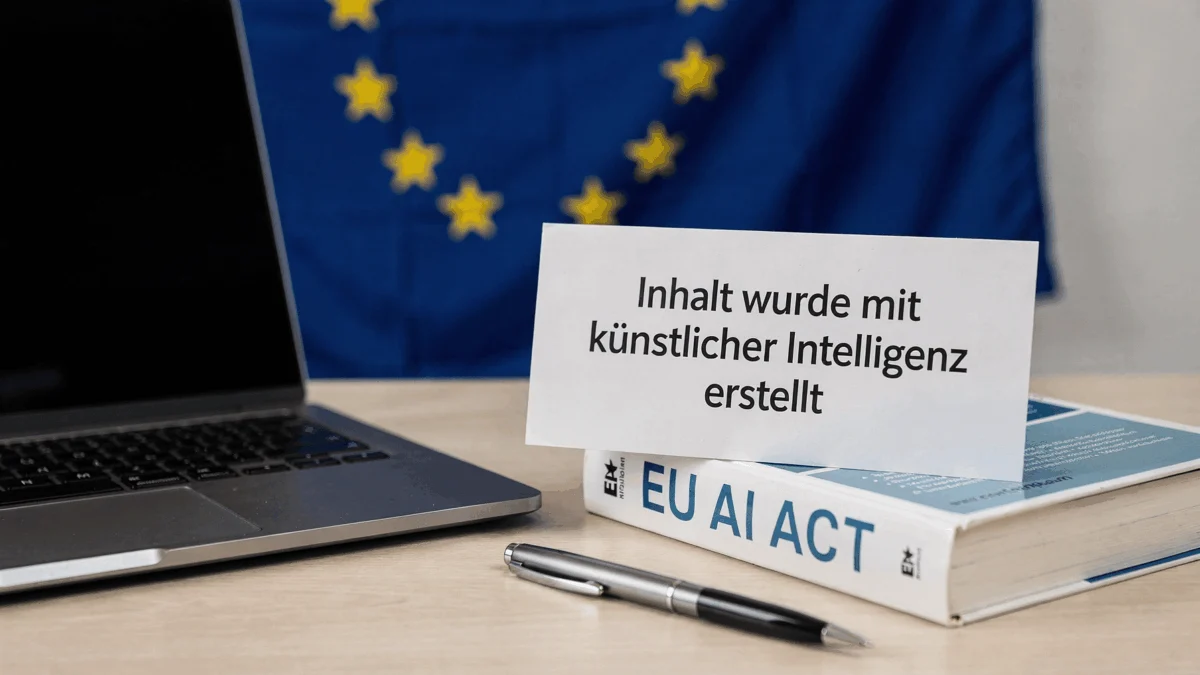
As of this Sunday, the European Union has officially entered a new era of digital accountability. With the latest implementation phase of the landmark Artificial Intelligence Act (AI Act) coming into force, the rules governing how AI-generated content is presented to the public have shifted from voluntary guidelines to strict legal requirements. For businesses, developers, and digital platforms, this marks a fundamental change in how they must interact with their users.
The core of this regulation is simple in theory but complex in practice: Any content—be it text, image, video, or audio—that has been generated or substantially altered by artificial intelligence must be clearly labeled as such. Additionally, users interacting with AI-powered chatbots or virtual assistants must be informed that they are communicating with a machine, not a human.
The Main Facts: What Has Changed?
The European Union’s AI Act is the world’s first comprehensive legislative framework for artificial intelligence. By introducing a risk-based approach, the EU aims to balance innovation with the protection of fundamental human rights and digital transparency.

The new labeling requirements specifically target "generative AI" systems. Under the new provisions:
- Content Transparency: Any synthetic media—deepfakes, AI-generated images, or automated articles—must carry a disclosure that the content is not human-made.
- Bot Disclosure: When a natural person engages with a chatbot, the system must proactively disclose its identity as an AI, ensuring the user is not deceived into thinking they are receiving advice or assistance from a human expert.
- Scope of Application: These rules apply to virtually any commercial entity operating within the EU or targeting EU citizens, regardless of where the company is headquartered.
The goal is to mitigate the risk of disinformation and digital manipulation, particularly in an age where AI models can mimic human creativity and discourse with uncanny precision.
A Chronology: The Path to Enforcement
The journey to these mandates began years ago, but the timeline accelerated rapidly following the mass adoption of generative AI tools like ChatGPT and Midjourney.

- April 2021: The European Commission presents its initial proposal for the AI Act, aimed at creating a "trustworthy" ecosystem.
- December 2023: After intense negotiations, the European Parliament and the Council reach a political agreement on the final text of the AI Act.
- May 2024: The Council of the European Union officially adopts the AI Act, setting the countdown for implementation.
- August 2024: The Act enters into force, marking the start of the phased rollout of various requirements.
- November 2024 (Current): The specific provisions regarding transparency and the mandatory labeling of AI-generated content become active for a wider range of market participants.
This phased approach has allowed industry players a narrow window to adapt their systems, though many are finding that the technical and operational burden of compliance is greater than initially anticipated.
Supporting Data: The Stakes for Business
The consequences of failing to comply with these transparency rules are severe. The EU has structured its penalty framework to be as stringent as the GDPR (General Data Protection Regulation). Companies found in violation of the AI Act face fines of up to €35 million or 7% of their total global annual turnover for the preceding financial year, whichever is higher.
These figures underscore the importance of the "compliance-by-design" philosophy. Beyond the financial risk, the reputational damage of being labeled a "deceptive" company in the EU market could prove even more costly. Industry analysts suggest that firms will need to invest heavily in "watermarking" technologies and metadata management to ensure that AI-generated assets remain tagged throughout their entire lifecycle, from the server to the end-user’s screen.
Official Responses and Regulatory Outlook
European officials have framed these measures as a victory for consumer trust. During a recent briefing, EU Vice President Henna Virkkunen emphasized that this move is a critical step toward creating an AI environment that citizens can navigate without fear of manipulation.
"With the beginning of this implementation, we are taking a significant step toward an AI that people and companies can understand and trust," Virkkunen stated. "Transparency is the bedrock of digital democracy."
However, industry groups have voiced concerns. While trade associations generally support the need for clear rules, many tech leaders argue that the "definitions" remain ambiguous. For instance, at what point does an image "substantially altered" by a simple AI-powered retouching tool require a label? If a marketing team uses a basic AI tool to adjust the lighting of a photo, is that "AI-generated"? Such edge cases are currently creating a legal grey area that many fear will lead to "compliance paralysis."

Navigating the Fallstricke: Practical Challenges
The "Fallstricke" (pitfalls) for companies are numerous. Moving from policy to practice involves several hurdles:
1. The Definition Dilemma
As noted, the distinction between "AI-assisted" and "AI-generated" is blurred. Current guidelines focus on systems that produce content independently, but modern workflows often involve iterative collaboration between humans and machines. Businesses must now audit their entire creative production pipeline to determine which specific outputs meet the threshold for mandatory labeling.
2. Technical Implementation and Watermarking
Adding a visual tag to an image or a disclaimer to a chatbot is straightforward. However, ensuring that these labels persist when content is shared across third-party social media platforms is a massive technical challenge. If a user downloads an AI-generated image and shares it on a platform that strips metadata, who is liable? The original creator, or the user who shared it? The legal consensus is still evolving, but companies are advised to use robust digital watermarking that is resistant to tampering.

3. User Experience (UX) Considerations
There is a fine line between necessary transparency and "disclaimer fatigue." If every interaction or piece of content is cluttered with heavy-handed legal warnings, user engagement may drop. Companies are now tasked with designing elegant, unobtrusive ways to inform users about the AI nature of the content without disrupting the user experience.
Implications: A New Standard for the Global Market
The EU’s AI Act is widely expected to set a "Brussels Effect" standard, much like the GDPR did for data privacy. Companies worldwide that wish to do business in the European Union are already adjusting their global policies to align with these rules, as it is often easier to apply the highest common denominator of compliance across all markets.
In the long term, this regulation will likely spur a new market for "AI provenance" technologies—tools that can cryptographically verify the origin and history of digital files. This could lead to a safer, more transparent internet, though it will undoubtedly raise the barriers to entry for smaller startups that cannot afford the legal and technical overhead required for compliance.

Ultimately, the goal of these regulations is to preserve the integrity of the information ecosystem. As AI becomes increasingly indistinguishable from human output, the ability to discern the "who" and "how" behind the screen will become a fundamental consumer right. For the business world, the era of "move fast and break things" has officially been replaced by an era of "move carefully and document everything."
As the market adjusts to this new reality, one thing is certain: transparency is no longer just a best practice—it is the law. Businesses that embrace this shift will likely find that they build deeper, more resilient relationships with their customers, while those that attempt to bypass these requirements face a precarious future in the world’s most significant regulatory market.