In a development that has sent shockwaves through Germany’s security apparatus, a major incident at Leipzig/Halle Airport has prompted a high-level investigation into what officials are calling a "very serious security breach." Authorities discovered a drone equipped with an improvised explosive device (IED) in the immediate vicinity of a Ukrainian cargo aircraft, leading to a temporary shutdown of the airport and an ongoing federal probe into potential acts of sabotage or terrorism.
The discovery, which occurred during the night from Tuesday to Wednesday, has raised immediate concerns regarding the vulnerability of Germany’s critical infrastructure. With the airport serving as a major logistical hub for NATO and a transit point for military equipment destined for Ukraine, the incident is being viewed not merely as a reckless hobbyist mistake, but as a deliberate and potentially malicious act.

The Incident: A Discovery on the Tarmac
The alarm was raised after a suspicious object was identified on the airport’s "South Runway." Upon inspection, it was confirmed to be a drone carrying an explosive device. The device was professionally handled by specialists from the Federal Police, who managed to neutralize the threat by removing the detonator.
According to preliminary laboratory analyses, the explosive material contained within the package was not a crude or improvised substance. Tests revealed the presence of nitrates, with subsequent analysis confirming the use of PETN (Pentaerythritol tetranitrate) and Semtex—both highly explosive substances typically reserved for military applications. The precision and the nature of the materials involved have led investigators to conclude that this was a sophisticated attempt to cause significant damage.

A Chronology of the Night
The security event unfolded rapidly between the late hours of Tuesday, August 4, and the early hours of Wednesday, August 5, 2026.
- Late Tuesday (August 4): Operations at the airport proceeded under normal conditions until unidentified aerial activity was reported in the vicinity of the cargo apron.
- Early Wednesday (August 5): A drone, identified to be carrying a suspicious package, was discovered near a parked Antonov AN-124, a heavy-lift transport aircraft operated by Ukrainian firms.
- Immediate Response: Airport security alerted the state police, who cordoned off the area. The South Runway was immediately closed to all traffic to facilitate the work of bomb disposal experts.
- Neutralization: Federal Police bomb technicians arrived on the scene and successfully removed the detonator from the IED, rendering the drone safe.
- Secondary Incident: Following the closure of the South Runway, an incoming DHL cargo flight was forced to initiate a go-around procedure. During this maneuver, reports emerged that the aircraft collided with a second, as-yet-unidentified object. The plane was subsequently diverted to Hannover, where inspectors confirmed "slight damage" to the fuselage.
- Morning (August 5): By the morning hours, the North Runway was reopened, allowing commercial passenger traffic to resume, though the South Runway remained closed for forensic investigation.
Official Responses and Political Repercussions
The severity of the situation has drawn immediate attention from the highest levels of the German government. Saxon Interior Minister Armin Schuster (CDU) did not mince words, describing the discovery as a "very serious security incident" that warrants the full attention of the state’s intelligence and counter-terrorism units.
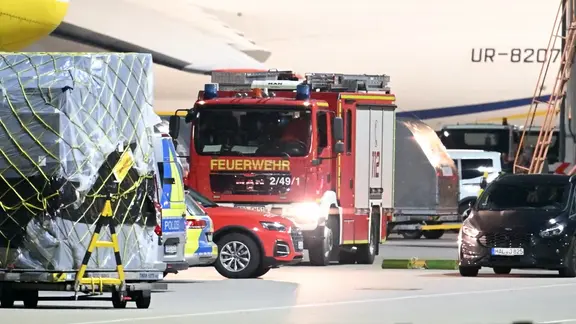
The General Prosecutor’s Office in Dresden, in coordination with the Police Counter-Terrorism and Extremism Defense Center (PTAZ), has officially assumed control of the investigation. They are actively pursuing a political motive, noting that the target—a facility housing Ukrainian cargo planes—suggests a strategic intent.
Leipzig’s Mayor, Burkhard Jung (SPD), emphasized the "new quality" of the threat. "A drone equipped with an explosive device makes it unmistakably clear that our safety is being threatened," Jung stated, calling for a radical re-evaluation of how critical infrastructure, such as major international airports, is protected against modern aerial threats.

Federal Interior Minister Alexander Dobrindt (CSU) cut his vacation short to coordinate with state authorities, underscoring the gravity of the potential breach. A high-level meeting between federal and state security chiefs is currently underway to determine the extent of the security lapse and how such a device was able to penetrate the restricted airspace of one of Germany’s most important airports.
Implications for Critical Infrastructure
The incident has triggered a fierce debate regarding the adequacy of current drone defense systems at German airports. Ralph Beisel, Chief Executive of the German Airports Association (ADV), issued an urgent plea to the federal government to fast-track the installation of advanced anti-drone technology.

"Airports are critical infrastructure and require the highest level of protection," Beisel stated. "The technology to detect and neutralize unauthorized drones exists, but its deployment has been too slow. We need these systems to be fully operational across all major hubs immediately."
Security experts, including those consulted by the ARD broadcasting network, have pointed out that if the drone was indeed functional and capable of detonation, it would represent a historic first for Germany—a public acknowledgment of a successful, or near-successful, aerial sabotage attempt of this nature.

Geopolitical Tensions and Suspicions
The presence of the drone near an Antonov AN-124—a massive aircraft often used for the transport of heavy military equipment—has fueled speculation regarding a foreign state actor. Ukraine’s Ambassador to Germany, Oleksii Makeiev, was quick to suggest that the shadow of Russia looms over the incident.
"I hope the authorities in Germany establish the facts, but who else could it be other than Russia?" Makeiev asked during an interview with the Welt TV news channel. His sentiment was echoed by security analyst Nico Lange, who argued that the incident fits the "pattern of Russian hybrid warfare against Germany." Lange noted that such operations are designed to create fear, disrupt supply chains, and test the resilience of German security protocols.

The Path Forward: Investigation and Public Cooperation
As the investigation intensifies, the State Criminal Police Office (LKA) has established a dedicated hotline and a secure portal for witnesses. Authorities are seeking information from anyone who may have been in the vicinity of the airport between Tuesday afternoon and Wednesday morning. They are specifically interested in reports of suspicious persons, vehicles, or unusual activity near the airport perimeter.
"We are treating this with the utmost priority," said an LKA spokesperson. "Our focus is to determine the point of origin for these devices and to identify the perpetrators who have violated the sanctity of a restricted high-security zone."

The airport, which serves as a vital logistics hub for global trade and a critical supply link for the ongoing war in Ukraine, remains under heavy surveillance. While commercial flights have largely returned to normal, the presence of police and specialized security teams remains heightened.
Conclusion
The events at Leipzig/Halle represent a wake-up call for European security. The use of an explosive-laden drone to target a logistical node—particularly one involved in the defense supply chain for Ukraine—marks a significant escalation in the scope of threats facing Germany. As the federal authorities pore over evidence and the search for those responsible continues, the incident stands as a stark reminder that the front lines of modern hybrid conflict are not just in the air over Eastern Europe, but on the runways and infrastructure of the heart of the continent.

The investigation is expected to be a long and complex process, involving forensic experts, intelligence services, and international cooperation to determine whether this was a singular act of extremist sabotage or a coordinated attempt by a foreign power to undermine German support for Ukraine. For now, the message from Berlin is clear: the era of regarding drones as mere toys at the airport is over, and the protection of critical infrastructure must now be elevated to a paramount national security priority.