By Financial News Desk
Asian stock markets experienced a lackluster start to the trading week, as investors grappled with a convergence of macroeconomic headwinds, geopolitical tensions, and a looming corporate earnings season in the United States. The overall sentiment across the region was one of cautious observation, with major indices showing minimal movement as market participants braced for key economic indicators from Washington.
Main Facts: A Stagnant Start to the Trading Week
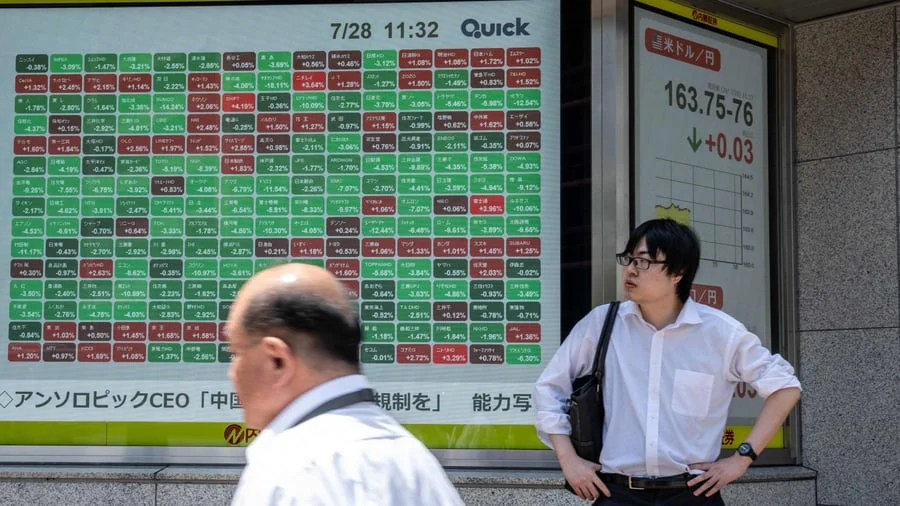
The week commenced with a distinct lack of momentum across Asian exchanges. In China, the Shanghai Stock Exchange remained largely static, hovering at the 3,810-point mark. Similarly, the blue-chip index representing the most significant companies across the Shanghai and Shenzhen exchanges recorded a marginal decline of 0.1 percent, closing at 4,312 points.
The lack of activity was compounded by a holiday in Japan, which left the Tokyo Stock Exchange shuttered for the day, removing one of the primary drivers of regional market liquidity. Across other major Asian hubs, traders maintained a defensive posture, awaiting the release of critical US inflation data expected later in the week. These figures are anticipated to be a pivotal factor in the Federal Reserve’s upcoming interest rate policy decisions, adding a layer of volatility to an already nervous market environment.
Chronology of Market Sentiments
The current market hesitation did not emerge in a vacuum; it is the culmination of several weeks of building pressure:
- Mid-Last Week: Global investors began pivoting away from speculative growth assets as geopolitical tensions in the Middle East and Eastern Europe showed few signs of de-escalation, prompting a "flight to quality."
- Friday Closing: Markets closed on a note of uncertainty as the U.S. labor market data suggested that the economy, while resilient, might keep the Federal Reserve from cutting interest rates as aggressively as the market had initially hoped.
- Monday Morning: Asian markets opened with thin volumes. The absence of Japanese institutional investors allowed for a drift in prices rather than a sustained trend. Traders focused their attention on the impending US Consumer Price Index (CPI) report, which is seen as the next major catalyst for global equity movements.
Supporting Data: The Cost of Capital in the AI Era
A central narrative dominating the current market cycle is the aggressive capital-raising activity by global technology giants. In the spotlight on Monday was the Chinese tech conglomerate Tencent. The company announced plans to issue new debt in both US dollars and offshore yuan to secure fresh liquidity.
This move is not an isolated incident. Across the globe, technology firms are tapping the corporate bond market at an unprecedented rate. The primary driver for this influx of debt is the insatiable requirement for funding to support the massive infrastructure investments needed for Artificial Intelligence (AI) development. From server farm construction to the acquisition of advanced semiconductors, the capital expenditure (CapEx) requirements for AI are reaching historic highs.
However, the market is beginning to show signs of "AI fatigue" regarding balance sheet health. Data from the bond markets suggests that while tech companies are having no trouble finding buyers for their debt, the risk premiums—or spreads—on these bonds are widening. Investors are becoming increasingly concerned about the long-term sustainability of debt-fueled growth.
Official Responses and Expert Analysis
The sentiment among analysts is shifting from blind optimism regarding AI to a more granular analysis of return-on-invested-capital (ROIC). My Bui, an economist at the major wealth management firm AMP, highlighted the growing disconnect between investment and immediate profitability.
"Overall, the wider spreads we are seeing in the corporate bond market indicate that investors are starting to question whether AI revenues can actually keep pace with rising credit costs," Bui stated. "The massive issuance of corporate bonds is not a free lunch; it is a commitment to higher interest expenses that will weigh on balance sheets for years to come."
Market strategists note that while the promise of AI is transformative, the "trough of disillusionment" may be approaching as companies face the reality of high-interest-rate environments. When money was cheap, debt-fueled expansion was a straightforward strategy. In the current environment, where central banks are keeping rates elevated to combat sticky inflation, the hurdle rate for new projects has risen significantly.
Implications for Global Markets
The implications of this trend extend far beyond the technology sector. Several key areas are being closely monitored by institutional investors:
1. The Refinancing Cliff
As companies issue short-term debt to fund long-term AI infrastructure, they are exposing themselves to a "refinancing cliff." If the anticipated productivity gains from AI do not materialize quickly enough, companies may be forced to refinance their debt at even higher rates, leading to significant earnings compression.
2. Geopolitical Risk Premiums
The market is currently pricing in a "geopolitical premium." With trade relations between the US and China remaining fragile, any further escalation in semiconductor export restrictions could render the massive investments currently being made by Chinese tech firms less effective. This adds a layer of systemic risk that is currently difficult to quantify.
3. The Impact of US Inflation Data
The immediate future of the Asian markets is inextricably linked to the US CPI data. If inflation proves to be higher than expected, the resulting surge in US Treasury yields would likely trigger a sell-off in Asian tech stocks, as investors would demand higher yields to compensate for the risk of holding growth-heavy portfolios.
4. Sector Rotation
We are beginning to see a subtle rotation out of pure-play AI hardware stocks and into companies with more stable, cash-generative business models. This shift indicates that the "easy money" phase of the AI trade may be coming to a close, replaced by a more selective, value-oriented approach to investing.
Conclusion: A Period of Reassessment
As the week progresses, the narrative in Asia will likely remain dominated by these three themes: the wait-and-see approach regarding US inflation, the sustainability of corporate debt in the face of rising interest costs, and the geopolitical overhang that continues to stifle risk appetite.
For Tencent and its peers, the ability to successfully navigate the bond market will be a litmus test for the broader tech industry. If they can continue to issue debt at reasonable spreads, it will suggest that the institutional investor community still holds high confidence in the AI roadmap. However, should the spreads continue to widen, it may signal a broader structural shift in how the market values the growth prospects of the technology sector.
Investors are advised to remain cautious, as the convergence of these factors creates an environment where volatility is likely to remain elevated. The current stagnation in Shanghai and other Asian markets is not merely a lack of interest; it is a profound period of reassessment. Market participants are moving away from the speculative frenzy that characterized the early AI boom and are now beginning to demand hard evidence of financial viability. In this new phase, the strength of a company’s balance sheet will be just as important as the ingenuity of its software.
As we look toward the mid-week sessions, all eyes remain fixed on the macro data coming out of the United States. Whether the markets break out of their current range or continue to drift sideways will depend largely on whether the economic data offers the clarity that investors so desperately crave. Until then, the Asian markets will remain in a state of watchful waiting, balancing the immense potential of future technologies against the cold, hard reality of today’s cost of capital.