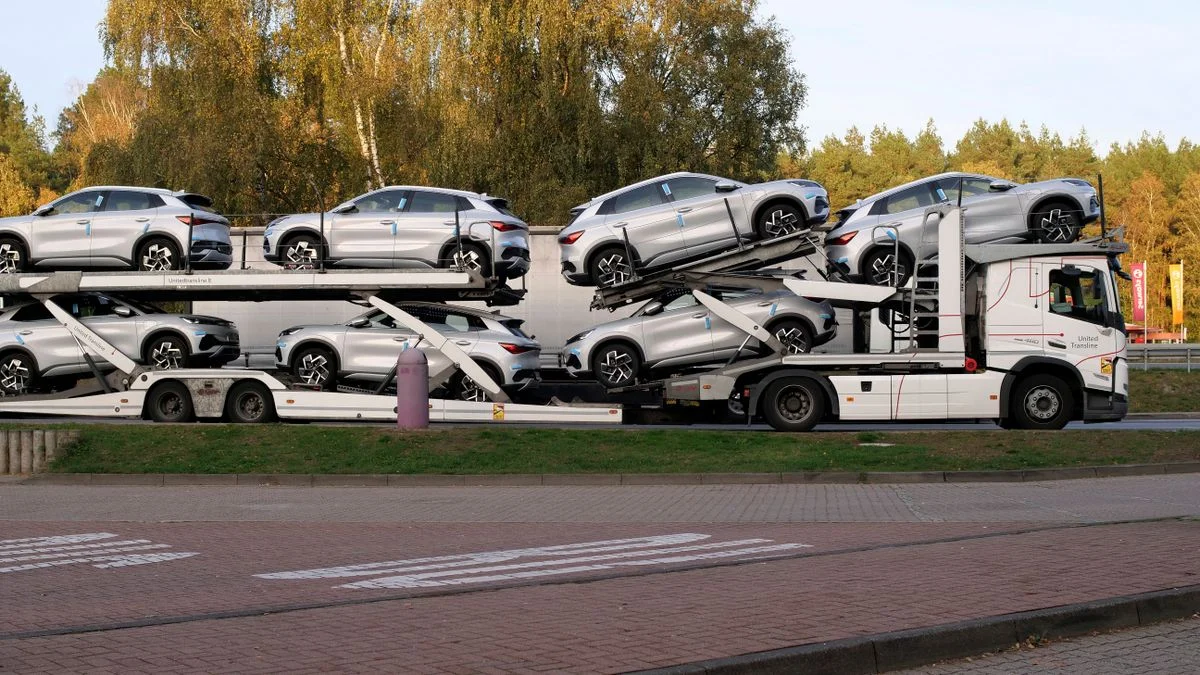
The global automotive industry stands at a critical juncture. As the European Union moves to tighten environmental regulations and accelerate the transition toward electrification, the role of hybrid vehicles—once viewed as a mere "bridge technology"—has become the focal point of a high-stakes geopolitical and economic standoff between Brussels and Beijing.
The recent compromise reached regarding the classification and taxation of hybrid vehicles marks a significant shift in European industrial policy. It is a deal born of necessity, balancing the EU’s aggressive climate goals with the stark reality that its domestic car manufacturers are still struggling to catch up to Chinese dominance in battery supply chains and electric vehicle (EV) production.
Main Facts: The Anatomy of the Compromise
At the heart of the latest regulatory development is a refined approach to the classification of Plug-in Hybrid Electric Vehicles (PHEVs). For years, these vehicles—which combine an internal combustion engine with an electric battery—occupied a gray area in European policy. While they offered lower emissions than traditional gasoline cars, critics argued they were often used in ways that negated their environmental benefits.
The new agreement seeks to standardize the criteria under which these vehicles are manufactured and imported. Key components of the deal include:
- Standardized Emissions Reporting: Stricter mandates on how manufacturers report the real-world fuel consumption of hybrids, moving away from laboratory-controlled testing that often skewed favorable.
- Localized Production Requirements: Incentives for Chinese manufacturers to establish joint ventures or production facilities within the EU, effectively "localizing" the supply chain to circumvent punitive tariffs.
- Technology Transfer Clauses: New agreements ensuring that European firms gain access to Chinese software and battery management systems in exchange for continued market access.
For European carmakers, the deal provides a vital breathing room. It allows them to continue selling profitable hybrid models while they scale up their pure battery-electric (BEV) platforms, which remain expensive to develop and produce at high volumes.
Chronology: A Path to Confrontation and Reconciliation
The road to this compromise was paved with years of trade friction and regulatory uncertainty.
2020–2021: The Rise of the Hybrid. As Europe grappled with the COVID-19 pandemic and the economic slowdown, hybrid vehicles saw a surge in popularity. Consumers were hesitant to commit to full electric vehicles due to "range anxiety" and underdeveloped charging infrastructure.
2022: The Investigation Begins. The European Commission, citing concerns over unfair subsidies and market distortion, launched an in-depth investigation into Chinese EV imports. The investigation was not merely about price; it was about the entire ecosystem of subsidies provided by Beijing to its domestic players like BYD, SAIC, and Geely.
2023: The Threat of Tariffs. As the investigation neared its conclusion, the EU signaled its intent to impose hefty countervailing duties on Chinese-made electric vehicles. Beijing responded with veiled threats of retaliation, targeting European luxury car exports and critical raw materials.
Early 2024: The Diplomatic Pivot. Recognizing that an all-out trade war would damage the European economy as much as the Chinese, high-level diplomatic channels were opened. European trade commissioners traveled to Beijing, seeking a "managed trade" solution rather than a total blockade.
Mid-2024: The Compromise. The final agreement was reached, effectively stalling the most aggressive tariff proposals in favor of a "price commitment" and technical cooperation framework.
Supporting Data: Why Hybrid Vehicles Still Matter
The data suggests that the European consumer is not yet ready to abandon the internal combustion engine entirely. Despite the EU’s 2035 target to phase out CO2-emitting new cars, current market penetration for BEVs has hit a plateau in several key markets, including Germany and Italy.
- Market Share: Hybrids and PHEVs currently account for nearly 25% of the European new-car market, a figure that has remained remarkably resilient despite the push for full electrification.
- Infrastructure Gap: The European Court of Auditors recently released a report noting that the deployment of charging stations in the EU is significantly lagging behind the target of 1 million points by 2025.
- The Cost Factor: The average price of a European BEV remains approximately 30% higher than an equivalent hybrid, keeping the latter as the primary entry point for middle-income buyers.
For the Chinese manufacturers, the compromise allows them to continue exporting high-quality, competitively priced hybrid vehicles that utilize their superior battery integration technology, while the EU gains the time needed to bolster its domestic charging network.
Official Responses: A Divided Consensus
The reaction to the compromise has been predictably polarized.
The European Commission: Officials in Brussels have framed the deal as a "pragmatic success." By avoiding a trade war, the Commission argues it has protected European consumers from immediate price hikes while keeping the pressure on China to adhere to international "level playing field" standards.
The German Automotive Lobby (VDA): Major manufacturers like Volkswagen and Mercedes-Benz have expressed cautious optimism. Their survival relies on the Chinese market, and they have lobbied heavily against punitive tariffs that would trigger retaliatory measures from Beijing. For them, this deal is the lesser of two evils.
Environmental NGOs: Organizations such as Transport & Environment have been highly critical. They argue that by extending the relevance of hybrids, the EU is effectively subsidizing the "fossil fuel status quo" and delaying the inevitable shift to zero-emission mobility.
Beijing’s Ministry of Commerce: The Chinese perspective remains guarded. While officials welcomed the removal of immediate trade barriers, they have publicly warned that the EU’s "protectionist tendencies" remain a threat to the global green transition.
Implications: What This Means for Europe’s Industrial Future
The compromise is not a permanent solution; it is a strategic pause. The long-term implications for the European automotive industry are profound:
1. The Survival of Legacy Brands
European OEMs are currently caught in a "pincer movement." They face pressure from low-cost Chinese EVs from below and high-end Tesla models from above. The hybrid compromise allows them to leverage their existing manufacturing expertise—which is still heavily optimized for combustion engines—to remain profitable while their EV software divisions undergo expensive restructuring.
2. Supply Chain Sovereignty
The deal forces a move toward "Europeanization" of the supply chain. By incentivizing Chinese firms to build factories in Hungary, Poland, and Spain, the EU is attempting to gain domestic control over battery technology and software integration. It is a gamble: can the EU replicate the Chinese efficiency in battery production, or will it become overly dependent on Chinese-owned factories operating on European soil?
3. The 2035 Horizon
The fundamental target of 2035 remains the North Star. However, the compromise suggests a more nuanced path to that date. It implies that the transition will be less "binary" than originally planned. We are likely to see a "multimodal" fleet in Europe, where hybrids remain a significant component of the secondary market long after 2035, provided they can be adapted to run on synthetic e-fuels.
4. Geopolitical Balancing
Finally, this deal underscores the impossibility of "decoupling" from China. The automotive sector, which accounts for a significant portion of the EU’s GDP, is too deeply intertwined with Chinese capital and technology to be disentangled without catastrophic economic consequences. The deal is a recognition that interdependence is not a weakness, but a reality that must be managed through diplomacy rather than isolation.
In conclusion, the EU-China hybrid deal is a masterclass in modern industrial diplomacy. It acknowledges that while the future is electric, the transition must be grounded in economic stability. As the industry moves forward, the success of this agreement will be measured not just by the number of hybrids sold, but by whether this period of grace is used effectively to build a truly independent, competitive, and sustainable European automotive ecosystem. The bridge has been built—now the industry must cross it.