


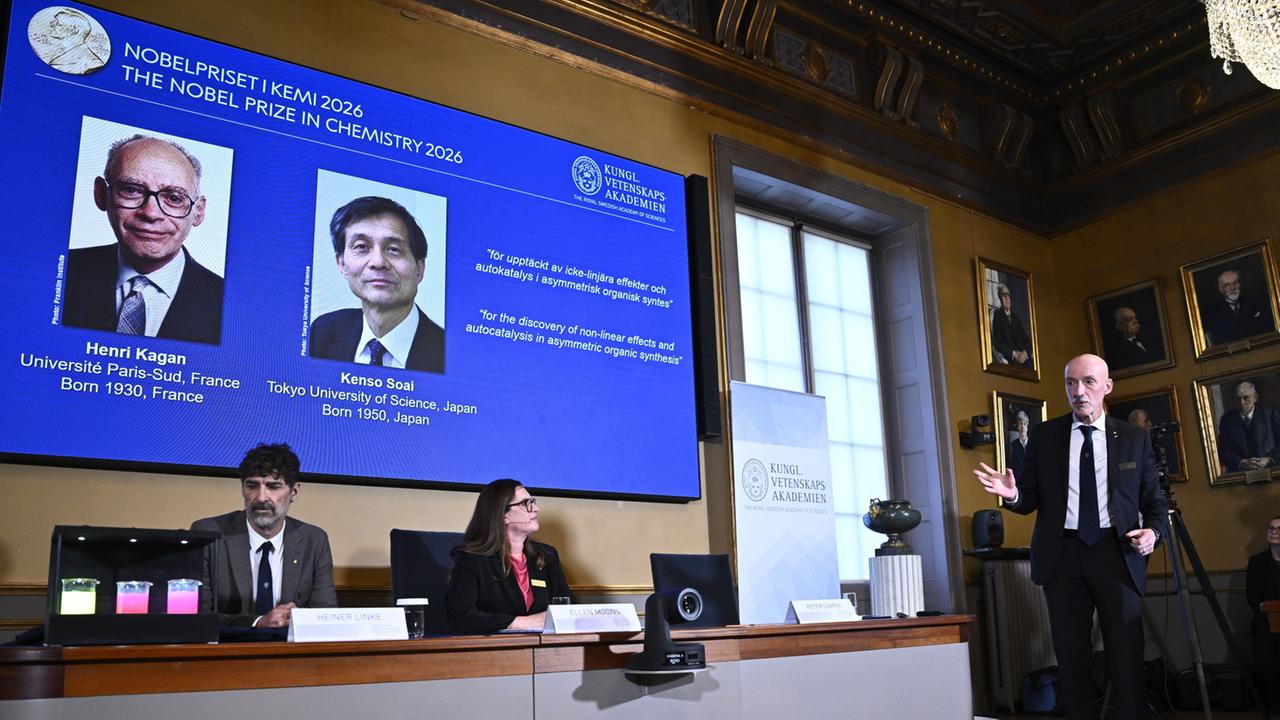
Stockholm – The Royal Swedish Academy of Sciences has awarded the 2026 Nobel Prize in Chemistry to Henri Kagan and Kenso Soai. The duo was honored for their pioneering contributions to the field of asymmetric catalysis—specifically, their work in decoding the complex mechanisms of "chirality," a fundamental property of matter that dictates everything from the effectiveness of life-saving medicines to the sensory profile of our food.
The announcement, delivered in the heart of Stockholm, celebrates a breakthrough that Nobel committee member Peter Somfai described as "the coolest experiment in the history of organic chemistry." By unlocking the secrets of how nature prefers one mirror-image molecule over another, Kagan and Soai have provided the pharmaceutical and material science industries with the "rulebook" for creating safer, more efficient chemical compounds.
The Concept: What is Chirality?
To understand the magnitude of Kagan and Soai’s achievement, one must first look at the simple geometry of the human hand. Your left and right hands are mirror images of one another; they possess the same components (four fingers and a thumb), yet they are not interchangeable. If you try to put a left-handed glove on your right hand, it simply does not fit.
In chemistry, this phenomenon is known as "chirality" (derived from the Greek word cheir, meaning "hand"). Many molecules exist in two distinct forms—enantiomers—that are mirror images of each other. While they contain the exact same atoms linked in the same order, their spatial arrangement differs. In the microscopic world, this subtle difference can mean the difference between a life-saving treatment and a toxic compound.
The Real-World Consequences
The implications of molecular handedness are profound. A classic, tragic example is the drug Contergan (thalidomide). In its two mirrored forms, one acted as an effective sedative, while the other caused devastating developmental defects in unborn children. Similarly, the molecule responsible for the aroma of caraway seeds is a chemical mirror image of the molecule that gives peppermint its refreshing scent.
Nature itself exhibits a strong "left-handed" bias. Biological systems, from amino acids to DNA, are predominantly constructed from one specific mirror image. For decades, the greatest challenge for synthetic chemists was to replicate this selectivity in a laboratory setting—to create one "hand" of a molecule without producing its unwanted, potentially harmful twin.
Chronology of a Breakthrough
The road to the 2026 Nobel Prize was paved by decades of rigorous experimentation and theoretical refinement.
The Kagan Era (The 1970s and 80s)
Henri Kagan, born in France in 1930, fundamentally changed the landscape of organometallic chemistry. In the 1970s, Kagan began developing chiral ligands—specialized molecules that act as a "chiral scaffold" during a chemical reaction. By attaching these ligands to metal catalysts, Kagan demonstrated that he could steer a chemical reaction to produce a massive excess of one specific mirror-image molecule over the other. This was a paradigm shift; it meant that chemists were no longer at the mercy of chance, but could exert control over the 3D architecture of their creations.
The Soai Revolution (The 1990s)
Building on the foundations laid by researchers like Kagan, Japanese chemist Kenso Soai (born 1950) took the concept to its logical—and most mysterious—conclusion. In the 1990s, Soai developed an autocatalytic reaction that defied traditional expectations.
In the "Soai reaction," the product itself acts as a catalyst for its own production. Once a small amount of a specific "handed" molecule is present, it forces the reaction to continue producing only that same version, exponentially increasing the purity of the sample. This "asymmetric autocatalysis" mirrors the self-replicating nature of biological systems, providing a potential explanation for how life on Earth originally acquired its preference for specific chiral forms.
Supporting Data: Why This Matters for Industry
The impact of Kagan and Soai’s work extends far beyond the laboratory bench. In modern chemical manufacturing, efficiency is measured by the ability to avoid "waste" mirror images.
- Pharmaceutical Synthesis: Today, nearly every major drug on the market is chiral. By applying the "Kagan-Soai rules," pharmaceutical companies can streamline the production of high-purity medications, reducing the need for costly and environmentally taxing separation processes.
- Material Science: The development of advanced polymers, liquid crystals, and specialized electronic materials often relies on the precise structural orientation of molecules. The ability to dictate chirality allows for the creation of materials with unprecedented optical and electronic properties.
- Agrochemicals: The production of herbicides and pesticides has been revolutionized by these methods, allowing for more targeted, potent chemicals that require lower application rates, thereby reducing the environmental burden.
Dr. Oliver Trapp, a researcher at Ludwig-Maximilian-University in Munich, emphasized the elegance of the Soai reaction. "The product is the architect of its own existence," he noted. "It is a rare instance where the laboratory environment mimics the self-organizing complexity of biological life. It is not just a scientific technique; it is a fundamental insight into the order of the universe."
Official Responses: A Global Scientific Milestone
The reaction from the scientific community has been one of universal acclaim. During the announcement, the Royal Swedish Academy highlighted that the laureates have moved chemistry from an era of trial-and-error to an era of "rational design."
The Nobel Committee’s View
Heiner Linke, a prominent member of the Nobel Committee in Stockholm, summarized the impact during the press briefing: "The benefit here is that organic chemists have finally learned the ground rules. These are the rules for planning the synthesis of a single mirror image. This plays a critical role in the manufacturing of every single modern drug we consume. Kagan and Soai didn’t just give us a tool; they gave us a language to speak to the molecular world."
A Message from the Laureate
Kenso Soai, reached via telephone at his home in Japan, expressed his deep humility and excitement. "This is truly one of the most exhilarating days of my life," he said. "When I first observed the autocatalytic effect in the lab, I knew it was special, but I never dared to dream it would reach this level of recognition."
Soai also issued a call to action for the next generation of scientists. "Our reaction is by no means the final answer to the mystery of chirality. It is a doorway. I hope this prize encourages young researchers to continue pushing the boundaries of this field, to delve deeper into the origins of life, and to use this knowledge to make the world a healthier and more sustainable place."
Implications: The Future of Synthetic Chemistry
As the Nobel Prize celebration approaches, the scientific community is already looking toward the next decade. The work of Kagan and Soai has laid a robust foundation, but the "chiral mystery"—the question of why nature chose the specific "hand" it did—remains an active area of inquiry.
Toward "Green" Chemistry
The move toward sustainable manufacturing is heavily reliant on the principles established by the laureates. By increasing the selectivity of reactions, the need for chemical purification steps is reduced, leading to lower energy consumption and less chemical waste. This "atom economy" is the cornerstone of 21st-century green chemistry.
The Search for Life Beyond Earth
The study of chirality is also central to astrobiology. When searching for life on other planets, scientists look for chiral "fingerprints"—an excess of one mirror image over the other. The work of Kagan and Soai helps researchers understand what kind of chemical signatures might indicate the presence of biological life versus purely geological processes.
Conclusion
Henri Kagan and Kenso Soai have provided humanity with the keys to the mirror world. By mastering the handedness of molecules, they have bridged the gap between basic chemical curiosity and the practical, life-saving applications that define modern medicine and technology. Their legacy, honored by the 2026 Nobel Prize, is a testament to the power of human ingenuity to decode the most fundamental patterns of the natural world. As we look forward, their contributions will undoubtedly continue to shape the way we understand, design, and create the building blocks of our future.













