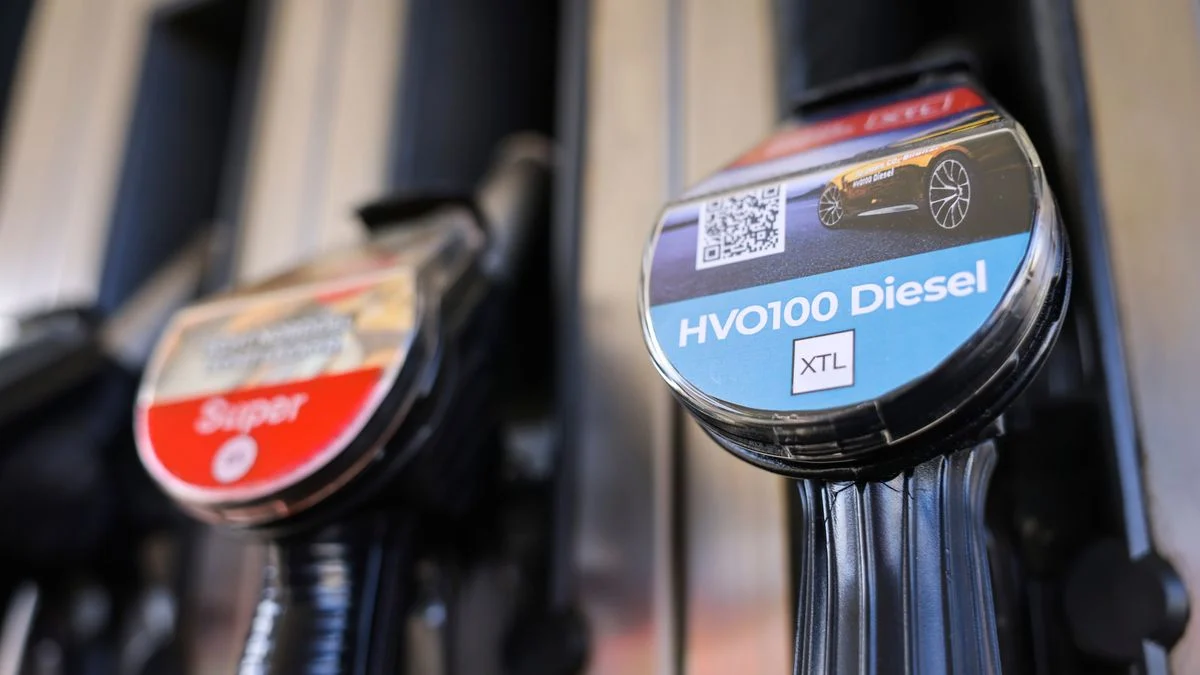
For years, the promise of renewable fuels remained confined to laboratory settings and niche heavy-duty transport fleets. However, a significant market shift is currently unfolding: for the first time, the wholesale price of Hydrotreated Vegetable Oil (HVO)—a high-performance, sustainable diesel alternative—has dipped below that of conventional fossil-fuel diesel.
According to data from the price reporting agency Argus Media, this transition marks a potential turning point in Europe’s energy landscape. While the geopolitical instability triggered by conflicts in the Middle East has driven up the costs of all fuel commodities, the price of HVO has remained comparatively resilient. This decoupling from the extreme volatility of traditional oil markets suggests that the era of the “green premium” for sustainable fuels may finally be drawing to a close.
The Main Facts: A Paradigm Shift in Fuel Economics
The core development is the structural change in wholesale pricing. Historically, HVO, which is produced through the hydro-processing of vegetable oils, waste fats, and used cooking oils, carried a substantial price premium due to production complexities and supply chain infancy. However, since mid-August, Argus Media has observed that the wholesale cost of HVO has become more competitive than fossil-based diesel.
Marcel Pott, an expert on the German oil products market at Argus Media, notes that while the entire energy sector has felt the sting of inflation and supply chain disruptions, HVO has demonstrated a surprising degree of price stability. "While HVO has certainly become more expensive in the wake of recent global conflicts, the margin of increase has been significantly lower than that of conventional diesel," Pott explained.
This stability is critical for the long-term adoption of HVO100—the pure-grade version of the fuel that became widely available at German service stations in May 2024. Consumers, who were initially deterred by price premiums of more than 20 cents per liter, are now finding the gap closing rapidly. Current market data suggests that the surcharge at the pump has narrowed to between four and eight cents, with some stations already offering parity or even lower prices for HVO100 compared to standard diesel.
A Chronology of the HVO Evolution
To understand the current state of the market, one must look at the rapid timeline of HVO’s introduction and integration into the European transport sector.
- Pre-2024: The Niche Phase. For several years, HVO was primarily used as a drop-in additive or reserved for specific corporate fleets committed to environmental, social, and governance (ESG) goals. High production costs and limited retail distribution prevented it from reaching the average commuter.
- May 2024: The Retail Launch. Germany officially opened the gates for the sale of HVO100 at standard filling stations. This was a landmark moment for motorists, as it allowed owners of diesel-powered vehicles to utilize a cleaner, drop-in alternative without engine modifications.
- Summer 2024: The Price Volatility. The onset of renewed geopolitical tensions in the Middle East caused oil prices to spike. Conventional diesel, being highly sensitive to crude oil fluctuations, saw significant volatility.
- August 2024: The Inflection Point. For the first time, the wholesale market signaled that HVO had achieved a competitive price floor. The cost of raw materials for HVO began to stabilize relative to the high-pressure crude oil market.
- Present Day: The Closing Gap. The retail sector, typically characterized by a time-lag in reflecting wholesale shifts, is now beginning to show signs of price convergence, forcing a rethink of the "green premium" narrative.
Supporting Data: Why the Economics are Changing
The shift in pricing is not merely a matter of chance; it is the result of shifting supply chain dynamics and the scaling of production facilities.
The Composition of HVO
HVO is a second-generation biofuel. Unlike first-generation biodiesel (FAME), which can have issues with cold-weather flow and storage stability, HVO is chemically similar to fossil diesel. It is produced by reacting waste oils and fats with hydrogen. This process allows it to be used in any modern diesel engine without performance loss.
Scaling Efficiency
As demand for carbon-neutral fuels has grown, major petrochemical companies have converted existing refineries or built new hydro-treating units. This economies-of-scale effect has helped drive down the marginal cost of production. According to Argus Media, the ability of producers to source diverse feedstocks—ranging from restaurant waste to animal fats—has provided a buffer against the price spikes seen in the crude oil market.

Price Convergence Table (Estimated)
| Period | Retail Premium (HVO vs. Diesel) | Trend |
|---|---|---|
| May 2024 | +20–25 cents/liter | High |
| July 2024 | +12–15 cents/liter | Declining |
| August 2024 | +4–8 cents/liter | Narrowing |
| Sept 2024 | 0–4 cents/liter (Selective) | Parity |
Official Responses and Industry Outlook
Market analysts and government bodies are watching these developments with cautious optimism. The transition is significant because it suggests that the "decarbonization of transport" may not require the immediate retirement of the entire internal combustion engine fleet.
The Role of Market Lag
Experts like Marcel Pott emphasize that consumers should not expect immediate uniformity. "Developments in the wholesale market are traditionally passed on to the pump with a temporal delay," Pott notes. Gas station operators, facing their own overheads and supply chain costs, are often slow to lower prices when wholesale rates drop, yet quick to raise them when trends reverse.
The Risk of Success
There is a paradox in the success of HVO100: if the fuel becomes too attractive, the resulting surge in demand could overwhelm current production capacity. "Whether HVO100 will become cheaper than diesel across the board remains an open question," Pott warns. "A permanently attractive price level would likely increase demand, which could then drive prices back up." Furthermore, the limited availability of high-quality waste feedstocks poses a potential bottleneck that could cap supply and prevent further price reductions.
Implications: The Future of Road Transport
The emergence of competitively priced HVO has profound implications for climate policy and the automotive industry.
Decarbonizing Existing Fleets
The most significant implication is the ability to reduce CO2 emissions from the existing fleet of diesel vehicles. Since most European transport relies on diesel, the ability to switch to HVO without vehicle modifications represents an immediate, massive reduction in carbon output. This is a critical bridge as the world transitions to full electrification.
Political and Regulatory Challenges
Government efforts to subsidize fuel costs—such as the "tank rebate" schemes seen in previous years—have often been criticized as inefficient "watering-can" policies. As HVO becomes a viable market-based alternative, the argument for government intervention shifts. Policymakers are now faced with a choice: do they continue to subsidize fossil fuels, or do they incentivize the transition to sustainable biofuels like HVO?
The ongoing struggle to manage fuel price caps while ensuring energy security remains a priority for the German government and its European counterparts. However, the data suggests that the market might be doing the work that regulators have struggled to achieve for years.
Final Considerations
As we look toward the future, the integration of HVO100 into the mainstream retail market is a testament to the power of technological evolution in the energy sector. While supply chain constraints and the risk of price volatility remain, the fact that a cleaner alternative is now flirting with price parity with the dirtier incumbent is a landmark achievement. For the everyday motorist, the future of driving may be turning green, not just by mandate, but by the simple, undeniable logic of the bottom line.
Whether this trend holds will depend on the scaling of global production and the continued availability of sustainable feedstocks. For now, the "green premium" is shrinking—and with it, perhaps, the final justification for the dominance of conventional fossil diesel.