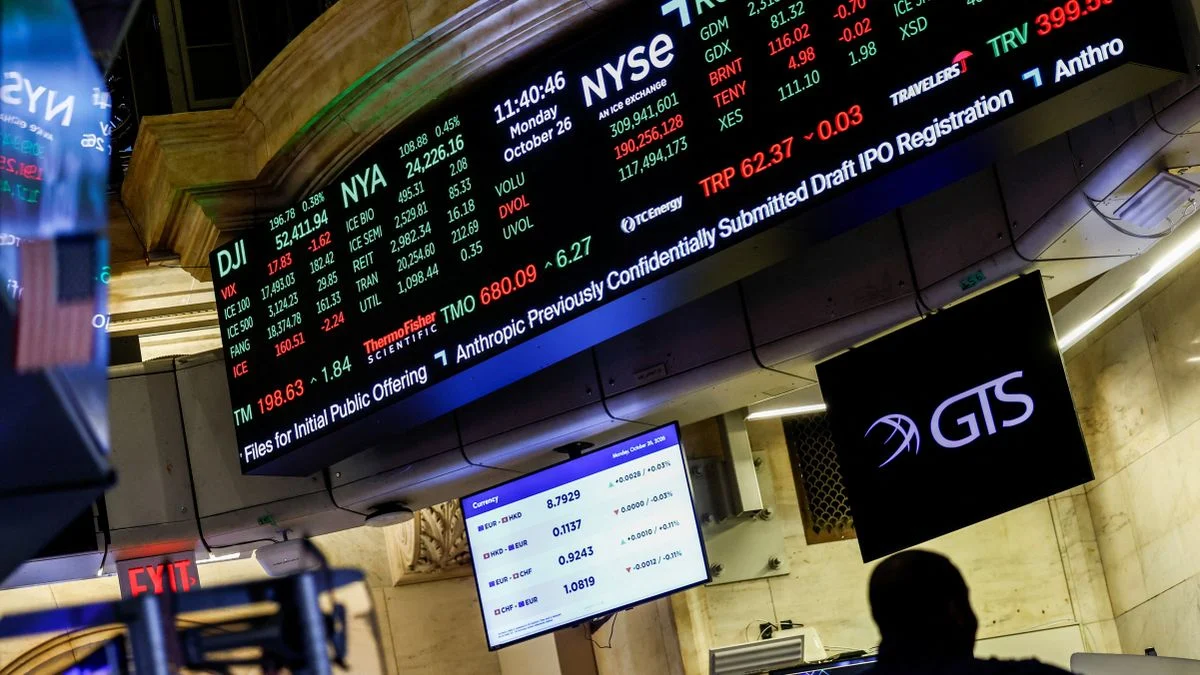
New York — The U.S. equity markets have kicked off the post-Labour Day week with a palpable sense of caution. After a mandatory pause for the federal holiday on Monday, traders returned to their terminals on Tuesday to find a landscape defined by defensive positioning and macroeconomic anxiety. As the opening bell rang, the major U.S. indices—the Dow Jones Industrial Average, the S&P 500, and the tech-heavy Nasdaq—all signaled a retreat, reflecting the prevailing mood of uncertainty that has gripped global financial centers.
Main Facts: A Tepid Return to Trading
The atmosphere at the New York Stock Exchange was notably subdued as market participants weighed the implications of a thin calendar of corporate earnings and economic reports against a backdrop of rising input costs. With the Labour Day long weekend behind them, investors were forced to grapple with immediate pressures: energy costs are climbing, and the long-term outlook for interest rates remains as opaque as ever.
Market analyst Markus Koch, commenting on the morning’s activity, highlighted two primary catalysts for the negative sentiment: “The yields on ten-year Treasury bonds are holding firm at just under 4.8 percent, and oil prices continue to climb, putting a squeeze on both equity valuations and consumer sentiment.” This combination of high-interest-rate pressure and energy-driven inflationary concern has created a "risk-off" environment, prompting a flight to quality as investors recalibrate their portfolios for the final quarter of the year.
Chronology of Market Sentiments
To understand the current hesitation, one must look at the recent timeline of the U.S. economic narrative:
- Pre-Labour Day: Markets closed on a note of cautious optimism, with investors hoping for a "soft landing" scenario in which the Federal Reserve would refrain from further aggressive tightening.
- Labour Day Holiday: The market closure on Monday provided a cooling-off period, but it also allowed geopolitical developments in the energy sector to manifest without the mitigating presence of active trading.
- Tuesday Morning: The return to the trading floor saw an immediate repricing of assets. The combination of rising bond yields—often seen as a "risk-free" alternative to stocks—and the renewed volatility in energy markets effectively dampened the enthusiasm that had built up in the prior week.
- The Week Ahead: Markets are now in a "wait-and-see" mode, with eyes firmly fixed on Friday’s release of preliminary inflation data, which will serve as the primary barometer for the Federal Reserve’s upcoming policy shift.
Supporting Data: The Inflationary Pressure Cooker
The underlying concern driving the current market sentiment is the stubbornness of inflation. While headlines have often focused on the decline from previous peaks, the reality remains that the cost of living—and the cost of doing business—is not retreating as quickly as the Federal Reserve would prefer.
Recent data indicates that the inflation rate in the United States stands at approximately 3.4 percent. While this is a marked improvement from the double-digit fears of the previous cycle, it remains well above the Federal Reserve’s stated target of 2.0 percent. This gap between reality and the mandate creates a dangerous environment for equity investors. When inflation remains elevated, the Federal Reserve is effectively backed into a corner, forcing them to maintain a "higher for longer" interest rate stance.
The impact on the bond market is direct. As the ten-year Treasury yield hovers near 4.8 percent, the equity risk premium—the extra return an investor demands for holding stocks over safer bonds—shrinks. This makes equities, particularly high-growth tech stocks, appear significantly less attractive.
Official Responses and Monetary Policy Outlook
The upcoming Zinsentscheid (interest rate decision) by the Federal Reserve has become the focal point of the global financial calendar. There is currently no consensus among policymakers or market participants regarding the next move.
Within the Federal Reserve, a split has emerged. Several governors have signaled a hawkish preference, citing the persistence of inflation and the resilience of the labor market as evidence that the economy can withstand further rate hikes. Others remain cautious, fearing that excessive tightening could trigger an unnecessary recession.
The sentiment among market participants is equally fractured. According to the Fed Watch Tool provided by the Chicago Mercantile Exchange (CME), the investment community is currently divided, though a slight majority—nearly 60 percent—is betting on a hawkish move. This group anticipates that the Federal Reserve will raise the federal funds rate into a target range of 3.75 to 4.0 percent. This shift in expectations has been a major contributor to the current market volatility, as traders unwind positions based on the assumption of a pause in interest rate hikes.
Implications for Investors and the Global Economy
The ramifications of this uncertainty extend far beyond the trading floor of the New York Stock Exchange.
1. The Energy-Inflation Feedback Loop
The surge in energy prices, similar to the trends observed across European markets, is creating a ripple effect. Higher oil prices translate to increased transportation and production costs, which are inevitably passed on to the consumer. This creates a feedback loop: higher prices lead to higher inflation readings, which in turn force the Fed to consider further rate hikes, which then pressure the stock market.
2. The Bond Market as the New North Star
For decades, the stock market was the primary focus of retail and institutional investors alike. However, in the current high-yield environment, the bond market has reclaimed its position as the "North Star" of finance. When bond yields are high, the cost of capital for corporations increases. This impacts everything from corporate expansion plans to stock buyback programs, effectively acting as a headwind for share price appreciation.
3. Geopolitical and Global Economic Sensitivity
The U.S. market is not an island. The current sentiment in New York is deeply tied to international developments. European markets, which are already grappling with energy crises and structural economic shifts, are mirroring the U.S. trend of cautious trading. If the U.S. economy were to enter a downturn, the shockwaves would be global, potentially triggering a wider contraction in international trade and investment.
4. Navigating the "Wait-and-See" Period
For the average investor, the next few weeks are critical. The volatility seen this Tuesday is likely to persist until the Federal Reserve provides clarity on its interest rate trajectory. Financial advisors are generally recommending a defensive posture, emphasizing quality companies with strong balance sheets and the ability to pass on cost increases to their customers.
Conclusion: A Pivot Point for the Markets
As the week progresses, the narrative will likely shift from broad market malaise to specific data-driven reactions. The Friday release of the inflation data will be the first major stress test. If the numbers come in hotter than expected, the probability of a rate hike will increase, likely putting further downward pressure on equities. Conversely, if there is a cooling trend, the markets may find the relief they are seeking.
Until then, Wall Street remains in a state of high alert. The "Labour Day hangover" is not just a seasonal phenomenon; it is a symptom of a broader, deeper anxiety regarding the direction of the U.S. economy. As the Federal Reserve prepares for its next critical meeting, the world’s financial markets will continue to hang on every word of its officials and every decimal point of the incoming economic data. The path forward remains uncertain, but one thing is clear: the era of easy money and predictable growth has been replaced by a period of rigorous scrutiny and fundamental recalibration.