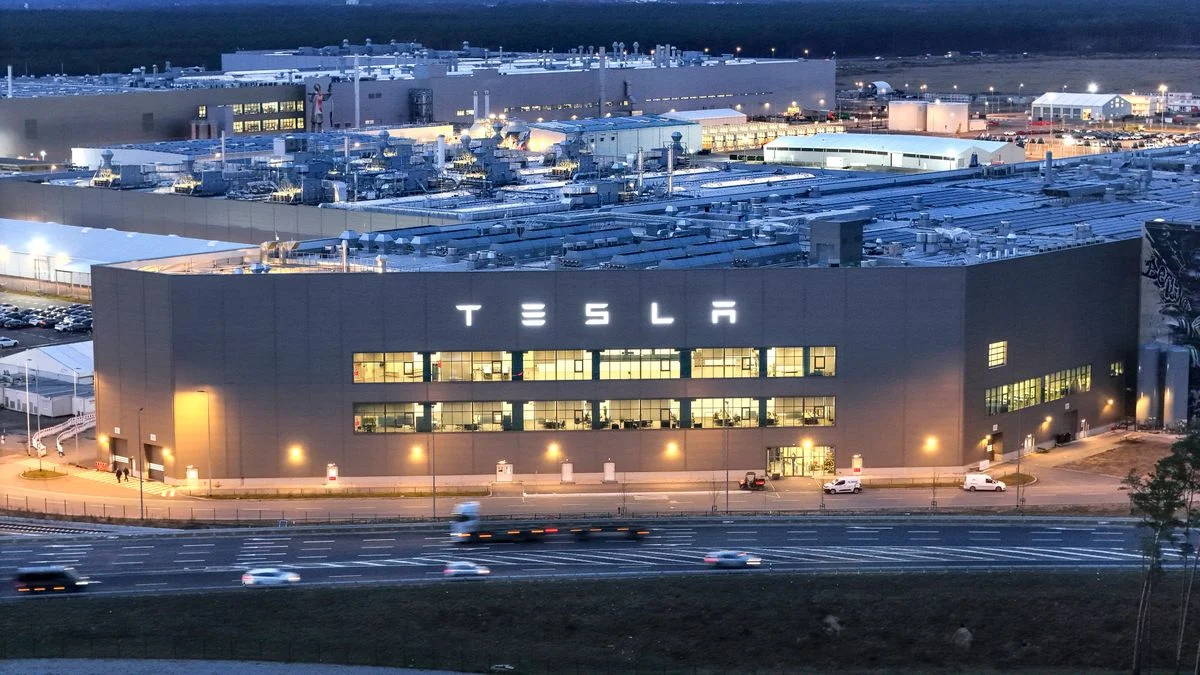
In a bold move that signals a renewed commitment to European industrial dominance, Tesla has announced a significant expansion of its Gigafactory Berlin-Brandenburg. Despite recent turbulence in the global electric vehicle (EV) market and fluctuating production numbers, the American automaker is doubling down on its German operations. The company plans to invest approximately 250 million US dollars (roughly 214 million euros) into its Grünheide site, specifically targeting the localization of battery cell production. This move is accompanied by the creation of 1,500 new jobs, a clear indicator that Tesla views its German outpost not merely as an assembly plant, but as a future cornerstone of its global vertical integration strategy.
The Core Investment: Vertical Integration at the Source
The primary objective of this capital injection is to establish the infrastructure necessary for the annual production of 18 gigawatt-hours (GWh) of battery cells. Currently, the Grünheide plant functions primarily as an assembly facility, where the complex task of battery cell manufacturing is largely outsourced to facilities in the United States, with the finished components being shipped to Germany for final integration.
Tesla’s vision for the site is ambitious: by 2027, the company aims to achieve a fully integrated production loop, where every step—from the raw battery cell to the final vehicle assembly—is executed within the same site in Brandenburg. This strategy is designed to insulate the company from global supply chain disruptions, reduce logistics-related carbon emissions, and leverage the high-tech industrial ecosystem that has coalesced around the Berlin-Brandenburg region over the past four years.
Chronology: From Vision to Industrial Reality
To understand the weight of this announcement, one must look back at the trajectory of the Gigafactory Berlin-Brandenburg:
- 2020: The Grand Promise: Elon Musk publicly announces the intention to transform the Berlin site into the world’s largest battery factory, setting a high bar for European industrial expectations.
- 2021-2022: Rapid Scaling: Following the official opening, Tesla began the initial phase of operations, targeting an output of 500,000 vehicles per year, with a stated long-term goal of doubling that capacity to one million.
- 2023: The Headwinds: The factory faced a challenging year, characterized by broader economic uncertainty, cooling consumer demand in the West, and production bottlenecks, leading to a dip in registration and output figures.
- 2024: The Turning Point: The first quarter of 2024 has shown a marked improvement. With surging demand in Asian and South American markets and a nascent recovery in Europe and North America, Tesla has recalibrated its operations.
- April 2024 to Present: The company announced a surge in hiring and a production ramp-up targeting 6,000 vehicles per week (an annual run rate of 300,000). The current announcement regarding the 1,500 new battery-focused roles represents the latest phase of this growth strategy.
Supporting Data: Production and Workforce Dynamics
The current workforce at the Gigafactory stands at approximately 10,700 employees. The decision to hire 1,500 additional staff specifically for battery production reflects a shift toward higher-skilled, specialized manufacturing roles. Furthermore, as a signal of internal stability, Tesla has confirmed plans to transition approximately 500 temporary agency workers into permanent employment contracts throughout the year.
The move to produce cells locally is critical. Historically, Europe has trailed significantly behind Asia in the race for battery technology and manufacturing capacity. By shifting production from the U.S. to Germany, Tesla is effectively shortening its supply chain for the European market. The target of 18 GWh is substantial; it represents a significant portion of the European battery requirements for Tesla’s Model Y production in Germany, effectively reducing the "transportation footprint" of the vehicles.
The production ramp-up to 6,000 vehicles per week is a testament to the factory’s increasing efficiency. While earlier reports highlighted concerns about fluctuating production, the current output targets demonstrate that the facility is finally hitting its stride, moving past the initial "production hell" phase that characterizes the scaling of any automotive gigafactory.
Official Responses and Political Implications
The announcement has been met with enthusiasm from the political establishment in Germany, which has been grappling with concerns regarding deindustrialization and the competitiveness of the German manufacturing sector.
Martina Klement, the Minister of Economics for Brandenburg, lauded the move as a crucial signal for the German economy. "Germany is clearly still in a position to attract large-scale industrial investments," Klement remarked. She emphasized that battery technology is the linchpin for future industrial value creation and the transition to modern, sustainable mobility.
Her comments address a prevailing anxiety in German politics—the fear that high energy costs and complex regulatory frameworks might drive major investors away. Tesla’s commitment serves as a political win for the region, proving that despite the "uncertainties" cited in recent national debates, the state of Brandenburg remains a top-tier destination for high-tech manufacturing.
Implications: A Strategic Shift in the EV Landscape
The implications of this investment are far-reaching, both for Tesla and the broader European automotive market.
1. Supply Chain Autonomy
By producing battery cells on-site, Tesla is significantly reducing its dependency on trans-Atlantic shipping. This mitigates risks associated with geopolitical instability and maritime logistical costs. Furthermore, it allows Tesla to iterate on its battery chemistry more rapidly, applying localized improvements to its German-built models without waiting for cross-continental feedback loops.
2. The European Battery Race
For years, European policymakers have lamented the region’s reliance on Asian battery giants like CATL, LG Energy Solution, and Samsung SDI. Tesla’s investment validates the European Union’s push for a "Battery Alliance." It signals to other manufacturers that localized, integrated production is not only feasible but essential for long-term viability in the European market.
3. Economic Multiplier Effect
The addition of 1,500 specialized jobs in battery manufacturing creates a ripple effect throughout the local economy. It necessitates advanced training programs, bolsters the local tax base, and encourages ancillary industries—such as raw material processing and specialized logistics—to cluster around the Grünheide site.
4. Market Resilience
Tesla’s ability to pivot from a period of declining demand to a renewed expansion phase highlights the agility of its business model. While traditional automakers often struggle with the "sunk cost" of legacy infrastructure, Tesla’s "Gigafactory" concept allows for iterative, modular expansion. The current plan to go from components to a fully integrated, closed-loop production system by 2027 shows a company that is planning for the next decade of EV adoption, not just the next quarter of financial results.
Conclusion: The Road to 2027
As Tesla moves toward its 2027 goal, the Berlin-Brandenburg site will likely become the blueprint for the company’s future global operations. The combination of state support, a skilled regional workforce, and a clear, unified manufacturing strategy positions the plant to be one of the most efficient automotive production centers in the world.
While the global EV market remains subject to volatility, the specific focus on battery self-sufficiency indicates that Tesla is no longer just selling cars; it is building a comprehensive energy and mobility infrastructure. For Germany, the expansion is a vital vote of confidence in its industrial future. For Tesla, it is the next step in securing its position as the dominant player in the global transition to electric mobility. The coming years will be decisive, but with the foundation now being laid in Brandenburg, the company appears well-prepared for the challenges ahead.