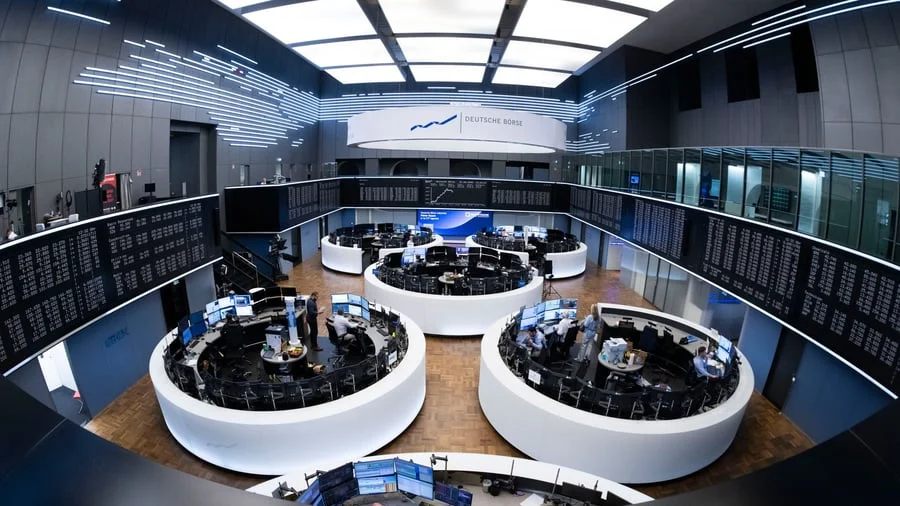
Düsseldorf. The German stock market, represented by the benchmark DAX, is currently navigating a period of pronounced consolidation. Following a moderately positive start to the week, the index has struggled to find sufficient buying interest, hovering around the 25,385-point mark on Tuesday morning. This performance comes on the heels of a 0.9 percent gain on Monday, which saw the index close at 25,411 points. As the market enters a critical phase of the corporate earnings season, investors are balancing the weight of company-specific news against the looming uncertainty surrounding global monetary policy.
Main Facts: A Market in Search of Direction
The current state of the DAX can best be described as a "sideways drift." For several weeks, the index has been trapped within a well-defined trading range, lacking the necessary catalysts to break out in either direction. Market mechanics currently dictate a rhythmic pattern: whenever the index approaches the 25,500-point threshold, profit-taking sets in, capping any potential rallies. Conversely, should the index slide toward the 25,000-point support level, a fresh wave of opportunistic buyers emerges, effectively creating a floor for the market.

This equilibrium reflects a broader hesitation among institutional and retail investors alike. The absence of a clear, overarching trend is not merely a technical phenomenon but a symptom of a wait-and-see approach. As the third-quarter reporting season kicks into high gear, market participants are scrutinizing the latest filings from major DAX and MDAX constituents, including notable reports from consumer giant Beiersdorf and automotive powerhouse Porsche AG.
Chronology of Market Sentiment
To understand the current stagnation, one must look at the progression of market sentiment over the past few weeks.

- Early Month: The market began the month with moderate optimism, buoyed by hopes that cooling inflation figures might provide central banks with enough "breathing room" to pause aggressive interest rate hikes.
- Mid-Month: As economic indicators began to show mixed results, the initial fervor cooled. Concerns regarding the energy transition and the persistence of high operational costs for German industry began to weigh on investor sentiment.
- The Current Week: Monday’s 0.9 percent gain provided a brief glimmer of hope for a sustained breakout. However, Tuesday’s lack of follow-through buying—the phenomenon of "missing" the next leg up—has reinforced the view that the market remains in a defensive posture. The focus has now shifted entirely to the upcoming calendar of central bank meetings, which many analysts believe will determine the market’s trajectory for the remainder of the year.
Supporting Data: Earnings and Macroeconomic Pressures
The current earnings season serves as a litmus test for the resilience of the German corporate sector. Beiersdorf and Porsche AG are the focal points of Tuesday’s trading session, providing investors with tangible data on consumer spending and luxury demand.
Corporate Performance Metrics
Beiersdorf’s performance is being watched closely as a barometer for consumer sentiment. In an environment of elevated inflation, the company’s ability to pass on rising input costs to consumers without eroding volume is a key indicator of brand strength. Similarly, Porsche AG’s results are under the microscope. Given the luxury automotive sector’s sensitivity to interest rate cycles and economic growth forecasts, any sign of softening demand or supply chain bottlenecks in the luxury segment could trigger a wider revaluation of industrial stocks.
Macroeconomic Tailwinds and Headwinds
The macroeconomic landscape remains characterized by a duality of forces:
- Energy Costs: The structural shift in energy prices continues to haunt the German industrial sector. While the worst of the energy crisis appears to be in the past, the "new normal" of higher costs places a permanent burden on margins for energy-intensive manufacturers.
- Inflationary Persistence: Although headline inflation has moderated, core inflation remains sticky. This complicates the narrative for the European Central Bank (ECB), which must weigh the risk of cooling the economy too much against the need to maintain price stability.
- The Central Bank Trio: The immediate future is dominated by the upcoming policy decisions of the Federal Reserve (Fed), the European Central Bank (ECB), and the Bank of Japan. These institutions are currently at different stages of their respective monetary cycles, and their combined decisions will dictate the global liquidity environment for the coming quarter.
Official Responses and Expert Analysis
The consensus among market observers is that the market is in a "biding time" phase. Andreas Lipkow, a seasoned market analyst at CMC Markets, notes that the current situation is particularly "brisant" (volatile/sensitive) due to the proximity of the central bank meetings.

"We are seeing a market that is fundamentally cautious," says Lipkow. "The players on the sidelines are waiting for a clear signal. If the central banks maintain a ‘higher for longer’ interest rate narrative, we could see the DAX testing the lower bound of its current range. Conversely, any dovish surprise could provide the spark needed to push past the 25,500-point ceiling."
Furthermore, corporate leaders are expressing cautious optimism. During recent earnings calls, executives have emphasized the importance of cost-discipline and operational efficiency as the primary drivers of shareholder value in an environment where top-line growth is increasingly difficult to achieve.

Implications: What Lies Ahead for Investors?
The current stagnation carries significant implications for both short-term traders and long-term investors.
For Short-Term Traders
The well-defined range (25,000–25,500) provides a clear framework for range-trading strategies. Traders are currently "selling the peaks and buying the dips." However, this strategy is inherently risky; a breakout or breakdown, when it eventually happens, will likely be sharp and violent. Traders are advised to utilize tight stop-loss orders to protect against sudden volatility spikes triggered by unexpected macro news.

For Long-Term Investors
For those with a multi-year horizon, the current sideways movement presents an opportunity to accumulate high-quality assets at stable valuations. The focus should shift away from the daily noise of the index and toward the fundamental health of companies with robust balance sheets and the ability to maintain pricing power.
The Macro Outlook
The "big three" central banks—the Fed, ECB, and Bank of Japan—are essentially the gatekeepers of the next market trend.

- The Fed: Investors are looking for clarity on when the first rate cuts might materialize.
- The ECB: The European narrative is more complex, given the varying economic health of member states. Investors are watching for any signs of a growth-oriented pivot.
- The Bank of Japan: While often overlooked by European investors, the BoJ’s potential shift away from its ultra-loose policy has global liquidity implications, as it could lead to the repatriation of Japanese capital.
Conclusion
The DAX remains in a state of suspended animation, awaiting the signals that will define its next chapter. While corporate earnings provide a temporary distraction and individual stock movements, the overarching theme remains one of macro-driven uncertainty.
As we look toward the remainder of the week, the market will likely continue its tug-of-war between the bulls, who see value at the 25,000-point support level, and the bears, who see excessive valuations at the 25,500-point resistance. Only when the fog surrounding central bank policy clears—and the dust settles on the quarterly earnings reports—will the DAX likely find the momentum required to break out of its current malaise. Until then, discipline, risk management, and a focus on fundamental business strength remain the most effective tools for navigating this challenging, yet potentially rewarding, market environment. Investors should prepare for increased volatility as the "wait-and-see" phase gives way to the reality of the next monetary policy cycle.