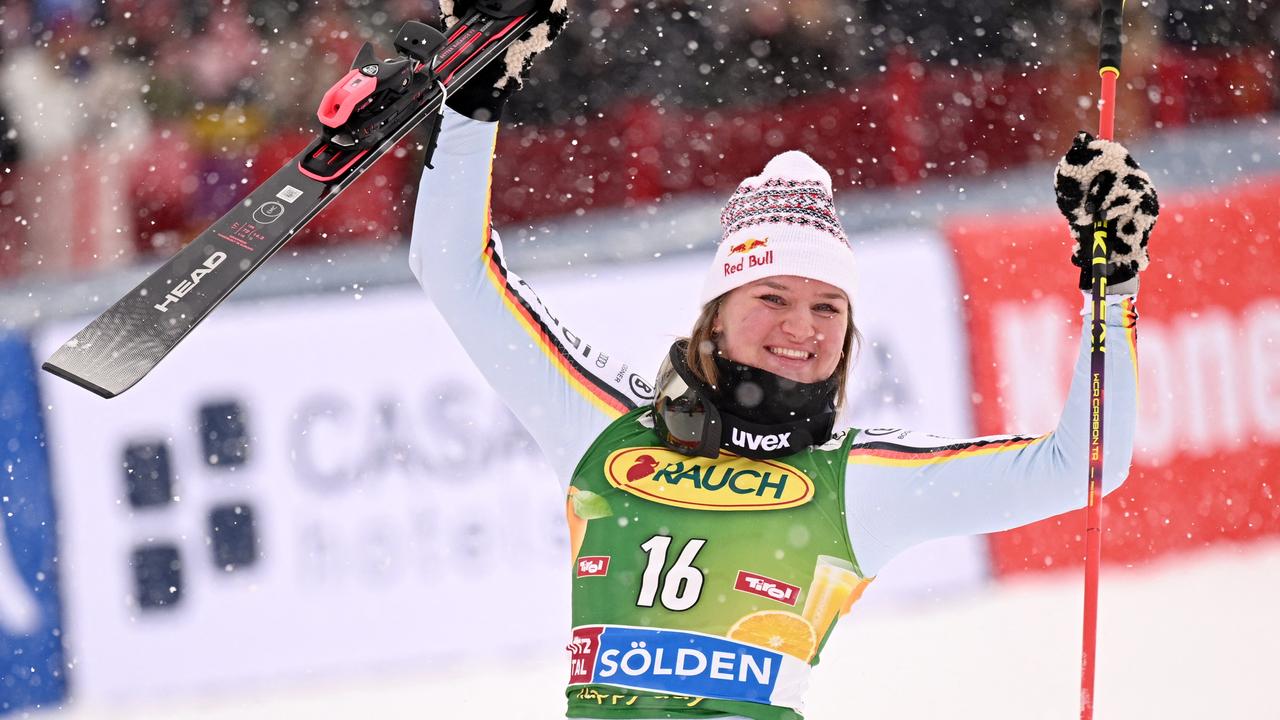
SÖLDEN, Austria – The Rettenbach glacier, a venue synonymous with the high-stakes theater of alpine skiing, served as the stage for a seismic shift in the women’s circuit this Saturday. In a performance that signals her transition from a promising talent to a bona fide contender for the overall crystal globe, 22-year-old German standout Emma Aicher delivered a career-defining performance, clinching a sensational third place at the World Cup season opener in Sölden.
The result is more than just a podium finish; it is a statement of intent. For Aicher, who has long been heralded as one of the most versatile "all-rounders" in the sport, this breakthrough in the giant slalom—historically her most challenging discipline—confirms that she has successfully bridged the gap to the world’s elite.
The Race: A Masterclass in Consistency and Grit
The Sölden giant slalom is notoriously unforgiving. With its steep gradients, shifting light, and the thin, biting air of the Austrian Alps, it is the ultimate test of a skier’s technical precision.
When the first run concluded, the leaderboard told a story of expected dominance and unexpected gaps. American superstar Mikaela Shiffrin, hunting for her 111th career victory, sat in the pole position, appearing untouchable. Aicher, meanwhile, found herself in a respectable but distant ninth position. For many, a top-ten finish would have been considered a successful start to the campaign. For Aicher, it was merely the launchpad.
The second run proved to be a masterclass in tactical aggression. As the course began to break down under the relentless pressure of the field, Aicher navigated the ruts and icy patches with a composure that belied her years. She attacked the middle section of the course, gaining time on every turn. By the time she crossed the finish line, she had vaulted from ninth to third, setting a benchmark that the remaining favorites struggled to match.
The eventual victory went to the United States’ Paula Moltzan, who capitalized on a clean, daring second run to secure the first World Cup giant slalom win of her career. Albania’s Lara Colturi, demonstrating the rapid progression that has made her a fan favorite, snatched the silver medal, cementing her status as a force to be reckoned with.
Chronology of a Breakthrough: From Ninth to the Podium
The dynamics of the race were defined by the stark contrast between the two runs.
- 09:30 AM (CET): The first run begins under clear, cold conditions. Mikaela Shiffrin sets a blistering pace, establishing a lead that suggests the rest of the field is fighting for second place.
- 10:45 AM: Emma Aicher completes her first run. While technically sound, she sits in ninth, nearly a second behind the leaders. The narrative in the press box focuses on the established veterans.
- 12:30 PM: The second run gets underway. The temperature on the glacier drops, and the surface becomes increasingly variable.
- 01:45 PM: Aicher enters the start gate for her final attempt. She executes a near-flawless line, displaying immense strength in her lower body to absorb the chatter of the ice. She records the fastest intermediate times in the lower half of the track.
- 02:00 PM: Aicher crosses the finish line. The crowd erupts as the digital display confirms her jump to the top spot. She remains in the "leader’s chair" as one by one, the field fails to eclipse her combined time.
- 02:30 PM: The final contenders, including Shiffrin, succumb to the mounting pressure. Shiffrin, uncharacteristically struggling with the grip in the second run, drops back to seventh place.
Supporting Data: Why This Result Matters
To understand the magnitude of Aicher’s performance, one must look at her trajectory. Throughout the previous season, Aicher consistently teased the upper echelons of the rankings. Her previous career-best in the giant slalom was a fourth-place finish in Åre, Sweden, last March.
By podiuming in Sölden, Aicher has effectively erased the "weakest link" label that critics had placed on her giant slalom ability. In the modern World Cup, where the overall title is contested by those who can score points across slalom, giant slalom, and occasionally the speed disciplines, Aicher’s newfound proficiency in the GS makes her a mathematically viable candidate for the overall crystal globe.
Furthermore, the race saw the unfortunate exit of Julia Scheib. The Austrian, who entered the season as a defending favorite and the standout GS skier of the previous winter, crashed out in the first run. Her absence left a vacuum at the top, which Aicher and Moltzan were more than happy to fill.
Official Responses and Tactical Shifts
The atmosphere in the finish area was one of shock and jubilation. "I felt like I had nothing to lose after the first run," Aicher told reporters in the mixed zone, her face glowing with the adrenaline of the moment. "I wanted to trust my edges and commit to the turn. To be on the podium here, in front of this crowd, is a dream come true."
For the American camp, the day was one of mixed emotions. Paula Moltzan’s victory was celebrated with fervor, yet Mikaela Shiffrin’s seventh-place finish sparked immediate analysis. Shiffrin, who is entering what she calls a "Season of Exploration," has openly stated her intention to reduce her slalom volume to focus more on giant slalom and super-G.
"It’s a long winter," Shiffrin noted during the post-race press conference. "I’m trying new setups, new approaches. Today was a learning experience. You have to take the lumps if you want to evolve your skiing."
The German team, meanwhile, expressed guarded optimism. While Lena Dürr (22nd) and Kira Weidle-Winkelmann (26th) struggled to find their rhythm on the technical Rettenbach slope, the success of Aicher provided the team with a much-needed boost in morale as they head into the upcoming races in the calendar.
Implications for the Season Ahead
The Sölden result has effectively blown the doors off the women’s World Cup.
- The Rise of the "New Guard": With Aicher, Moltzan, and Colturi occupying the podium, the sport is witnessing a clear generational shift. The dominance of the established titans is being challenged by a cohort of younger, hungrier athletes who are unafraid to take risks.
- The Overall Title Race: If Aicher can maintain this level of consistency in the giant slalom, her path to the overall title becomes significantly easier. Her prowess in the slalom is already established; by adding high-level GS results to her repertoire, she becomes a threat in every single technical race.
- Psychological Momentum: Confidence in alpine skiing is as much about the mind as it is about the legs. Aicher now enters the next block of races knowing she can beat the best in the world. This psychological edge is often the deciding factor in a season that stretches across four months and multiple continents.
Looking Ahead: The Road to the Crystal Globe
As the caravan moves on from the Rettenbach glacier, the focus shifts to the technical rounds in Levi and beyond. The question remains whether Aicher can sustain this intensity. The physical toll of the World Cup is immense, and the mental strain of defending a podium spot can be exhausting for a 22-year-old.
However, the maturity displayed by Aicher on Saturday suggests she is not merely a flash in the pan. Her technical foundation, combined with the strategic support of her coaching staff, positions her as the most exciting prospect in German skiing since the departure of the sport’s previous icons.
The 2026/27 season is young, but after Sölden, one thing is certain: Emma Aicher has arrived, and the rest of the field has been served notice. The battle for the crystal globe will be a marathon, not a sprint, but the German prodigy has proven that she has the pace, the power, and the nerve to stay in the hunt until the final gate of the season.
As the sun sets over the peaks of the Ötztal Valley, the skiing world turns its gaze toward the next challenge. For Emma Aicher, the journey to the top of the world has only just begun.