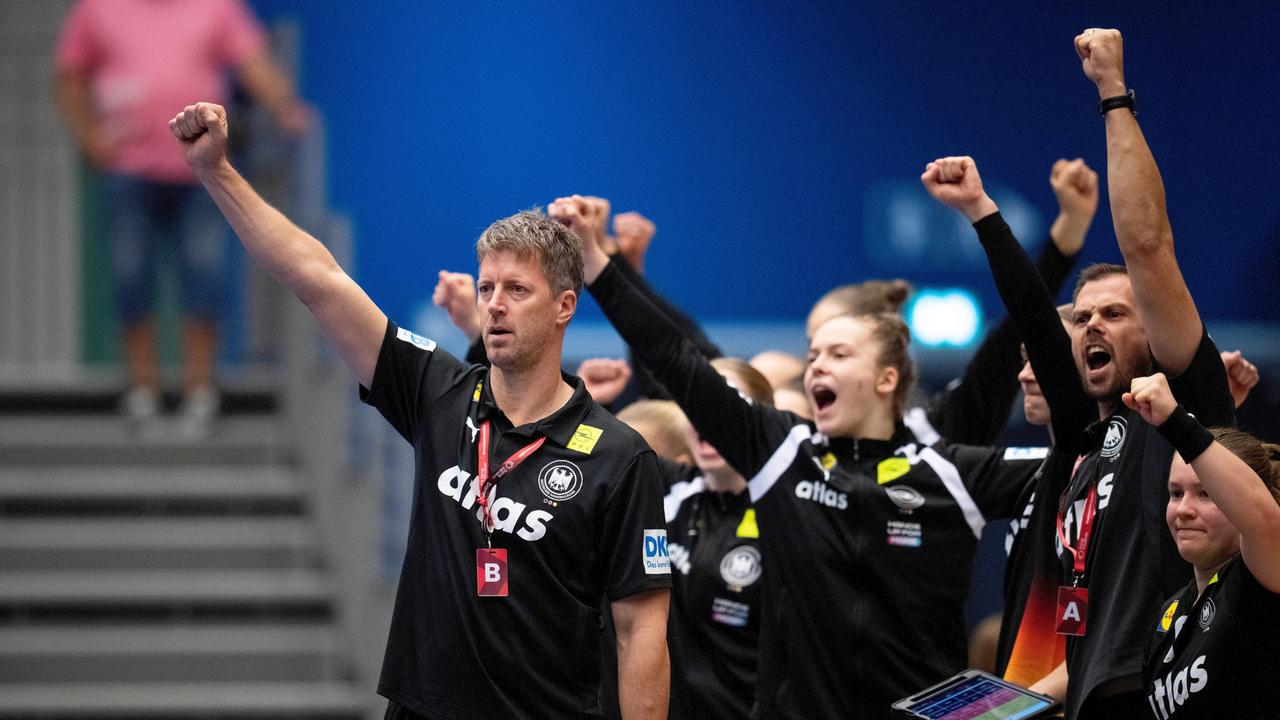
In a display of tactical discipline and defensive tenacity, the German women’s handball team sent a resounding message to their European rivals on Thursday evening. Facing Olympic-pedigree opponents in their own backyard, the DHB selection secured a commanding 26-21 victory over Denmark, signaling that they are firmly on course for the upcoming European Championship.
The win in Odense, achieved in front of 3,500 vocal spectators at the SJF Arena, served as the opening salvo of the "Golden League," an elite invitational tournament that functions as the final litmus test before the continental crown is contested in December. For head coach Markus Gaugisch, the victory was less about the scoreline and more about the structural integrity of his side.
The Core Narrative: A Defensive Masterclass
The hallmark of Germany’s performance was an uncompromising defensive structure. Against a Danish side renowned for their fluid transition play and high-tempo attack, the German defense remained a rigid, impenetrable wall. By limiting the host nation to just 21 goals, the team proved that they possess the physical and mental fortitude required to compete against the world’s elite.
"Overall, we maintained a really good defensive posture for the full 60 minutes," Gaugisch remarked following the final whistle. "That has always been our foundation. When we defend with such passion and cohesion, it provides the perfect basis for our transition game and offensive rhythm."
Chronology of the Clash: How the Match Unfolded
The match began with a focused intensity from the German squad. From the opening throw-off, it was evident that the tactical preparations in training camp had translated seamlessly to the court.
A Dominant First Half
Germany dictated the tempo from the outset. By the mid-point of the first half, the visitors had established a rhythm that the Danes struggled to disrupt. The defensive unit, anchored by the agile and composed Katharina Filter in goal, forced Denmark into difficult shots and tactical errors. By halftime, Germany held a comfortable 15-10 lead, a cushion earned through disciplined ball management and clinical finishing.
The Danish Counter-Punch
Recognizing the deficit, the Danish side returned from the locker room with renewed aggression. They narrowed the gap to a precarious 17-16 margin by the 45th minute, testing the German resolve. The momentum appeared to be shifting in favor of the hosts, as the atmosphere in the arena grew increasingly tense.
The Closing Surge
It was during this critical juncture that the true maturity of the German team shone through. Instead of collapsing under pressure, they responded with grit. Katharina Filter reached a crescendo in her performance, denying several key Danish attempts. Simultaneously, the offensive unit regained its composure. A crucial brace from Alina Grijseels in the 57th minute—extending the lead to 24-19—effectively extinguished any hopes of a Danish comeback. The match concluded with a convincing five-goal margin, 26-21.
Supporting Data and Individual Performances
While the victory was a collective effort, several individual performances were instrumental in securing the result.
- The Goalkeeping Wall: Katharina Filter was undeniably the player of the match. Her ability to read the Danish shooters and her quick reflexes in one-on-one situations were the backbone of the defensive success.
- Offensive Distribution: Germany showcased a balanced offensive threat, with Nieke Kühne, Nina Engel, and Emily Vogel each contributing four goals. This distribution is a promising sign for Gaugisch, as it suggests the team is not overly reliant on a single playmaker.
- Danish Resistance: For Denmark, the efforts of former Bundesliga standout Trine Østergaard Jensen were notable. Her eight-goal performance kept the hosts in contention, but she often found herself fighting a lone battle against the collective German defensive effort.
Strategic Implications: Building Toward December
This win is more than just a notch on the tournament ladder; it is a vital psychological victory. As the European Championship (scheduled for December 3–20) approaches, the pressure on top-tier nations intensifies. Germany’s performance in Odense confirms that they are not merely participants, but potential contenders.
The tournament in Denmark provides a high-pressure environment that mimics the realities of the upcoming Championship, which will be co-hosted by Poland, Romania, the Czech Republic, Slovakia, and Turkey.
The Road Ahead: Testing Against the Best
The schedule does not get any easier for the DHB women. The Golden League continues this Sunday with a high-stakes match against the Netherlands, the current world-class fourth-place finishers.
Following the Golden League, the team faces a final intensive preparation block. They are slated to play two additional high-profile friendly matches against the Paris Olympic silver medalists, France, on November 26 and 28 in Ulm. These encounters will be the final opportunity for Gaugisch to tinker with his roster and finalize his tactical rotations before the tournament opener.
Looking Toward the Tournament Opener
Germany’s campaign for European glory officially begins on December 4th in Bratislava, where they will face Sweden. Given the current form of the squad, expectations within the German Handball Federation (DHB) are cautiously optimistic.
The integration of young talents alongside experienced veterans has created a competitive internal dynamic that is clearly paying dividends. The ability to perform under the lights of a hostile away arena—and to manage a comeback attempt by a world-class opponent—demonstrates a level of "tournament maturity" that has sometimes been lacking in previous years.
Conclusion: A Culture of Excellence
The atmosphere surrounding the team is currently one of focused ambition. Coach Gaugisch has successfully fostered a culture where defensive effort is prioritized over individual accolades. As Filter noted in her post-match comments: "We stood compactly and helped each other at every turn. I am incredibly proud of this defense."
If this unity persists, the German women’s team will arrive in Bratislava not just as a competitor, but as a squad that the rest of Europe will be forced to take seriously. The path to the podium is arduous, but with the foundation laid in Odense, the German handball women have signaled that they are ready to embrace the challenge.