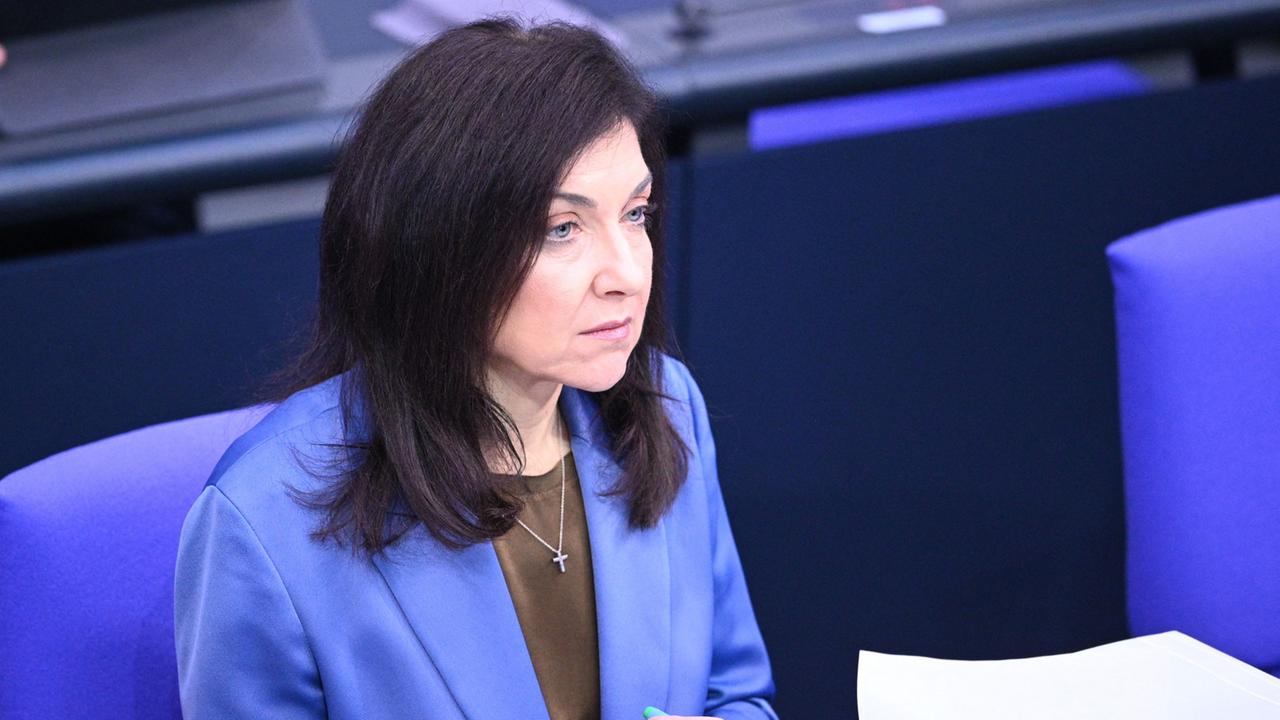
Berlin, October 15, 2026 – Federal Minister of Economics, Katherina Reiche, a prominent member of the Christian Democratic Union (CDU), has been ordered by the Federal Constitutional Court to temporarily remove a contentious Instagram video. The post, published on the official account of the Federal Ministry of Economics, contained severe accusations of antisemitism and advocacy for expropriation against the Left Party (Die Linke), igniting a fierce debate about political rhetoric, state neutrality, and the boundaries of ministerial communication in the digital age. The court’s decision, delivered in an expedited procedure, marks a significant intervention in the ongoing political discourse, particularly in the wake of the recent Berlin state elections.
Constitutional Court’s Swift Intervention
The ruling from Germany’s highest court mandates the immediate, albeit temporary, deletion of the video. The court deemed that the dissemination of the post, leveraging the "specific invocation of official authority and state resources," presented a potential violation of constitutional principles. While the Constitutional Court has not yet made a definitive judgment on the veracity or constitutionality of Minister Reiche’s statements themselves, its preliminary assessment found a greater potential for harm if the video remained online until a final clarification could be reached. This decision underscores the judiciary’s role in safeguarding the integrity of political competition and upholding the principle of state neutrality, especially when government officials use official platforms for partisan commentary.
The Incendiary Post: A Deep Dive into Minister Reiche’s Controversial Statement
The now-contested video first appeared on the official Instagram page of the Federal Ministry of Economics on September 24, 2026. Its accompanying preview text immediately signaled a confrontational tone: "Federal Minister finds clear words, antisemitism and expropriation endanger the economy My Way Conference 26." This headline alone set the stage for the controversy that would quickly follow.
The "My Way Conference 26" Address
The video itself captured Minister Katherina Reiche speaking from the stage of a privately organized event, the "My Way Conference 26." In her address, Reiche launched a scathing attack on the prospect of a potential state government coalition in Berlin involving Die Linke, the Greens, and the Social Democratic Party (SPD). Her words were sharp and unequivocal, directly targeting Die Linke with accusations that resonated deeply within the charged political atmosphere of the capital.
Specifically, Minister Reiche declared: "…that a party is now preparing here in Berlin, not ashamed not only to speak about expropriation but to write it into its program, which openly lives antisemitism, which frightens the Jews in this city (…)." These powerful accusations—linking Die Linke directly to the open practice of antisemitism and suggesting they instilled fear in the Jewish community of Berlin—were not merely criticisms of policy but direct attacks on the party’s fundamental character and ethos. The inclusion of the expropriation debate further fueled the political fire, framing Die Linke’s policy proposals as a threat to economic stability and social cohesion. The fact that these statements were made at a private conference but then disseminated via an official ministerial channel became the crux of the legal challenge, blurring the lines between a minister’s individual political opinion and their role as a representative of the state.
Chronology of a Contentious Digital Dispute
The dispute escalated rapidly, following a clear timeline of events that led to the Constitutional Court’s intervention.
From Publication to Legal Challenge
- September 20, 2026: The Berlin state elections conclude with Die Linke emerging as the strongest political force, setting the stage for complex coalition negotiations. This result immediately put Die Linke under increased scrutiny, particularly from conservative parties like the CDU.
- September 24, 2026: The controversial video featuring Minister Katherina Reiche’s statements is published on the official Instagram page of the Federal Ministry of Economics. The explicit accusations against Die Linke, particularly concerning antisemitism and expropriation, instantly draw criticism.
- Late September 2026 (exact date unspecified, but after Sept 20): Following the widespread attention and criticism, Die Linke formally demands the deletion of the video and the issuance of a cease-and-desist declaration from the Ministry. They set a deadline of September 29 for these demands to be met.
- September 29, 2026: The Federal Ministry of Economics officially refuses Die Linke’s demands. This refusal signals the ministry’s and Minister Reiche’s initial belief that the statements were legitimate and did not violate any constitutional or ethical boundaries.
- Early October 2026: Minister Reiche, through her legal counsel, communicates that her statements were constitutionally permissible and did not violate the principle of state neutrality. This legal stance indicated a readiness to defend the post in court.
- October 15, 2026: The Federal Constitutional Court issues its ruling in an expedited procedure (Eilverfahren), ordering the temporary removal of the Instagram video. This decision comes after Die Linke escalated the matter to Germany’s highest court, seeking urgent legal protection against what they considered an unlawful attack by a state official. The court’s swift action highlights the perceived urgency and potential severity of the alleged constitutional violation.
Underlying Tensions: Berlin’s Political Landscape and Die Linke’s Contested Positions
The backdrop to this legal skirmish is the highly charged political environment of Berlin, where Die Linke’s recent electoral success and its long-standing policy positions have made it a frequent target of criticism, particularly from the more conservative political spectrum.
Post-Election Dynamics in the Capital
The Berlin state elections on September 20, 2026, were pivotal. Die Linke’s emergence as the strongest party marked a significant shift in the city’s political landscape, challenging established power dynamics. This outcome immediately triggered intensive discussions about potential coalition formations. The prospect of a left-leaning coalition involving Die Linke, the Greens, and the SPD—often referred to as a "red-red-green" alliance—became a central point of contention. For parties like the CDU, such a coalition represented a radical departure from traditional governance and raised concerns about economic stability and social policy. Minister Reiche’s speech, therefore, can be understood as a direct intervention in these sensitive post-election negotiations, aiming to influence public opinion and potentially derail the formation of a left-leaning government in Germany’s capital.
The Persistent Shadow of Antisemitism Allegations
The accusation of "openly living antisemitism" leveled against Die Linke is not new but rather a recurring theme in German political discourse, often intensified by the party’s stance on the Israeli-Palestinian conflict. Die Linke has a history of expressing strong solidarity with Palestinians, which critics frequently interpret as veering into anti-Zionism or even antisemitism. This debate is particularly sensitive in Germany due to the country’s historical responsibility concerning the Holocaust.
While Die Linke officially rejects antisemitism and condemns all forms of hatred, its nuanced positions on Israel, including criticism of Israeli government policies and support for boycotts of goods from Israeli settlements, have consistently drawn the ire of pro-Israel groups and political opponents, particularly from the CDU and parts of the SPD. These criticisms often highlight instances where individual party members have made controversial statements or participated in demonstrations perceived as antisemitic. The accusation from Minister Reiche thus taps into a deeply entrenched and emotionally charged debate, seeking to delegitimize Die Linke by associating it with a grave historical and moral failing.
"Expropriation" as an Economic and Social Flashpoint
Beyond the antisemitism allegations, Minister Reiche’s criticism also focused on Die Linke’s program to "expropriate" large housing companies. This refers to the "Deutsche Wohnen & Co enteignen" initiative, a highly visible and successful citizens’ movement in Berlin that advocates for the socialization of housing from large, corporate landlords. The movement aims to address Berlin’s severe housing crisis, characterized by skyrocketing rents and gentrification, by bringing thousands of rental units under public ownership.
For Die Linke, this policy is a core tenet of their social justice platform, seeking to ensure affordable housing as a fundamental right rather than a market commodity. They argue that large housing corporations prioritize profit over people, contributing to the housing crisis. However, for liberal and conservative parties, including the CDU and Minister Reiche’s Ministry of Economics, this proposal is viewed with alarm. They argue that expropriation undermines property rights, deters investment, and could severely damage Berlin’s economy and reputation. Opponents warn of legal battles, financial burdens on taxpayers, and a potential exodus of businesses. Minister Reiche’s reference to expropriation "endangering the economy" directly reflects these concerns, framing Die Linke’s economic policies as a threat to prosperity and stability.
The Constitutional Imperative: Upholding the State’s Neutrality
The Federal Constitutional Court’s decision hinges on the fundamental principle of state neutrality, a cornerstone of Germany’s democratic order. This principle is designed to ensure fair political competition and prevent the state apparatus from being used for partisan ends.
The Principle of State Neutrality Explained
The principle of state neutrality, often derived from Article 21 of the Basic Law (Grundgesetz), which governs political parties, dictates that the state, including its organs and officials, must remain neutral in political contests. This means that public resources, including official communication channels and the authority vested in government positions, cannot be used to promote or disparage specific political parties or their programs. The rationale is clear: ministers and ministries, funded by taxpayers, wield significant financial resources and institutional authority. Using these resources to favor or disfavor political parties would distort the democratic process, giving an unfair advantage to the party in power or those aligned with the government.
Therefore, government members are obligated to clearly distinguish between their activities as ministers (representing the state impartially) and their roles as party politicians (expressing partisan views). While ministers are, by definition, political figures and members of parties, their official actions and communications must adhere to a higher standard of objectivity and neutrality. This principle is crucial for maintaining public trust in state institutions and ensuring a level playing field for all political actors. Past rulings by the Federal Constitutional Court have consistently affirmed this principle, intervening in cases where government campaigns or ministerial statements were deemed to cross the line into partisan electioneering.
The Court’s Rationale in an Expedited Procedure
The Federal Constitutional Court’s decision was rendered through an "Eilverfahren," an expedited procedure designed for urgent cases where immediate action is required to prevent irreparable harm. In such procedures, the court does not make a final judgment on the merits of the case—i.e., whether Reiche’s statements were ultimately constitutional or antisemitic. Instead, it undertakes a "weighing of consequences" (Folgenabwägung).
This process involves assessing which outcome would cause greater harm: allowing the post to remain online until a full legal review, only to find it unconstitutional later, or ordering its removal, only to find it permissible in a final ruling. In this instance, the court clearly saw the greater potential for harm in allowing the video to persist. Its reasoning highlighted that the post’s dissemination "under specific invocation of official authority and state resources" created a possibility of legal violation. The court found that leaving such a potentially unconstitutional statement, amplified by the legitimacy of a federal ministry, online would unduly prejudice Die Linke and distort political competition. This pragmatic approach prioritizes the immediate protection of constitutional rights, even before a comprehensive legal assessment of the content itself.
The court also clarified that its ruling does not curtail Minister Reiche’s fundamental right to freedom of speech. She remains free to express her political opinions as a party politician or a private citizen, provided she does so without invoking her official ministerial authority or using state resources. This distinction is vital, emphasizing that the issue is not what was said, but how and where it was said.
Official Reactions and Lingering Questions
The court’s decision elicited strong reactions and left several questions unanswered, particularly regarding the Ministry’s immediate compliance.
Die Linke’s Firm Stance
Die Linke welcomed the court’s decision as a vindication of their position. A party spokesperson released a statement reiterating their core argument: "A federal ministry is not an election campaign office." They emphasized that any entity utilizing the authority and resources of a federal ministry must be held to strict standards of neutrality and objectivity. For Die Linke, the ruling affirms that even high-ranking government officials cannot use their positions to launch partisan attacks, especially when those attacks involve such severe accusations. The party views this as a crucial victory for fair political competition and a rebuke to what they perceive as an abuse of power.
The Ministry’s Compliance and Silence
In response to inquiries from the ARD-Hauptstadtstudio (ARD Capital Studio), the Federal Ministry of Economics stated that it would "now review the decision of the Federal Constitutional Court and will, of course, implement the consequences." The ministry declined to make any further comments at that time, indicating a cautious approach in the immediate aftermath of the ruling. However, a notable observation was made shortly after the announcement: approximately one hour after the court’s decision was made public, the contentious video remained accessible on the ministry’s Instagram page. This delay in implementation, even if brief, raised questions about the immediate practical implications of the court’s order and the speed of bureaucratic response to judicial mandates.

Broader Implications for Political Discourse and Digital Governance
The ruling against Minister Reiche carries significant implications that extend beyond this particular case, affecting political communication, the role of social media in governance, and the ongoing tension between freedom of speech and official authority.
The Blurred Lines of Ministerial Communication
In an era dominated by social media, the lines between a public official’s personal political views and their official duties have become increasingly blurred. Ministers, like all politicians, use platforms like Instagram to connect with constituents, share policy updates, and engage in political discourse. However, this case starkly highlights the unique challenges faced by government ministers, who simultaneously hold partisan affiliations and represent the entire state. The ruling serves as a potent reminder that when using official channels, the principle of state neutrality takes precedence over individual political expression. This requires a careful distinction, which is often difficult to maintain in the fast-paced, often informal environment of social media. Future guidelines for ministerial social media use may need to become more explicit to prevent similar legal challenges.
A Precedent for Future Online Political Engagements?
This decision by the Federal Constitutional Court could set an important precedent for how government officials utilize official social media accounts for political commentary in Germany. It sends a clear message that such platforms are not to be used as extensions of party election campaigns or for making unverified, politically charged accusations against opposing parties. While the ruling is temporary, its very existence, especially from the highest court, reinforces the constitutional boundaries of official communication. This might lead to greater caution among ministers and ministries when crafting and disseminating political content online, potentially fostering a more objective and less confrontational tone on official government channels.
The Unfolding Political Drama in Berlin
The incident is likely to have repercussions for the delicate political landscape in Berlin. The strong accusations made by a federal minister against a potential coalition partner could further complicate the already challenging process of government formation. It might deepen mistrust between the CDU and Die Linke, making future cooperation more difficult, even at the federal level. For Die Linke, the court’s ruling offers a measure of political vindication, potentially strengthening their hand in coalition negotiations by demonstrating that their opponents resorted to legally questionable tactics. Conversely, the CDU might face questions about the appropriateness of their ministers’ rhetoric and their respect for constitutional principles.
Freedom of Speech vs. Official Authority
Ultimately, the case underscores the perennial tension between the fundamental right to freedom of speech and the obligations of official authority. The court explicitly stated that Minister Reiche, as a party politician or private person, retains her right to express her opinions within the bounds of free speech. The issue was not her right to speak, but her choice to speak from an official platform, leveraging the state’s authority to amplify a partisan attack. This distinction is crucial for democracies, ensuring that political debate remains robust while state institutions remain impartial. The ruling serves as a vital check on the power of the executive, affirming that even the highest officials are subject to constitutional constraints designed to protect the integrity of the democratic process. The temporary removal of the video, pending a full legal review, represents a commitment to these foundational principles.