The intersection of professional football and digital community management has reached a critical juncture at Eintracht Frankfurt. Following an investigation into the club’s official community forums, long-standing threads containing overt homophobia and anti-Cologne vitriol have been removed. These posts, which had persisted for over two decades under the club’s digital umbrella, have reignited a heated debate regarding the club’s responsibility to moderate its online spaces and the persistent, toxic undercurrents of “traditional” fan culture.
The Anatomy of the Digital Smear
The content removed from the Eintracht community platform was not merely sporadic trolling; it was a catalog of systematic, homophobic tropes directed primarily at the city of Cologne and its inhabitants. In one specific forum thread—a relic of digital communication that remained active for years—users debated the “appropriate” chants for matches against 1. FC Köln.
The suggestions provided by participants were often dehumanizing. One user contributed a distorted version of a carnival song, framing Cologne residents as effeminate and derogatory targets, labeling them with homophobic slurs. Another common refrain, frequently echoed in various sub-groups, was the designation of Cologne as the “capital of the gays,” used with the express intent to insult and demean.
These sentiments, while particularly pronounced in the rivalries between Frankfurt, Mönchengladbach, and Leverkusen, found a permanent home in the Eintracht-branded digital environment. For over 20 years, these posts remained visible, often accompanied by the club’s official logos and sponsorship banners, providing a veneer of institutional legitimacy to hate speech.
A Chronology of Neglect
The removal of these threads did not occur as a result of proactive internal moderation, but rather followed inquiries from the media outlet hessenschau. Within hours of these inquiries, the long-standing content vanished, replaced by standard system error messages.
The Problem of Internal Moderation
The Eintracht forum is ostensibly governed by a team of volunteer moderators. However, a deeper look into the history of these accounts reveals a troubling pattern: some of the individuals entrusted with enforcing community guidelines appear to have participated in the very same inflammatory discourse years prior.
Archived discussions—such as a thread titled "Cologne vs. Munich"—show moderators contributing to narratives that suggested Cologne was only worth visiting for those "into boys" or those looking for "something for the eyes" from "the other shore." The discussions were rife with infantile, homophobic stereotypes, including tropes about the physical anatomy of women in Cologne and requirements for visitors to display rainbow flags at city borders—all presented as “humorous” banter among the fanbase.
The Disconnect: Institutional Stance vs. Fan Reality
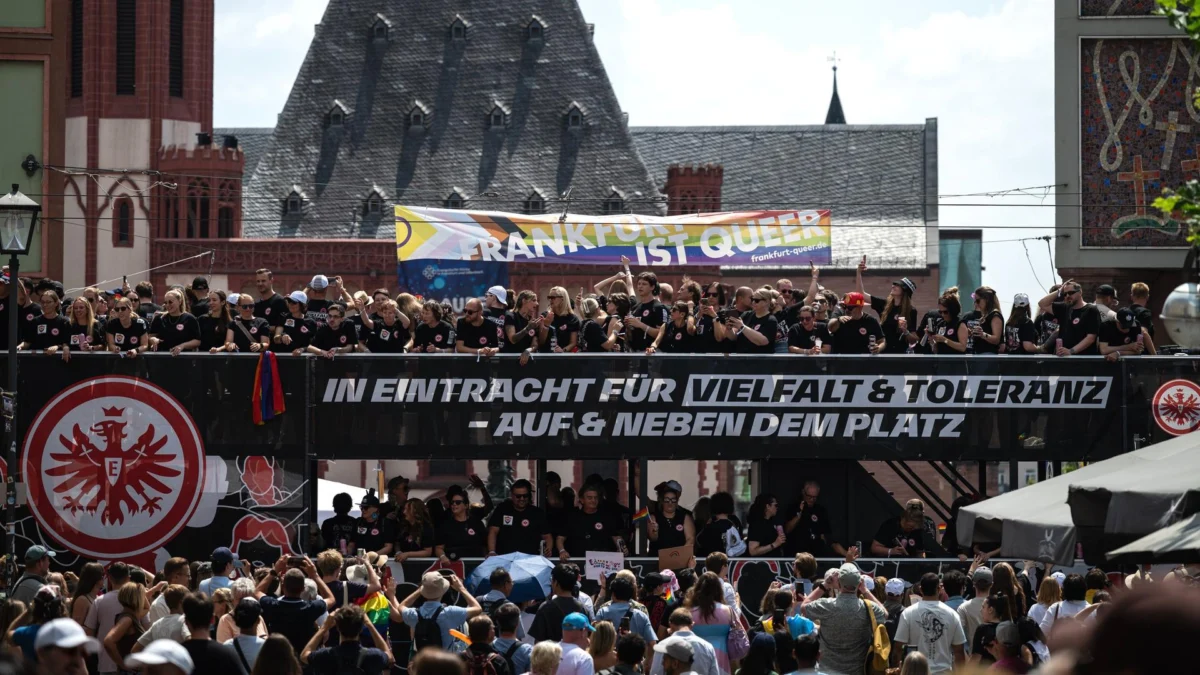
Eintracht Frankfurt has, on numerous occasions, publicly aligned itself with anti-discrimination initiatives. Following incidents such as the display of a queer-hostile banner during an away match in St. Pauli, the club’s leadership was quick to issue condemnations. They have maintained that such behavior has “no place” within the Eintracht family.
However, the reality in the stands often contradicts these statements. During a recent away fixture in Cologne, Eintracht supporters chanted the same homophobic slogans that had been cultivated in their online forums for years. The situation escalated beyond verbal abuse, with fans setting off pyrotechnics and firing rockets into the home crowd—an act that led the German Football Association (DFB) to impose a fine of €171,000 on the club earlier this year. The DFB’s ruling explicitly cited the “discriminatory chants” as a significant factor in the disciplinary action.
Comparative Perspectives: The “Digital Pillory”
The contrast between how clubs handle such behavior is becoming increasingly stark. 1. FC Köln recently made headlines by taking a radically different approach to online abuse. Instead of quietly deleting comments, the club published a gallery of homophobic Instagram comments directed at them, complete with the usernames of the perpetrators.
This “digital pillory” approach received significant support from the queer community, as it moved the focus from “hiding” the problem to exposing the individuals responsible for it. For the Eintracht fanbase, the comparison is unflattering. The lingering presence of hate speech in their own forums suggests a lack of urgency that critics—including members of the Regenbogen-Adler (Rainbow Eagles) queer fan club—find deeply problematic.
Sociological Implications: The Risk of a “Backlash”
Robert Claus, an ethnologist with the Berlin-based research group KoFaS, warns that the persistence of this rhetoric is symptomatic of a broader societal trend. According to Claus, while clubs and organized fan groups are striving to create more inclusive environments, there is a palpable fear of a “backlash”—a reactionary return to rigid, machismo-driven norms.
Claus points out that football acts as a “seismograph” for social trends. As support for extremist, anti-progressive ideologies grows among certain segments of the youth, the football stadium—and its associated digital platforms—often becomes a staging ground for these ideas. “We are witnessing a resurgence of old, narrow-minded concepts of masculinity,” Claus explains. “Any deviation from the heterosexual norm is frequently met with hostility, and that hostility is being amplified by the reach of online forums.”
Voices from the Stands: The Impact on Queer Fans
For members of the Regenbogen-Adler, the presence of these posts is not just a digital nuisance; it is a source of genuine pain and exclusion. Stephan Spengler, the chair of the fan club, argues that the club’s failure to “clean up” its digital footprint for two decades has sent a signal of indifference.
“We were already further along than this,” Spengler notes. “When fans sing these things in the stadium, it is not just an abstract insult; it is a direct affront to those of us who are part of the Eintracht family. We are proud of our club, but we demand that the club be consistent in its actions, not just in its press releases.”
The queer fan club Andersrum rut-wiess from Cologne shares this sentiment, albeit with a cynical take on the intellectual capacity of those involved. “The fact that people believe ‘capital of the gays’ is an insult says more about their own limited horizon than it does about our city,” they remarked. Regardless of the intent, they emphasize that such language has no place in the modern game.
The Path Forward: Demands for Transparency
The silence from Eintracht Frankfurt’s press office regarding the role of their volunteer moderators and the historical oversight of these forum threads remains a point of contention. Transparency is the minimum requirement if the club intends to maintain credibility in its fight against discrimination.
To move forward, several experts and fan groups have suggested a three-pronged approach:
- Professionalization of Moderation: Moving away from a purely volunteer-based model to a professional moderation team that is trained in identifying and de-escalating hate speech.
- Radical Transparency: Acknowledging the failure of the past 20 years and publishing a clear roadmap on how the club will ensure that digital platforms remain safe spaces for all fans, regardless of their sexual orientation.
- Educational Outreach: Leveraging the club’s influence to educate fans on why specific chants are not just “tradition,” but are harmful acts of exclusion that damage the reputation and integrity of the club itself.
As football clubs continue to struggle with the dual identity of being both professional businesses and cultural institutions, the case of the Eintracht forum serves as a sobering reminder. Digital spaces are not mere appendages to the game; they are reflections of the club’s culture. If that culture is to be inclusive, the cleanup must go beyond the digital realm and address the deep-seated prejudices that continue to be chanted in the stands and typed in the shadows of the internet. The era of the "official forum" as a lawless space for bigotry is coming to an end; the question is whether the clubs will lead that change or be dragged into it by public pressure.