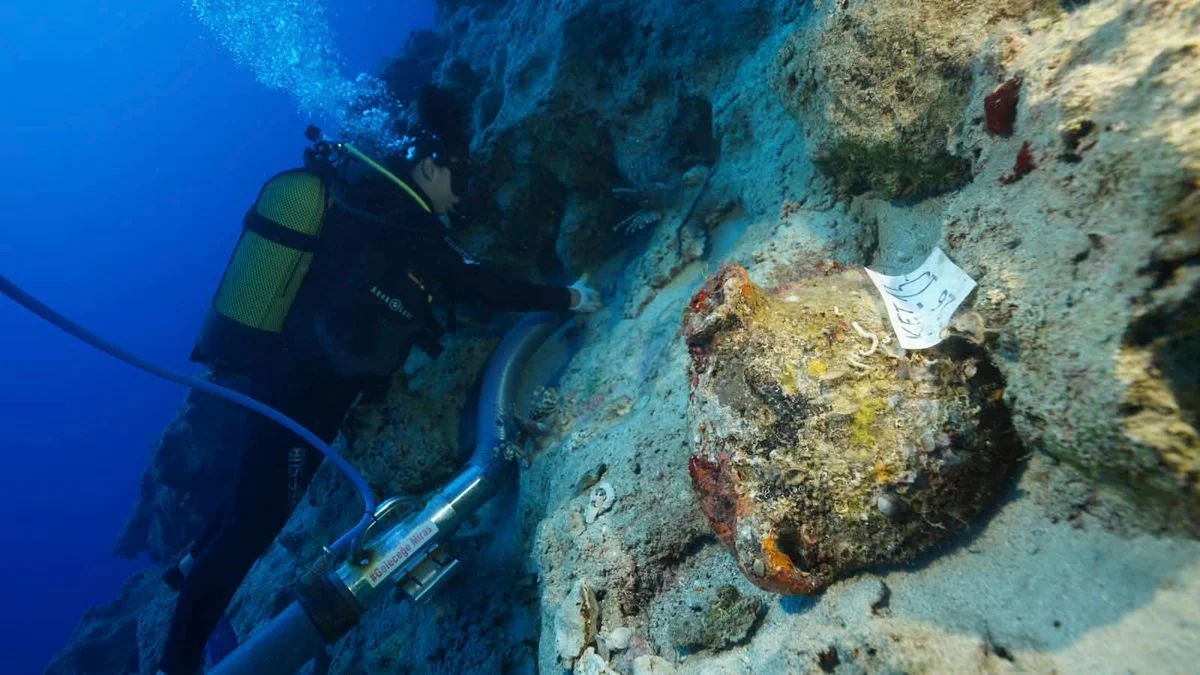
In a discovery that promises to rewrite the history of maritime trade in the Eastern Mediterranean, a team of marine archaeologists has identified the remains of a shipwreck off the coast of Kekova, Turkey. Estimated to be between 4,400 and 4,700 years old, the vessel dates back to the Early Bronze Age—a period contemporaneous with the construction of the Great Pyramids of Giza. This find is being hailed by the Turkish government and international experts alike as a "time capsule" that offers an unprecedented glimpse into the life, technology, and economic networks of one of history’s most enigmatic eras.
The Discovery: Unveiling the Bronze Age Maritime Hub
The wreckage was located in the crystalline waters near the island of Kekova, a region already renowned for its "sunken city" and rich archaeological heritage. The discovery was officially confirmed by the Turkish Minister of Culture and Tourism, Mehmet Nuri Ersoy, who shared the news via social media, highlighting the site’s significance in understanding the deep-rooted history of Anatolian coastal trade.
While the wooden hull of the ship—long since consumed by the relentless marine environment and biological decay—has vanished, the site is a treasure trove of artifacts. The most prominent feature identified by the dive team is a massive stone anchor, a relic that provides essential clues about the size and structural capabilities of the vessel. Alongside the anchor, archaeologists recovered more than 30 ceramic amphorae, which serve as the primary evidence for dating the wreck and identifying its cultural origin.
Chronology: Dating the Silent Vessel
Because the organic hull structure is entirely absent, standard radiocarbon dating—which relies on analyzing isotopes within surviving wood—could not be employed. Instead, the team, led by experts from Akdeniz University, relied on the typological analysis of the ceramic cargo.
The style, shape, and firing techniques of the amphorae found at the site align perfectly with the pottery styles of the Early Bronze Age. By comparing these items with existing records from terrestrial excavations across the Levant and the Aegean, researchers determined that the ship traversed these waters approximately 4,400 to 4,700 years ago. This dating places the vessel firmly in the third millennium BCE, a time when civilizations in Egypt and Mesopotamia were reaching early heights of administrative and structural sophistication.
This chronology is significant because it suggests that long-distance maritime trade was far more advanced and organized during the Early Bronze Age than previously assumed. The vessel represents a bridge between the early maritime pioneers of the Aegean and the nascent urban centers of the Anatolian coast.
Supporting Data: Decoding the Cargo
The preservation of the amphorae is nothing short of miraculous. Despite four and a half millennia on the seafloor, several of the jars still contain remnants of their original contents. Archaeologists describe these as "viscous, gleaming patches" that have adhered to the inner walls of the pottery.
Dr. Karin Sowada, a noted Australian archaeologist specializing in Mediterranean trade, suggests that the chemical residues represent the vital commodities of the Bronze Age economy. Preliminary hypotheses suggest the jars may have contained:
- Olive Oil: A staple of Mediterranean trade and a vital resource for lighting, cooking, and ritual anointing.
- Wine: The emergence of viticulture was a hallmark of the period, and wine was a highly sought-after luxury good.
- Tree Resins: Likely used for medicinal purposes, incense, or as a sealant for shipbuilding, resins were among the most valuable commodities traded across the ancient seas.
Advanced chemical analysis, including gas chromatography and mass spectrometry, will be conducted in the coming months to definitively identify the residues. These results could confirm specific trade routes, potentially proving that the ship was moving goods between Anatolia, Cyprus, and the Egyptian delta.
Official Responses and Scientific Context
Hakan Öniz, a leading maritime archaeologist from Akdeniz University, described the find as a "time capsule on the seabed." Speaking to the BBC and local media, Öniz emphasized that the lack of wood does not diminish the site’s value. "What we have here is a snapshot of an industry that defined the ancient world," he remarked. "The anchor and the cargo together tell a story of deliberate, calculated navigation."
Minister Ersoy’s announcement underscores Turkey’s commitment to preserving its underwater cultural heritage. The Turkish government has designated the site a protected area, ensuring that further excavations will be conducted with the highest scientific rigor. The ministry is already planning an exhibition of the findings, which will eventually be housed in a museum dedicated to the maritime history of the Antalya region.
Implications: A New Understanding of Bronze Age Life
The most startling discovery within the wreckage is a specific amphora that displays nine distinct holes in its exterior and two in its base. This unique vessel has sparked a lively debate among scholars.
The "Floating Kitchen" Hypothesis
The vessel’s design leads researchers to believe it functioned as a primitive churn or sieve. If these holes were used for straining or processing, it strongly suggests that the crew was producing their own dairy products—specifically cheese or butter—while at sea. This is a profound finding, as it implies that the ship was not merely a cargo vessel carrying goods from point A to point B, but a self-sustaining environment.
For a ship to carry livestock (likely goats or sheep) on a long-distance voyage in the 27th century BCE suggests a level of logistical planning previously attributed only to much later periods. It implies that these sailors were comfortable spending weeks or months at sea, managing a "living pantry" to sustain themselves during the arduous journey across the Mediterranean. This shift in perspective transforms our understanding of the sailors themselves: they were not just traders, but experienced mariners capable of complex life-support management.
Broader Historical Context: The Anatolian Connection
The coast of Anatolia has always been a crossroads of civilization. Throughout the Bronze Age, the region served as a gateway between the raw materials of the interior—such as metals and timber—and the luxury-hungry markets of the Near East.
The Kekova shipwreck serves as a physical manifestation of these trade networks. It demonstrates that the inhabitants of the Anatolian coast were active participants in a globalizing world as early as 4,700 years ago. The maritime expertise required to navigate the complex currents and winds near Kekova with such heavy cargo points to a long-standing tradition of shipbuilding and navigation that has been largely lost to history.
The Future of the Kekova Site
As the team continues their work, they hope to find more clues that might lead to the identification of the ship’s origin. Did it belong to a local Anatolian merchant, or was it a foreign vessel that met its end during a storm? The stone anchor, currently undergoing conservation, may hold markings or manufacturing signatures that link it to specific quarries or shipyards.
Furthermore, the site reminds us of the fragility of human history. The shipwreck is a testament to the risks undertaken by ancient sailors who braved the open sea to connect distant cultures. As we continue to probe the depths of the Mediterranean, every discovery like this one adds a new layer to our understanding of the human narrative.
In the coming months, the international archaeological community will watch the Kekova site with keen interest. The analysis of the residues, the structural study of the anchor, and the potential for finding further artifacts hidden beneath the silt promise to keep this shipwreck at the center of historical discourse for years to come.
For now, the site remains a silent, submerged sentinel—a witness to the birth of maritime commerce, a symbol of human resilience, and a vital key to unlocking the mysteries of the Bronze Age. As Minister Ersoy noted, this discovery is not just about the past; it is about recognizing the "deep-rooted history" that continues to shape our understanding of human ingenuity and our enduring connection to the sea.