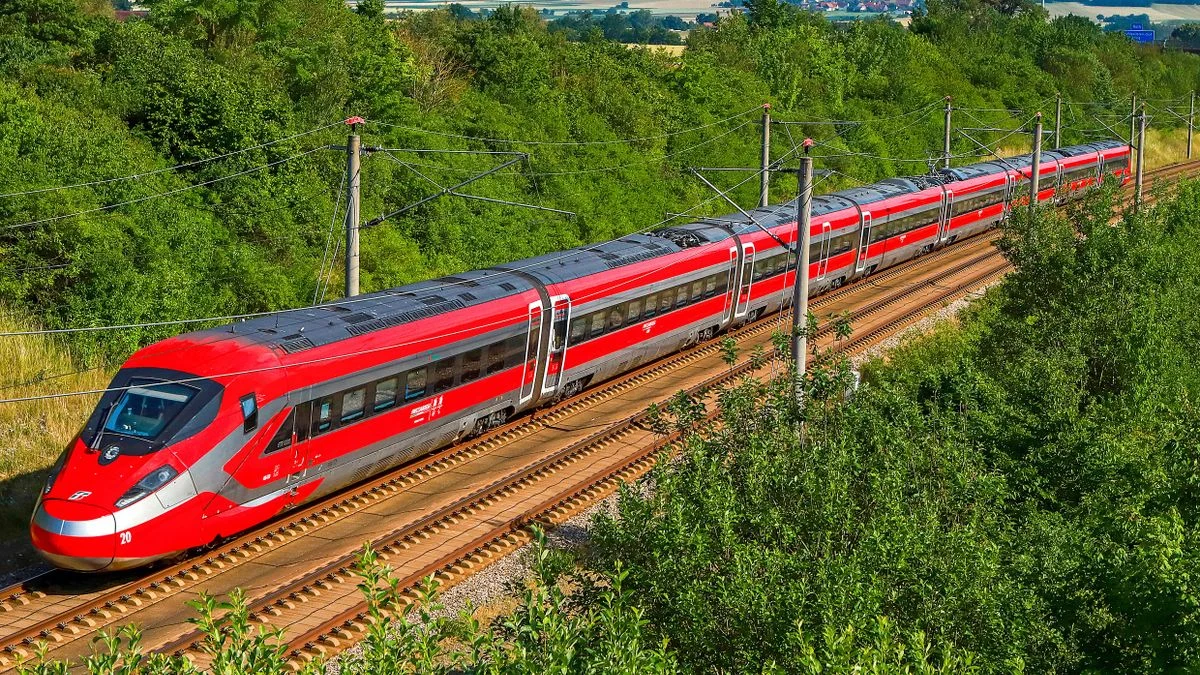
In the landscape of European rail travel, few success stories are as compelling as Italy’s Frecciarossa. Operated by Trenitalia, this high-speed fleet has turned the country’s rail infrastructure into a model of efficiency, punctuality, and customer service. As Germany’s national carrier, Deutsche Bahn (DB), grapples with chronic delays, aging infrastructure, and public frustration, the question has shifted from "can we improve?" to "should we adopt the Italian model?"
Recent test operations of the Frecciarossa on German soil have sparked a fierce debate among transport experts, politicians, and the commuting public. Can the Italian philosophy of high-speed rail, which emphasizes competitive pricing and market-driven service, bridge the gap in a German system historically defined by bureaucratic rigidity and infrastructure bottlenecks?
The Main Facts: Bridging Two Worlds
The arrival of the Frecciarossa in Germany is not merely a technical trial; it is a test of interoperability and service philosophy. The Frecciarossa 1000, known for its sleek design and engineering prowess, is currently undergoing rigorous testing to meet the stringent safety and signaling requirements of the German rail network.
Unlike the German ICE (InterCity Express) network, which often operates as a monopoly service, the Italian model thrives on the integration of high-speed transit with a focus on "experience-based travel." The Frecciarossa features multiple service classes—Executive, Business, Premium, and Standard—each designed to cater to specific demographics, from high-earning business commuters to families looking for affordability.
The core of the "Italian model" is not just the train itself, but the operational agility that Trenitalia employs. By maintaining a modular, high-performance fleet, the Italian operator has managed to keep costs lower while maintaining higher frequency on core routes like Milan to Rome. The current trial in Germany aims to see if these high-speed assets can navigate the complex topography and signaling systems of the German network without succumbing to the "delay syndrome" that plagues local operators.
Chronology of the Italian Expansion
The ambition to bring Italian rail technology to the German market did not happen overnight. The timeline of this integration reveals a strategic move by FS Italiane (Ferrovie dello Stato Italiane) to expand into the lucrative European market.
- 2020–2021: FS Italiane announces its intention to enter the German market through its subsidiary, Trenitalia, aiming to connect major cities like Munich and Stuttgart with Italian hubs.
- 2022: The first technical evaluations for the Frecciarossa 1000 series on German tracks begin. Regulatory bodies, including the Eisenbahn-Bundesamt (EBA), initiate a multi-stage safety approval process.
- 2023: Pilot projects demonstrate the compatibility of the train’s ETCS (European Train Control System) with the German signaling infrastructure.
- 2024: High-profile test runs are conducted between Munich and other major German junctions, attracting significant media attention and political scrutiny.
- Present: The testing phase has moved to the "customer experience" stage, where stakeholders are evaluating how the Italian service model fits into the German demand for reliability and punctuality.
Supporting Data: Efficiency vs. Reality
The disparity between the German and Italian experiences is stark when viewed through the lens of key performance indicators (KPIs).
Punctuality Metrics
In 2023, the punctuality rate of long-distance trains in Germany (defined as arriving within six minutes of the scheduled time) hovered around 64%. By contrast, the Frecciarossa network in Italy consistently reports punctuality rates exceeding 85% on its high-speed lines. While critics argue that Italy’s network is geographically simpler, the difference in operational efficiency is undeniable.
Infrastructure Investment
Germany’s rail network has suffered from decades of underinvestment. The "Deutschlandtakt" (Germany’s grand plan for a synchronized national timetable) requires billions in infrastructure upgrades. Data suggests that the cost per kilometer of maintaining German rail infrastructure is significantly higher than that of Italy, largely due to higher labor costs and the maintenance of an aging, overly complex network.
Fleet Age and Maintenance
The Frecciarossa 1000 series is relatively new, with an average age far lower than the older ICE-1 and ICE-2 fleets that still run on German tracks. The cost of maintenance for the German fleet has risen by 15% year-over-year, as parts become obsolete and mechanical failures become more frequent.
Official Responses: A Clash of Ideologies
The prospect of a foreign operator entering the German high-speed market has elicited mixed reactions from government officials and industry leaders.
The Ministry for Digital and Transport (BMDV):
The federal government has expressed cautious optimism. In a recent press briefing, a spokesperson noted, "Competition is generally welcomed if it improves the quality for the end-user. However, the primary focus remains the renovation of our core infrastructure. A faster train cannot compensate for a broken track."
Deutsche Bahn (DB) Management:
DB leadership has been more defensive. While publicly welcoming competition, internal memos suggest concern regarding "cherry-picking"—where private operators take the most profitable, high-speed routes, leaving the less profitable, regional services to the state-owned operator. A spokesperson stated, "Our focus is on the integration of all services. We are open to benchmarks, but the German rail system is uniquely complex in its density and usage patterns."
Trenitalia (FS Italiane):
Italian executives maintain that their presence is a boon for the European market. "We are not here to replace the German rail system," a lead engineer for the Frecciarossa project said. "We are here to provide an alternative that demonstrates what is possible when you prioritize passenger comfort and operational efficiency over legacy bureaucracy."
The Implications: What Does This Mean for the Commuter?
The implications of a successful Frecciarossa rollout in Germany are profound and multifaceted.
1. Market Liberalization
If the Frecciarossa succeeds, it will likely pave the way for further liberalization of the German rail market. This could lead to a "Europeanization" of rail services, where operators from across the continent compete for slots on German tracks, potentially driving down prices for consumers.
2. The Pressure on Deutsche Bahn
The presence of a high-performing competitor on domestic routes acts as a catalyst for reform within DB. The "Italian challenge" forces the German operator to modernize its digital ticketing, improve its onboard services, and rethink its maintenance cycles. It is a classic case of market pressure serving as a tool for institutional improvement.
3. The Infrastructure Bottleneck
The biggest hurdle remains the physical reality of the tracks. Even the world’s fastest, most reliable train cannot perform if it is stuck behind a regional freight train on a single-track bottleneck. The debate over the Frecciarossa has highlighted that the real issue is not just the "train" but the "track." Without a massive infusion of capital into the German rail network, the Italian model will reach its limit regardless of how efficient the locomotives are.
4. Environmental Impact
As Germany strives to meet its ambitious climate goals by 2030, shifting traffic from short-haul flights to rail is non-negotiable. An efficient, attractive high-speed rail service is the only way to achieve this modal shift. The Frecciarossa, with its high capacity and low carbon footprint, aligns perfectly with the European Green Deal.
Conclusion: A Paradigm Shift?
The Frecciarossa tests on German tracks serve as a mirror to the German rail system—a reflection of its current state and a preview of its potential. While the Italian model offers a compelling vision of how rail travel could be, its success in Germany is contingent on more than just superior technology.
It requires a political commitment to infrastructure, a cultural shift toward service-oriented operations, and a willingness to embrace competition. Whether or not the Frecciarossa becomes a permanent fixture in Germany remains to be seen, but one thing is certain: the conversation about the future of German rail has changed. The passenger, tired of delays and service disruptions, now knows that there is an alternative standard—and they will demand that their local operators meet it.
The Italian job is not just about bringing a fast train to Germany; it is about bringing a new standard of reliability to a nation that was once the global benchmark for engineering, but has lost its way in the tangled web of its own bureaucracy. The tracks are laid, the trains are in testing, and the clock is ticking for a system in need of a radical reset.