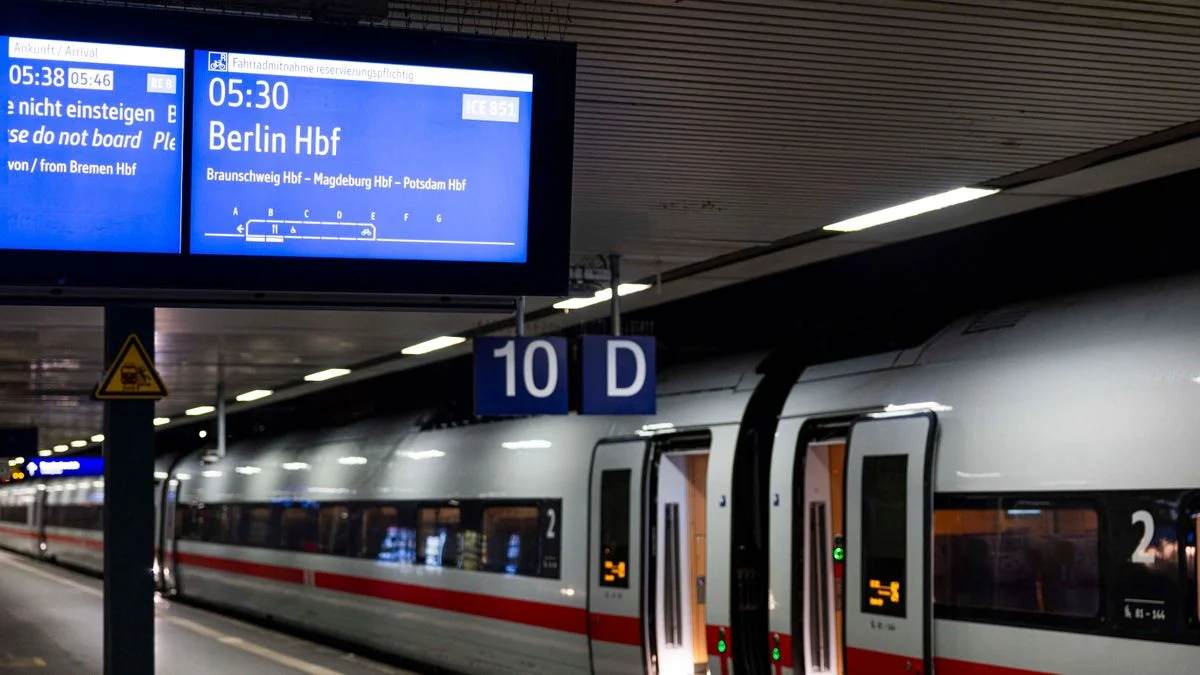
The German rail network, long criticized for its susceptibility to delays and infrastructure failure, is undergoing a profound transformation. As part of a sweeping initiative to modernize its most overburdened arteries, Deutsche Bahn (DB) has initiated a comprehensive "General Renovation" (Generalsanierung) of the critical rail link between Hannover and Berlin. While the long-term goal is to achieve the punctuality and reliability of a modern European network, the immediate reality for thousands of commuters and long-distance travelers is a period of severe disruption, including months of station closures and the implementation of extensive bus replacement services.
The Scope of the Disruption: A Network in Transition
For travelers navigating the Hannover-Berlin corridor, the current landscape is one of uncertainty. Deutsche Bahn has explicitly stated its commitment to keeping passengers mobile through diverted long-distance trains and robust bus-bridge services. However, the logistical reality on the ground remains challenging.
Wolfsburg and Stendal: The Frontline of Construction
The most significant impact is being felt in Wolfsburg, a city that acts as a vital hub for industrial traffic and regional connectivity. Under the current construction schedule, Wolfsburg will be completely devoid of long-distance rail service until at least the end of the year. The situation for Stendal is similarly stark; the city, usually a reliable stop for ICE (Intercity Express) trains, has been removed from the long-distance schedule entirely.
While the Bahn has hinted that these restrictions could potentially persist into 2027, they have attempted to mitigate the fallout for other regions. Magdeburg, for instance, has seen an increase in connectivity, receiving three additional daily ICE connections to Hannover, North Rhine-Westphalia, and Berlin. This strategic reallocation of resources highlights the complex "zero-sum game" the Bahn plays when managing capacity on a constrained network.
Engineering the Future: The Technical Challenge
The scale of the project currently underway is staggering. Hundreds of kilometers of tracks, turnouts, and overhead power lines are being ripped out and replaced. Beyond the rails themselves, two dozen train stations are undergoing thorough modernization to improve accessibility and passenger comfort.
The primary driver of this logistical marathon is the renewal of more than 50 kilometers of solid concrete track (Feste Fahrbahn) in the vicinity of Stendal. This infrastructure is reaching the end of its design life, and the Bahn argues that "patchwork" maintenance is no longer sufficient. By opting for a "General Renovation," the company aims to move away from reactive repairs and toward a state of systemic reliability. According to an official statement from Deutsche Bahn, the objective is to "fundamentally renew the highly burdened rail network and make train traffic more punctual, reliable, and powerful in the long term."
A Decade of Reconstruction: The Strategic Context
The Hannover-Berlin project is not an isolated event; it is a foundational component of a broader, decade-long strategy. Deutsche Bahn has identified more than 40 high-traffic corridors across Germany that require total renovation by the mid-2030s. This initiative represents the largest infrastructure investment program in the history of the German rail system.
The strategy involves "bundling"—the philosophy that it is more efficient to close a line completely for a set period to conduct all necessary repairs at once, rather than subjecting passengers to years of fragmented, weekend-only disruptions. This approach was successfully piloted on the Riedbahn corridor between Frankfurt and Mannheim, as well as the Hamburg-Berlin route. In those instances, major construction milestones were achieved within approximately six months, providing a blueprint for the current work between Hannover and Berlin.
Chronology of the Modernization Effort
To understand the current state of the network, one must look at the timeline of German rail infrastructure development:
- Pre-2020: The "Maintenance Deficit" era, characterized by aging assets, lack of digital signaling, and a surge in passenger numbers that outpaced infrastructure capacity.
- 2023: The announcement of the "General Renovation" program, targeting the most critical "bottleneck" corridors.
- 2024: Commencement of the Hannover-Berlin and associated corridor projects. The start of the long-term removal of Wolfsburg and Stendal from the ICE long-distance network.
- Late 2024/Early 2025: Expected completion of the current phase of the Hannover-Berlin construction, with evaluations underway for subsequent phases.
- 2025–2030: The "General Renovation" roll-out continues, with over 40 major corridors slated for closure and renewal.
- 2035 and beyond: The target horizon for a modernized, digitally-controlled, and high-capacity German core network.
Critical Analysis: The Digital Dilemma
Despite the high-minded rhetoric surrounding the modernization, the project has faced significant criticism from transport experts, political analysts, and passenger advocacy groups. The central point of contention is the missed opportunity for comprehensive digital transformation.
The ETCS Controversy
The European Train Control System (ETCS) is the gold standard for modern, digital railway signaling. It allows trains to travel closer together safely, increases throughput, and facilitates cross-border interoperability. Critics have long argued that when the Bahn spends billions to strip a track down to the ballast, it should, by default, install the latest digital signaling technology.
However, the current project for the Hannover-Berlin corridor falls short of this ideal. Reports indicate that only 6 of the 25 signal boxes (Stellwerke) along the route will be digitized and prepared for ETCS integration. This has led to accusations that the Bahn is prioritizing "old-school" infrastructure renewal at the expense of the digital leapfrogging necessary for a 21st-century rail system. By failing to fully digitize the corridor, experts fear that the network will remain locked into legacy technological constraints, even after the concrete and steel have been replaced.
Implications for the Passenger Experience
The immediate impact of these closures is a significant decrease in the attractiveness of rail travel for the average commuter. For those traveling between Berlin and Hannover, the reliance on replacement buses—which are subject to traffic conditions, have less capacity, and are often less comfortable than trains—is a major deterrent.
Economic and Environmental Repercussions
- The "Modal Shift" Risk: The primary risk for the German government, which has set ambitious climate targets for transport, is that passengers will simply return to their cars or choose short-haul flights. If the "pain" of the construction period is too high, the long-term loyalty of rail customers may be permanently damaged.
- Regional Economic Impact: Cities like Wolfsburg, which rely on the high-speed rail connection to facilitate business travel for the automotive industry, face a period of relative isolation. The lack of an ICE stop makes the city less competitive for business meetings and corporate conferences.
- Operational Complexity: For Deutsche Bahn, managing the replacement bus fleets is a monumental task. The labor required to drive these buses, the coordination of schedules, and the communication of these changes to millions of passengers represents a massive operational overhead that consumes funds otherwise earmarked for track improvements.
Official Responses and Future Outlook
Deutsche Bahn officials remain steadfast in their defense of the "bundling" strategy. They argue that the alternative—perpetual, small-scale construction sites that lead to constant delays—would be even more damaging to the network’s reputation. "We understand the frustration of our passengers," a spokesperson noted in a recent briefing, "but we are operating on a network that has been neglected for decades. This is a painful but necessary surgery to ensure the survival of rail as the backbone of German mobility."
As the project moves into the latter half of the year, the spotlight will turn toward the effectiveness of these measures. Will the new concrete track, once completed, actually result in the promised punctuality? Or will the lack of comprehensive digital signaling keep the route prone to the same bottlenecks that have plagued it for years?
The renovation of the Hannover-Berlin line is more than just a construction project; it is a litmus test for the future of German infrastructure policy. As the government continues to pour billions into the rail network, the public will be watching closely to see if the outcome justifies the massive disruption. For now, commuters have little choice but to adapt to the new reality: a network in the midst of a radical, albeit imperfect, rebirth. The success of this effort will likely determine whether Germany can achieve its goal of a "Rail-First" transport strategy or whether it will continue to struggle with the legacy of a fractured, over-extended, and outdated rail system.