By Science Editorial Desk
Updated: October 14, 2026
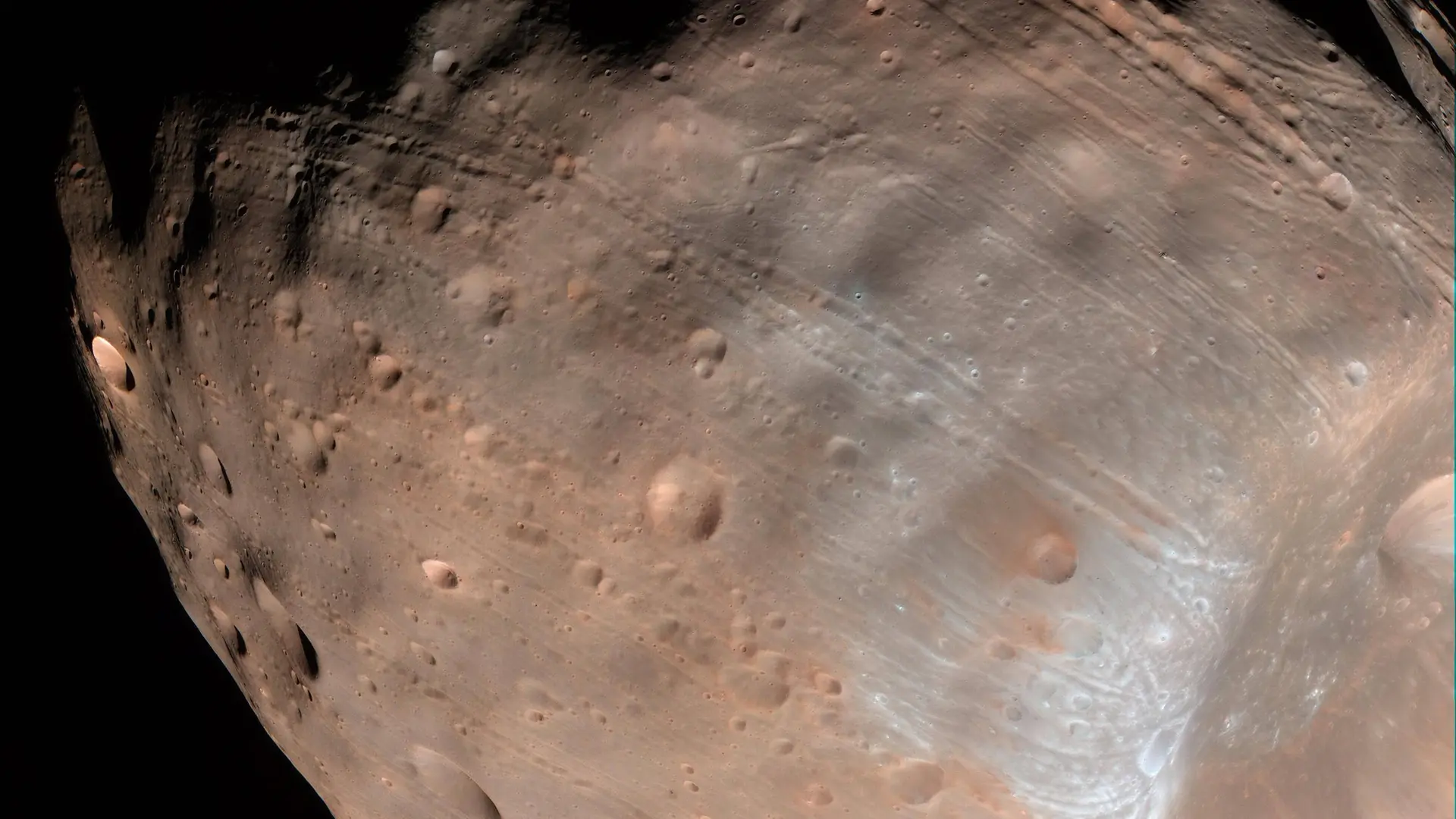
On October 20, 2026, humanity will embark on one of its most ambitious celestial detective stories to date. The Martian Moons eXploration (MMX) mission, spearheaded by the Japan Aerospace Exploration Agency (JAXA), is set to launch into the void, carrying with it a suite of instruments designed to solve a riddle that has perplexed astronomers for generations: Where did the two moons of Mars, Phobos and Deimos, actually come from?
While the mission represents a triumph of international cooperation, its beating heart features a piece of cutting-edge German engineering. A miniaturized, high-precision laser, developed by the Fraunhofer Institute for Applied Optics and Precision Engineering (IOF) in Jena, Thuringia, will be tasked with scanning the surface of Phobos from orbit. This is not merely an observational mission; it is a precursor to a historic retrieval effort that aims to bring physical samples of the Martian moon back to Earth by 2031.
The Core Objective: Unlocking the Origin Story
For decades, planetary scientists have debated the provenance of the Martian satellites. The primary theories are as compelling as they are distinct. One school of thought suggests that Phobos and Deimos are "captured" asteroids—ancient space rocks originating from the outer reaches of the solar system that were snagged by the gravitational pull of Mars during the chaotic early history of our solar system.
The competing theory proposes a much more violent origin: a massive, planetary-scale impact. According to this model, a gargantuan object collided with the young Mars, ejecting a massive cloud of debris into orbit. Over eons, this rubble coalesced into the two irregular, lumpy moons we observe today.
The MMX mission is specifically designed to provide the forensic evidence needed to distinguish between these scenarios. By combining orbital spectroscopy with a physical sample return, the mission seeks to characterize the chemical and isotopic composition of the lunar regolith. If the moons are debris from Mars, their mineralogical signature should match that of the Red Planet. If they are captured asteroids, they will likely resemble the carbonaceous chondrite meteorites found elsewhere in the solar system.
A Technical Marvel: The Jena Laser
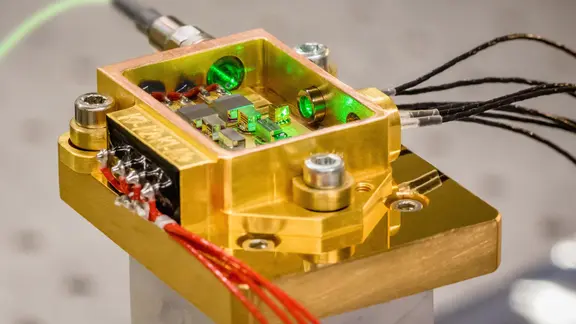
The mission’s ability to "see" the moon’s composition from orbit relies on a sophisticated laser system built in Thuringia. The module, which weighs a mere 50 grams, is a testament to the advancements in miniaturized optics.
Despite its diminutive size, the laser is a powerhouse. It emits green light at a wavelength of 532 nanometers with a power output exceeding 100 milliwatts—approximately 100 times more intense than a standard handheld laser pointer. This beam will be directed at the surface of Phobos, forcing the moon’s regolith to emit a characteristic spectral glow. This light is then captured by an onboard spectrometer, allowing scientists on Earth to analyze the chemical makeup of the moon from millions of kilometers away.
However, the engineering challenge was not just about power or weight; it was about survival. The laser must withstand the violent vibrations of a rocket launch and the brutal thermal environment of deep space, where temperatures swing from -130°C to +24°C.
"Statt die empfindlichen optischen Komponenten konventionell zu verkleben, haben wir Elemente des Laserresonators und der Sekundäroptik mit einer laserbasierten Löttechnik fixiert," explains Marta Gilaberte Basset, a key researcher at the Fraunhofer IOF. "Die Optik für eine Marsmission können wir nach dem Start nicht nachjustieren. Gelötet halten die Komponenten ihre Position über Jahre sehr genau." (Translated: "Instead of using conventional adhesives to bond the sensitive optical components, we fixed the elements of the laser resonator and the secondary optics using laser-based soldering. We cannot readjust the optics for a Mars mission once it launches. Soldering ensures the components maintain their position with extreme precision over years.")
Chronology of a Mission Reborn
The path to the 2026 launch has been far from linear. Originally conceived as the "ExoMars" mission, the project was intended to be a flagship partnership between the European Space Agency (ESA) and the Russian space agency, Roscosmos. However, the geopolitical landscape shifted dramatically in 2022. Following the Russian invasion of Ukraine, the collaborative project was dismantled as international sanctions and diplomatic ruptures made continued cooperation untenable.
The pivot to a Japanese-led mission was a strategic necessity. By integrating the European-built technology—including the Jena laser—into the JAXA-led MMX framework, the international scientific community ensured that years of research and hardware development did not go to waste. This resilience highlights the persistent nature of scientific inquiry, which often transcends the political borders that attempt to constrain it.
The Role of ‘Idefix’: Scouting the Surface
The MMX mission is not a solo act. Included in the payload is a small, highly specialized rover affectionately named "Idefix." Developed through a collaboration between the German Aerospace Center (DLR) and the French space agency (CNES), Idefix is a critical component of the mission’s logistics.
Before the MMX mothership attempts to land or deploy its sample-collection mechanisms, Idefix will be deployed to the surface of Phobos. Its mandate is to analyze surface characteristics and scout for a safe, scientifically significant landing zone. By operating on the surface, Idefix will provide "ground truth" data that calibrates the orbital observations made by the Jena laser, ensuring that the samples finally chosen for the return trip are the most representative of the moon’s overall history.
Implications for Planetary Science
The stakes for the MMX mission are incredibly high. Bringing extraterrestrial material back to Earth from the Martian neighborhood is a feat that has never been accomplished in the history of human spaceflight.
Scientific Significance
- Understanding Planetary Formation: Determining the origin of the moons provides a proxy for understanding the collision history of the inner solar system.
- Resource Exploration: Understanding the composition of Phobos informs future human exploration of the Mars system. If the moons contain water ice or specific minerals, they could serve as "gas stations" or refueling depots for future crewed missions to the Martian surface.
- Refining Detection Models: The success of the laser-spectroscopy technique from orbit will prove that we can remotely characterize the composition of small, airless bodies without requiring a landing, drastically lowering the cost and risk of future asteroid mining or exploration missions.
Looking Toward 2031
As the countdown to October 20, 2026, nears its end, the global scientific community watches with bated breath. The journey to the Martian system will take several months, followed by an intensive period of orbital analysis and rover deployment.
The culmination of the mission, scheduled for 2031, will see the return capsule entering Earth’s atmosphere and parachuting into the Australian outback. Inside, the canisters will contain the first pristine, untouched samples from the Martian region ever to be handled by researchers on Earth.
The data returned by the Jena-built laser and the physical samples gathered by the MMX mission will serve as a time capsule. By analyzing the chemistry of Phobos, we are essentially reading a diary of the early solar system. Whether the moons are captured remnants of a distant past or the scarred debris of a titanic, planet-forming impact, the findings will fundamentally alter our understanding of how Mars—and perhaps even our own Earth—came to be.
The collaboration between Japanese engineering, German precision, and international space agencies represents a new era of space exploration. It is a testament to the idea that, regardless of the challenges faced on the ground, the desire to look up and understand our origins remains a powerful, unifying force. As the MMX probe clears the atmosphere, it carries with it not just technology, but the collective curiosity of a planet waiting to learn the secret history of its neighbor.